Astronomical community fractures over little red dot interpretation
1 Sep 14 · 9d ago · 2 articles · 3 posts · 4 sources · development 1 of 1
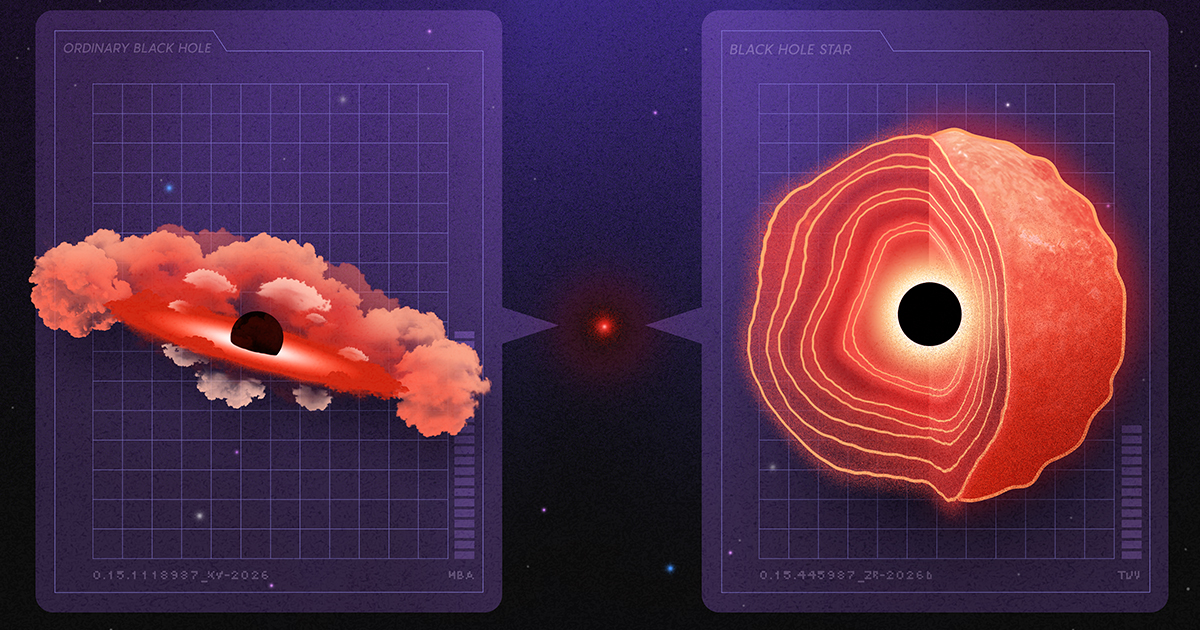
The bold black hole star hypothesis triggers sharp disagreement among researchers and spawns competing follow-up studies. Anna-Christina Eilers, an MIT astrophysicist studying the objects, characterizes the field as highly polarized.
“The field has gotten very polarized.”
Anna-Christina EilersAnna de Graaff Researcher, Max Planck Institute for AstronomyRohan Naidu Astronomer, University of Hawai'iAnna-Christina Eilers Astrophysicist, Massachusetts Institute of Technology
The whole story articlesposts the bright band is this development · numbered dots are the others · click one to jump
What was reported 1 claim about this development
-
9 outlets Black Holes or Black Hole Stars? Astronomers Spar Over Webb Telescope’s ‘Little Red Dots.’
first by Quanta Magazine, 9d ago · also NYT, NYT Science, Nature, ScienceDaily, Mirage News, Universe Today +2
7 more headlines
- Massive Black Holes May Have Started as Little Red Dots The New York Times · 7d ago
- Overmassive black holes and little red dots naturally form in simulations Nature · 7d ago
- New study links mysterious 'little red dots' to early black hole formation qz.com · 7d ago
- JWST’s mysterious little red dots may be black holes growing at incredible speeds Science Daily · 6d ago
- JWST's Red Dots Could Be Rapidly Growing Black Holes Mirage News · 6d ago
- Little Red Dots Are The Seeds of Quasars and Supermassive Black Holes Universe Today · 6d ago
- Black Holes or Black Hole Stars? Astronomers Spar over 'Little Red Dots' HN Frontpage · 5d ago
What people said 10 voices · best of 11 · verbatim
-
One thing worth noting is our popular notion of what a star seems to be is quite different from what astronomers have.One example, Canis Majoris has a radius of about 1420 solar radii. But its mass is roughly 17±8 times the mass of the Sun and therefore an average density of 5.33 to 8.38 mg/m3. “It is over 100.000 times less dense than Earth’s…
-
 K
K
WHY ARE THEY NOT CALLED BLACK HOLE SUNS. IT WAS RIGHT THERE. "Black Holes or Black Hole Stars? Astronomers Spar over Webb Telescope's Little Red Dots" in Quanta https://www. quantamagazine.org/black-holes -or-black-hole-stars-astronomers-spar-over-webb-telescopes-little-red-dots-20260914/
-
Perhaps they are somehow related to the elusive white hole: exit points of black holes.Fuel for a Big Bang, if you can imagine. A universe within itself.The article says they're sucking up gas though so I don't know. The arrow of time is weird. It would feel elegant to me, but I'm way out of my league.The imagined scenario only works if you…
-
Dr. Becky take: https://www.youtube.com/watch?v=KuTVjuXu7uEPBS Space Time: https://www.youtube.com/watch?v=FMdrD_jcYgElove those channels
-
The surface radius of a star is defined based on optical thickness. If you were there, the star would in fact look like a fairly well-defined opaque spheroid with the reported radius. The density of the photosphere plasma is near zero, but there’s a lot of it.
-
> therefore an average density of 5.33 to 8.38 mg/m3That's nuts. How on earth does fusion happen at that density? Is there a denser core that actually fuses, and the outer fluffy bits just glow from the inner heat?
-
I always wonder when do they stop considering the outer layers part of the star and not relatively dense solar wind soup. Nobody says Earth has 7000km radius, even tho there's traces of exosphere past 500km.
-
Is there an experiment that could resolve this? Literally resolve these objects better, or otherwise distinguish between these hypotheses?Is there anything behind these objects they could lens?
-
My layman definition of what a star is is "it's somewhere in the sky and it gives off light". The word "density" wouldn't even come to my mind
-
Wouldn't objects this ancient (following in the wake of the big bang, essentially) be redshifted anyway, on account of cosmological expansion?
All 1 developments of Webb's 'little red dots' spark debate: black holes or black… →
NewswiresHacker NewsMastodonGoogle News