talon8635 proposes deliberate degradation cycle theory
6 Sep 21 1:49 PM · 4d ago · 1 post · 7 comments · 2 sources · development 6 of 6
A commenter suggests a cycle in which AI companies release a new model, slowly degrade it over months, then release a marginally better replacement to create perceived improvement despite stagnant actual progress—a strategy that could sustain an industry facing frontier stagnation.
“Could there be a benefit to releasing a new model, slowly dumbing it down over a couple months, then releasing a new model that's marginally if at all better than the original to create a perceived improvement…”
talon8635Waterluvian Fable 5 userjotato gpt-5.6-luna usermlmonkey Frontier model researchertheplumber Claude userrcr-anti Claude Code tracker
The whole story articlespostscomments the bright band is this development · numbered dots are the others · click one to jump
What people said 18 voices · best of 19 · verbatim
-
> to create a perceived improvementIn addition to the dozens of opaque model parameters and hardware variables that can nerf or buff model intelligence, speed and profit, there's also the very real possibility that models aren't just training on benchmarks but could be evaluating if they are being benchmarked in real-time and applying more…
-
> Could there be a benefit to releasing a new model, slowly dumbing it down over a couple months, then releasing a new model that’s marginally if at all better than the original to create a perceived improvement when in reality there isn’t really one?Exactly what I am saying for months now. And it's exactly the reason why I am shifting to open…
-
I've subjectively detected this in previous codex releases where the 2 days before release of a new model the agent went from great to me pulling my hair out yelling at it. I think it's just a win-win for them. They need to ramp up basic capacity and usage on the new model, what better way to free up capacity than to reduce the effort with the…
-
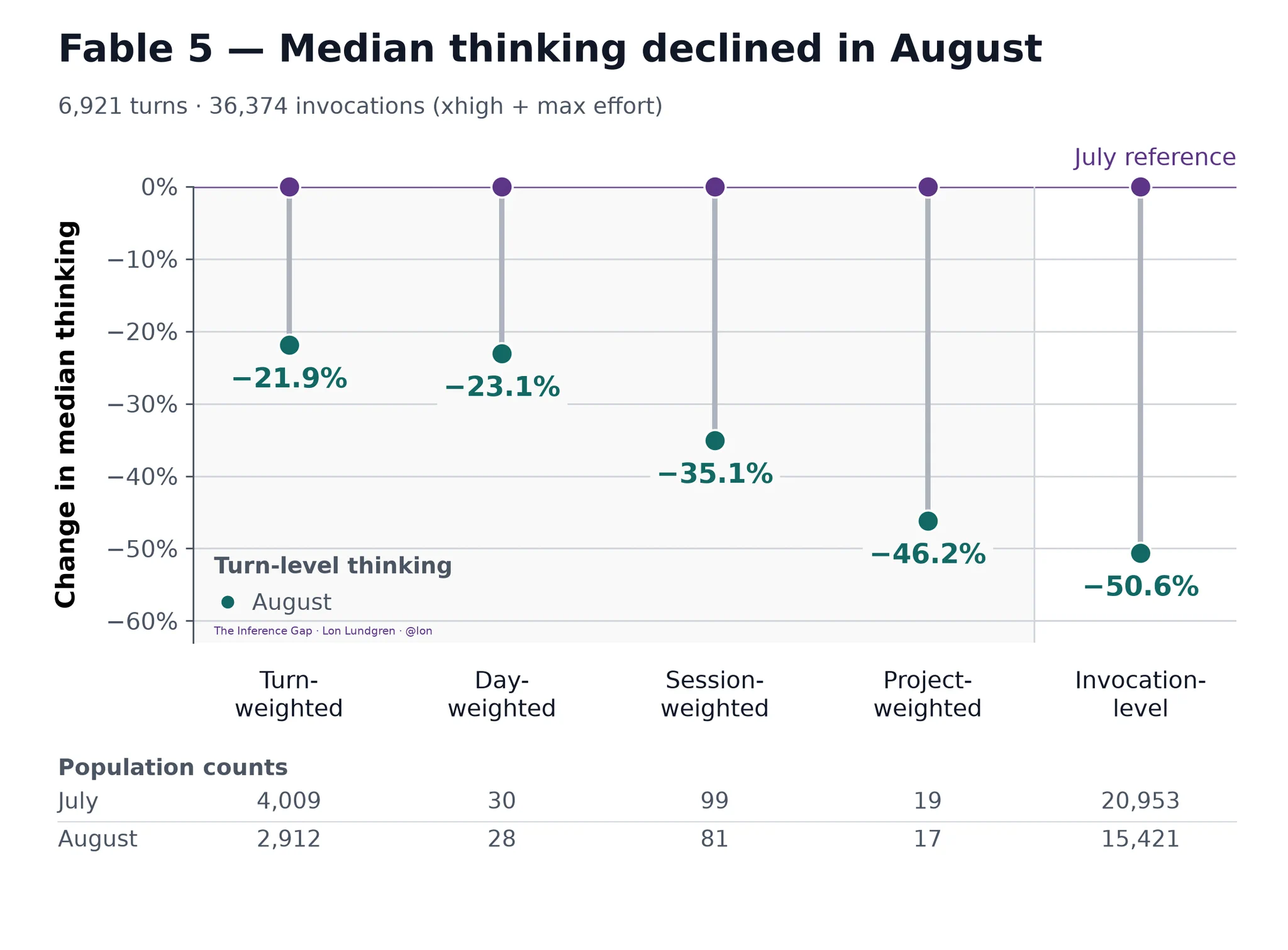
Not sure on the methodology here, but could this also just because people's projects mature on the new model which results in less thinking?I've personally seen people complain about new models getting slow after a week or so but I think it's mostly because the new model is able to briefly overcome the context collapse of their poorly managed…
-
There was a coding horror story I read some years ago where a developer bragged that he improved performance by artificially increasing iterations on some critical path in an app and then lowering the iterations occasionally while bragging to management about squeezing out more performance.Kind of reminds me of that, but with more smoke and mirrors
-
There must be some benefit if all the providers are doing it independently.GPT5.6-Sol on Max thinking just became regarded as of a few days ago.The boosters will tell me it’s my fault for using such an old, cheap out-of-date low quality near useless wish.com model (that was SOTA and better than human coders one month ago).The cycle repeats.
-
I stopped reading when I realized the article reminds me of my own Claude-generated solutions at work - just an endless maze of special business logic on top of special business logic. You need an LLM to understand it. You need an LLM help write the documentation. You need an LLM to help read the documentation.
-
This sounds similar to rumors about how SSD companies work. First they would design a new drive with better performance that everyone uses to benchmark against other models; then slowly change its parts to worse ones, either because they are cheaper, the originals are no longer available, or whatever reason
-
> to create a perceived improvement when in reality there isn’t really one?This wouldn't explain progress on benchmarks (including closed sets), or the fact that newer models are providing solutions to major math problems that older models cannot.
-
This is exactly what I have been experiencing and the difference is night and day! We have been advertised and given a taste of what Fable was and after that been served an exteme watered down version. It is so bad that sometimes chatgpt feels better.
-
> For an industry that’s stagnant in progressSurely you're not talking about the AI industry. Astra was released less than 3 weeks ago, and Fable-level models became public only 6 months ago. The rate of change is dizzying.
-
No, what they are doing is trying to optimize inference to increase margins which leads to degradations. Model deployment is not like websites, you can continuously tune performance based on usage, new memory optimizations, etc.
-
Definitely noticed this before, but this parti6 time was very noticeable. I'm convinced it's to get the benchmarks in, then lower cost and prepare for the next release to look better relatively to users.
-
AI just solved a millennium problem two weeks ago. "The pace is insane. And there is no reason to be this fast." to quote Terence Tao word by word.HN: Well, must be a stagnant industry...
-
All llm api providers should be compelled to return a checksum-like proof of quantization level of the model that served the request. Basic transparency should be the bare minimum.
-
I for sure felt that this was the case for a while now, but couldn’t explain it. Newly released feels great for the first couple of weeks, but then it starts to get worse.
-
Surely it's easy to verify by simply doing Benchmark tests every 2 or 3 days but not publishing them so they can't be gamed, then releasing all at once?
-
That definitely isn't what has been happening; Fable was much better than anything seen before it.Could be what happens next, though.
All 6 developments of Users report Fable 5 performance decline weeks after launch →
Hacker NewsNewswiresMastodon