SpaceX Falcon 9 rocket stage crashes into moon as predicted
An unintended collision occurred early Wednesday as a SpaceX upper stage impacted the lunar surface near Einstein Crater, creating a measurable crater.
Conversation activity · last 10 days peak 7/2h
Summary, timeline and people extracted by Claude from 43 items across 3 sources · 10h ago. Quotes are verbatim.
A SpaceX Falcon 9 second stage, which launched two private lunar landers in January 2025, struck the moon on Wednesday as space tracking experts had predicted. The impact at 5,400 mph created a crater approximately 60–90 feet wide near Einstein Crater on the moon's near side. Scientists observed the event to study debris hazards as lunar activity intensifies with upcoming crewed missions.
- A SpaceX Falcon 9 second stage impacted the moon on Wednesday as predicted by space tracking experts, creating a crater 60–90 feet wide near Einstein Crater.
- The impact was unintentional; experts noted it could have been prevented by nudging the upper stage into solar orbit rather than lunar trajectory.
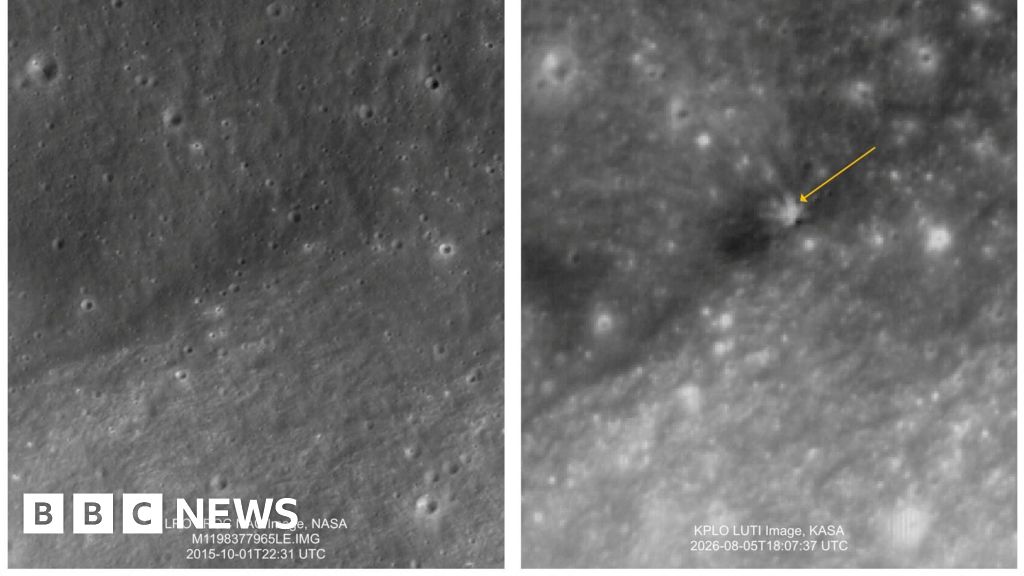
- South Korea's Danuri orbiter captured before-and-after images confirming the impact, providing scientists data on debris hazards as lunar traffic increases with upcoming crewed missions.
- The collision highlights growing space debris concerns as commercial and government activity around the moon accelerates, with U.S., China, SpaceX, and Blue Origin all planning lunar operations.
How it unfolded
-
Report First crater images published
Wired and multiple outlets published the Korea Aerospace Research Institute's first images showing the gash on the lunar surface. NASA estimates the crater is approximately 60 feet wide.
-
Analysis Scientists assess debris hazard lessons
Researchers emphasized the event's importance for understanding debris impacts as lunar traffic increases with upcoming U.S. and Chinese crewed missions and commercial ventures by SpaceX and Blue Origin.
-
Report South Korea releases crater images
Seoul's Danuri lunar orbiter captured before-and-after images of the moon showing the new crater created by the SpaceX rocket impact.
-
Report Astronomers observe impact aftermath
Amateur and professional astronomers pointed telescopes at the impact site. Most did not detect a visible impact flash, but NASA's Lunar Reconnaissance Orbiter and South Korea's Danuri orbiter were positioned to capture before-and-after imagery.
-
Event Rocket impacts moon
The SpaceX Falcon 9 second stage struck the moon's surface as predicted, releasing energy equivalent to three tons of TNT and creating an impact crater.
-
Report Crash predicted for early Wednesday
Space tracking expert Bill Gray predicted the drifting rocket upper stage would impact the moon early Wednesday morning near Einstein Crater at 5,400 mph.
- 81 weeks quiet
-
Event Falcon 9 launches lunar landers
SpaceX's Falcon 9 second stage lifted off carrying Firefly Aerospace's Blue Ghost and ispace's lunar lander. Blue Ghost succeeded in landing; ispace's lander crashed.
What people are saying verbatim
“Things are getting crowded up there”
Bill Gray, Space tracking expert · Boston Herald / AP News
“It was never SpaceX's intent to hit the moon. But space experts said the crash could have been avoided”
Marcia Dunn, AP Aerospace Writer · Boston Herald
“The gravity on the moon is low and there is no wind to blow the dust away”
Benjamin Fernando, Los Alamos National Laboratory scientist · Boston Herald / AP News
“Part of the reason for our interest in this event is to figure out how much of a hazard debris impacts pose to future astronauts”
Benjamin Fernando, Los Alamos National Laboratory scientist · Boston Herald / AP News
“It will be the second dead rocket known to crash into the moon accidentally.”
AP News, News organization · Boston Herald
Voices from the web unedited
-
“.. It was never SpaceX’s intent to hit the moon. But space experts said the crash could have been avoided .. “.. It will be the second dead rocket known to crash into the moon accidentally.” @apnews.com $SPCX
-
A discarded SpaceX rocket will unintentionally slam into the moon next Wednesday…
-
What will happen when a SpaceX rocket collides with the Moon? – bbc.com https://www.europesays.com/us/979798/ What will happen when a SpaceX rocket collides with the Moon? bbc.com A SpaceX Rocket Is Headed for a…#us #news #usnews
-
Lunar orbiter Danubri captured photos of the moon (before and after) impact of the Falcon 9 empty rocket stage