New York Times and Athletic unions oppose Kalshi prediction market deal
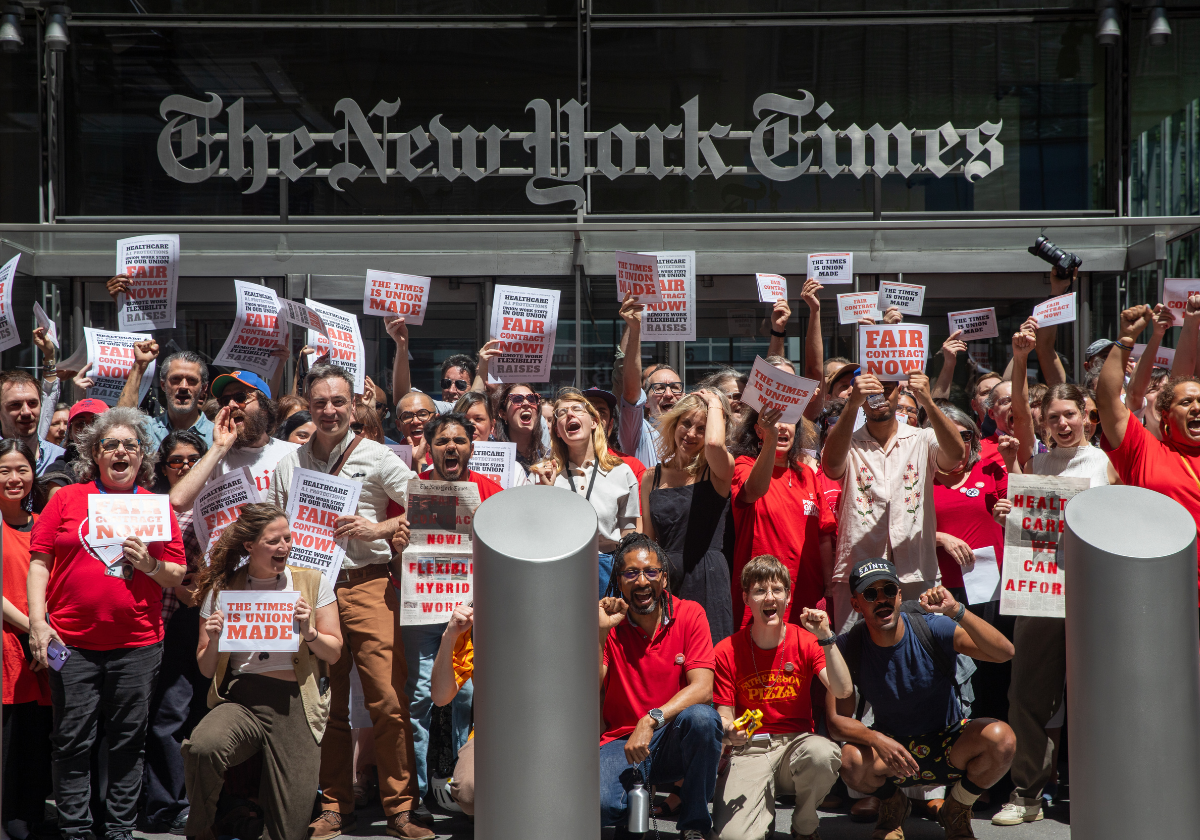
Unionized workers at both outlets vote unanimously to block a partnership they say threatens journalistic independence.
What to know
- The New York Times and The Athletic unions unanimously oppose a potential partnership with Kalshi, viewing it as incompatible with journalistic independence and editorial credibility.
- Kalshi operates as an unlicensed gambling platform that has been investigated by New York's attorney general, yet markets itself as a reliable data source without journalistic accountability.
- The central union concern is that association with prediction markets could undermine reader trust in both outlets' reporting, particularly when covering prediction markets themselves.
- Online commenters are divided: some support the union's stance on gambling and accountability, while others argue prediction markets offer more reliability than traditional journalism.
The dispute Whether prediction markets represent a dangerous unaccountable gambling threat or a more trustworthy alternative to traditional journalism with skin-in-the-game incentives. · positions read across 166 posts and comments
Prediction markets are unaccountable gambling that pose regulatory and integrity risks; the union is right to oppose the deal.
-
“I really don't understand how these markets survive a competent DOJ considering the rate they're having to ban people for "insider trading". Fully appreciate the Unions position here.”
mikeryan · Hacker News
Prediction markets are more trustworthy than journalism because real money is at stake; media's complaint about accountability is hypocritical.
-
“A great irony here is that Kalshi and media generally are competitors. When I make important decisions (e.g. understanding politics, where to travel and setup companies), I always value betting markets over hearsay (aka media). The former…”
nomilk · Hacker News
Prediction markets, while currently under-regulated, are valuable tools that offer genuine insights when properly designed.
-
“Prediction markets are a wonderful idea that at the moment is strongly lacking in prestige signals, bare minimum of regulation and liquidity.”
vovavili · Hacker News
Times Guild Unit Council Union representing NYT workersThe Athletic contract action team Union representing Athletic workers A.G. Sulzberger New York Times publisherKalshi Prediction market platform
The record 1 articles and posts · last 30 days
What people are saying 24 voices from 1 site · best of 166 · verbatim
- Has the NYT/Athletic deal been formally abandoned, and if so, was it due to union pressure or other factors?
- What other media outlets have or are considering similar partnerships with prediction market platforms?
- How does the legal status of Kalshi vary by jurisdiction, and what enforcement actions are actively underway?
- Sep 4
-
Yeah, it makes sense to advocate for that if you are a sophisticated trader who hope to fleece the naive retail. For 99%+ of people though near instant price discovery and efficient price is a big net benefit.Imagine news broke that makes a company worth 15% less. Naive investors isn't aware of it and makes their bid on the market. They look at a…
-
Inefficient market means someone is getting a bad price. That someone is going to be a retail/naive investor - Bill and Nancy who want to invest in Apple with part of their salary.Sophisticated investors would never be on the other side of the trade. Add to that bigger spreads and unsophisticated market participants get fleeced. As they wouldn't…
- Sep 3
-
He is interviewed in recent Netflix documentary on prediction marketshttps://media.netflix.com/en/only-on-netflix/82772143The book is the repulsive but popular "case study" format where various historical examples are consideredOne example he cites is of course news organisations that publish factual information intended to be relied upon for…
-
We've literally been through this before:https://en.wikipedia.org/wiki/Black_Sox_ScandalIt's always corrosive to society in a way other vices really aren't. Money is a massive influence and incentive, and in gambling you can artificially increase the possible incentive size with long shot bets.The best part of how gambling makes everything shit is…
-
IEM is still functioning but pretty dead since Kalshi put up election markets. Looking just now I see well under $100 in volume for all of August. (At least when Kalshi first put up those markets it gave me the only opportunity I've had to make a pure arbitrage.)Might be something the populace is just too dumb to have - the people seem to…
-
> Donald Trump Jr. Got A Kalshi Stake For Free— Now It Could Be Worth Billions As Prediction Market Platform Eyes $40 Billion Valuation> Kalshi handed him equity worth roughly $300,000 when he joined as a strategic adviser in early 2025. ... Kalshi granted him the stake when the company was valued at under $2 billion — less than a tenth of its $22…
-
I hate prediction markets but simultaneously find this a little rich.I think most people have experienced what Michael Chrichton called Gel Mann Amnesia - the idea that newspapers feel accurate except about topics you know about.Whenever I read about topics I know about: such as my employer, a political topic I am particular familiar with, etc -…
-
It was banned by the federal governmentNot exactly. The law was weird, and that's why it was overturned. It didn't make sports betting illegal federally, instead it prevented states from "authorizing" it, which the petitioners argued was an unconstitutional intrusion into the lawmaking ability of states in that it prevented them from repealing…
-
Its not just the broadcasts are advertisements. Its completely engrained in every professional sports league now. They now all have some kind of multi-year contracts with casino's, betting platforms and prediction markets. This is way beyond advertising now. Our local sports talk show has an hour long show that precedes the pre-game that is 100%…
-
I think a good toy example here could be a market on a coinflip. Let's say heads pays out $1 and tails pays out $0, and people can buy and sell contracts that resolve this way. Naively, people might think that this is a 50/50 outcome, so if anyone wanted to buy or sell this contract for some reason, they'd likely be able to find someone to trade…
-
Christ, just say you are conservative and don't like unions and their political stances. 'Accuracy' doesn't matter at all when it comes to assessing harm, but the existence of a market signal itself can change outcomes, and then much vaunted 'accuracy' becomes a mechanism for fraud in a new and different way.Even taking your nitpick a little bit…
-
obviously and definitely true in their current form. But it's maybe worth clarifying that before this last year or two, when Kalshi became an obvious regulatory dodge (including adding sports and really leaning into the gambling demographic), many were interested in prediction markets not just for that purpose: e.g. the rationalist community seems…
-
I've been in the desert fighting fires for the last 4 months. The news isn't going rampant with the arson stories for reasons (who knows, scaring the public, informing the public, etc).Open the watchduty app and start looking into how many fires are currently arson suspected/apprehended and how this is the largest national wildfire year we've ever…
-
The stock market isn't fundamentally a gamble. Spending money to buy a share of a company's future dividends is a sound way to invest money and earn a return on it.The problem with the stock market is when there aren't enough new companies going public to soak up the spigot of all the capital that people want to invest, leading average P/E ratios…
-
Note that's a US definition — Europe is stricter and draws the line at non-public information [0], aside from certain carveouts and safe harbors. Matt Levine describes this as "theft" (misappropriating nonpublic information) vs. "fairness" (using nonpublic information at all) — iirc if you're on a flight and overhear a passenger in business class…
-
> Prediction markets are a wonderful ideaYeah, it's just like being able to take an insurance policy on other people's lives. It's a wonderful idea for all of 15 minutes until people start getting murdered.> bare minimum of regulationNo amount of regulation will solve the issue when what you can take insurance on is not regulated.Prediction…
-
You've been able to gamble on your mobile device for 100 years in the UK?Modern gambling isn't you talking to a bookie and putting down $100 on your favorite team. That should still be legal. Phone apps which learn your behavior, your favorite teams, the offers you are likely to accept, the time of day that you're most likely to make a bet, etc…
-
>How can you go from being so restrictive to having absolutely no limits overnight?In 2018, the US Supreme Court said the federal law preventing it was illegal.https://en.wikipedia.org/wiki/Murphy_v._National_Collegiate_...It was banned by the federal government in 1992 by an act of Congress (with bipartisan consensus and signed into law by a…
-
> the claim that prediction markets do not accurately predict the future. It's trivial to prove that this claim is false, because if it were true, it would be very easy for anyone to make a huge amount of money on prediction marketsI'm not intimately familiar with prediction markets (I avoid gambling), but can you explain how this is the case? If…
-
> Instead, they felt compelled to make a trivially false claim, the claim that prediction markets do not accurately predict the future. It's trivial to prove that this claim is false, because if it were true, it would be very easy for anyone to make a huge amount of money on prediction markets.Isn’t that what’s actually happening though? Traders…
-
The linked article is pretty interesting:> found a pattern of [Polymarket] sharing false and misleading informationhttps://www.nytimes.com/2026/03/20/technology/polymarket-soc...They don't have much to say about Kalshi other than "unlike real mainstream journalism, there’s no accountability". Which isn't saying much, because nobody is claiming…
-
Unfortunately, this shows how much facts and reality have been turned into nothing more than a loyalty test by both sides of our political debate.> A partnership between The Times (for The Athletic) and Kalshi would also provide validation that their prediction market data should be taken seriously as an indicator of the future. Facts prove…
-
I find it really interesting that online sports betting, which has been a thing in my country for 15+ years and largely a non-issue, is suddenly a total shitshow once it gets legalised in the US. I feel like the US always takes things too far. I watch quite a few US sports and former athletes giving betting suggestions during broadcasts is…
-
This is about stopping a potential deal (https://frontofficesports.com/article/the-athletic-serious-t...), nothing finalized yet. They have allegedly abandoned the idea and claim that isn't because of the union demands: