Three Body Orbits atlas catalogs 3,915 periodic solutions
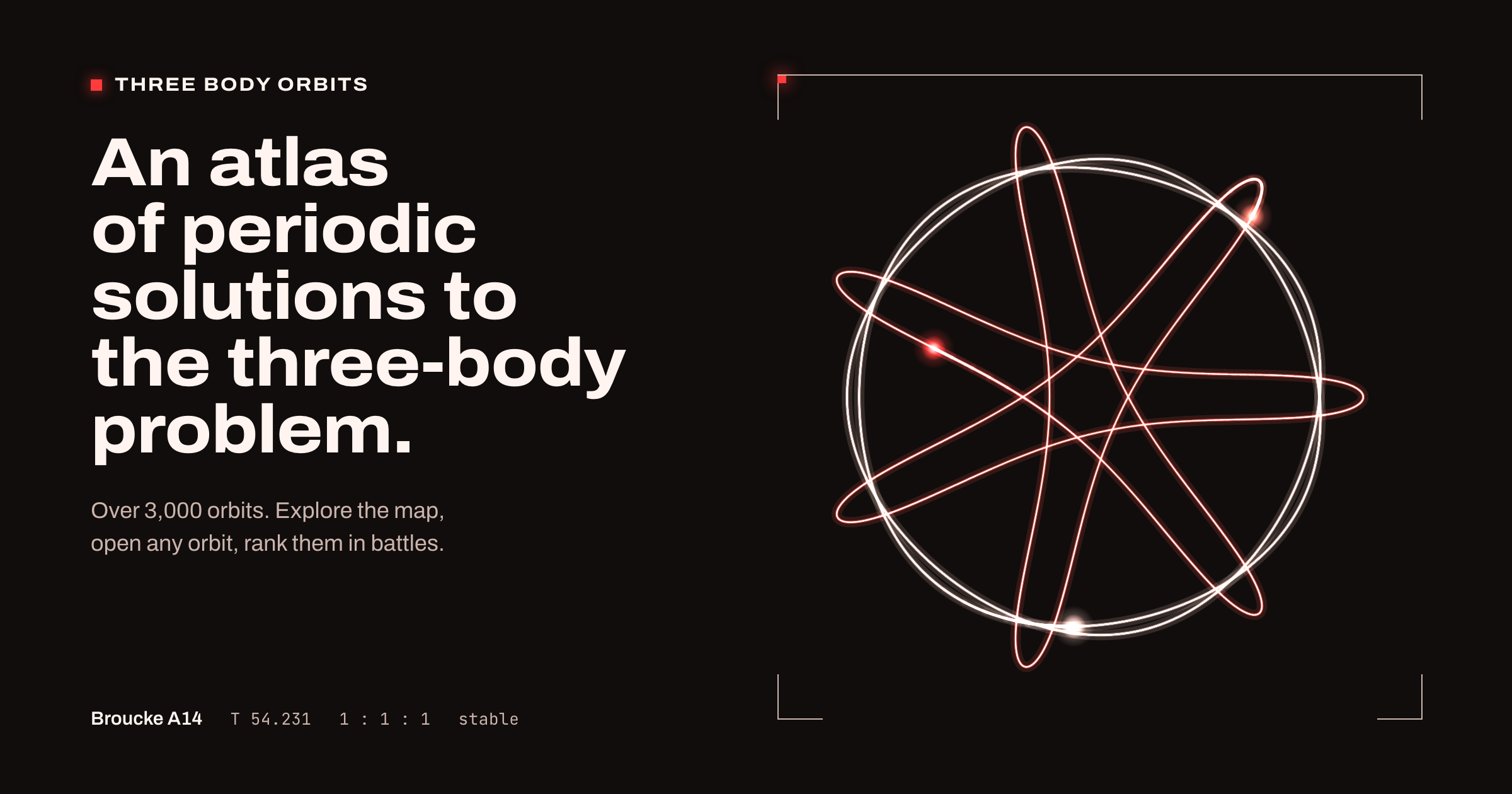
Interactive visualization maps all known periodic orbits where three masses return to starting positions.
What to know
- An interactive atlas now maps all 3,915 known periodic solutions to the three-body problem—a classic problem in physics with no general solution but thousands of special cases.
- The site organizes orbits by family similarity, animates each one, and allows users to explore stability by nudging orbits off their paths.
- A new distributed computing feature lets visitors search for novel stable orbits and name any linearly stable solutions they discover.
The dispute Whether certain standard solutions (like Lagrange points and equilateral triangle configurations) should be included in the 3,915-orbit count. · positions read across 15 posts and comments
The visualization is beautiful and engaging, regardless of immediate practical use.
-
“It's well organized, the animations are smooth, and it looks beautiful... I'm not sure what to do with the information, but it's mesmerizing and fascinating.”
mr_mitm · Hacker News ↗
Key technical details about orbit stability and configuration should be clarified or made more visible.
-
“It's my understanding that most 3-body orbits are unstable; minor random perturbations will set them adrift. Are there any 3-body orbits with a natural resonance that maintains the shape of the orbits?”
cobbzilla · Hacker News ↗
The hunt feature and community contribution model opens exciting possibilities for discovery.
-
“I would totally run hunt as an electric sheep style screensaver”
r3trohack3r · Hacker News ↗
threebodyorbits Site creator
How it unfolded 4 developments, newest first · click a bar or a number to jump articlespostscomments
-
4
Creator adds distributed computing hunt feature
The site developer announces a new feature allowing visitors to contribute compute via their browser to discover novel linearly stable orbits. Users who find such orbits can name them. The creator thanks the community for positive feedback.
“You can now contribute compute via your browser to help find novel orbits. If you find a linearly stable orbit, you get to name it!”
— threebodyorbits -
Hi all, I just added a new feature to the site. You can now contribute compute via your browser to help find novel orbits. If you find a linearly stable orbit, you get to name it!https://www.threebodyorbits.com/huntAlso thank you so much for all the positive feedback, I truly appreciate it. If you have any additional suggestions please let me know
2 more of the top 3 · 5 posts in this stretch
-
Cool, are any of these particularly stable? Like, is there any choreography that could plausibly survive in practice?
-
That Pythagorean one with the ejection is cool. I wonder whether you could use it to accelerate a spacecraft.
-
-
3
Community shares related work and extensions
Commenters begin sharing related projects, including a similar tool at gravitoy.xyz with discoveries of up to 11-dimensional choreographies, and questions emerge about which specific solutions are included or excluded.
“The three-body problem has no general solution, but it has thousands of periodic orbits: three masses falling around each other and arriving, after one period, at precisely their starting positions and velocities.”
— Three Body Orbits site · source -
I have something similar at https://gravitoy.xyzWith it I have discovered up to 11-dimensional choreographies, see https://lycium.github.io/hyperchoreography/ and code at https://github.com/lycium/hyperchoreography/Exposition video: https://youtube.com/watch?v=sIfff10hYZAExample rendered output from Gravitoy (not of a choreography though)…
2 more of the top 3 · 10 posts in this stretch
-
I took graduate orbital mechanics from Roger Broucke. He was one of my best professors. Not only did I learn from him what orbital elements were, but he also taught me the Runge-Kutta numerical integration method.I didn't learn until years later that he had discovered several of the periodic solutions to the three-body problems. You'll see his…
-
It’s my understanding that most 3-body orbits are unstable; minor random perturbations will set them adrift.Are there any 3-body orbits with a natural resonance that maintains the shape of the orbits?If so, how large of a disturbance can the most-stable 3-body orbit withstand?
-
- 1 day quiet
-
2
Site gains traction on Hacker News
The Three Body Orbits atlas reaches 27 points on Hacker News Frontpage, attracting discussion from the technical community.
-
first by HN Frontpage, 12d ago
-
-
1
Three Body Orbits atlas launches with 3,915 periodic orbits
An interactive web application becomes available mapping all 3,915 known periodic three-body orbits. The site organizes orbits by family, provides live animations, allows orbits to be nudged off track, and includes rating and ranking features.
What people are saying 7 voices from 1 site · best of 15 · verbatim
- Which of the 3,915 orbits are stable against small perturbations, and how stable is each?
- Why are certain expected solutions like Lagrange orbits apparently missing from the atlas?
- Sep 14
-
So proud to see the prof. who oversaw my masters thesis has their paper (and solutions) featured here. :D
-
Very nicely animated. Also didn’t know there can be so many stable solutions for 3 body problem
-
I was surprised that I couldn't find any simple-looking solutions in this atlas. At first I was looking for Lagrange orbits, but maybe it makes sense to exclude them if zero-mass bodies aren't allowed. I think the equilateral triangle ought to be included though.
-
It's well organized, the animations are smooth, and it looks beautiful... I'm not sure what to do with the information, but it's mesmerizing and fascinating. Great find!
-
I assume some of the solutions are stable against small perturbations, while others are not. That would be interesting to see.
-
Very cool visuals and site! Could I make a suggestion: You show the masses (1,1,1), but not the starting positions, which alter the course of events too.
-
I guess I misunderstood or mis-scoped the problem. Does the 3-body problem state 'the general case' has no solution, but that does not preclude some configurations from having a solution?