August 2026 sets atmospheric water vapor record, fueling extreme rainfall risk
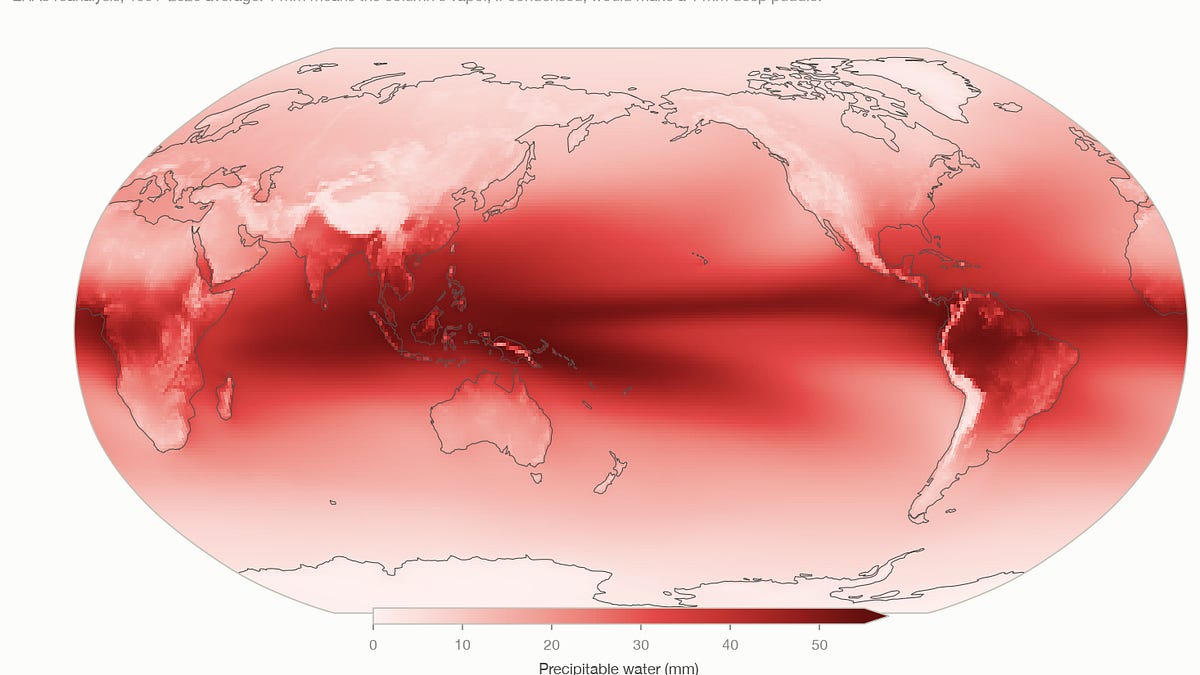
Precipitable water hit 27.35 mm in August 2026, likely the highest in thousands of years, intensifying potential for severe storms.
What to know
- August 2026 set a record for atmospheric water vapor (27.35 mm), likely the most in at least 100,000 years, directly tied to it being the hottest August in 170 years.
- Higher atmospheric moisture increases extreme rainfall intensity at roughly 7% per degree Celsius of warming—a thermodynamic law (Clausius-Clapeyron) confirmed by precipitation data across 3,104 U.S. monitoring stations.
- The record is not merely statistical; it raises the ceiling on the intensity of extreme precipitation events globally, with direct implications for flooding and severe weather risk.
“An analysis of 3,104 stations in the United States shows virtually every station exhibits a positive correlation between precipitable water (PW) and extreme daily precipitation (EP) with over one-third statistically significant.”
Kunkel et al. (2020), Research study · The Climate Brink ↗
Andrew Dessler Climate scientist, authorGary Lackmann Atmospheric scientist
How it unfolded 1 development · click the chart to see its coverage posts
-
1
Social amplification highlights century-scale milestone
Climatecasino.net shares the analysis on Bluesky, pulling Dessler's most stark observation about the 100,000-year context. The post gains 1,100 likes and 32 comments, amplifying the record's significance to a broader audience.
“it is unimaginable that any month in the last few thousand years, maybe 100,000 years, has more PWAT in the atmosphere than August 2026.”
— Andrew Dessler, Climate scientist · source -
C
Your 'bonus moment of doom' for today: "it is unimaginable that any month in the last few thousand years, maybe 100,000 years, has more [Precipitable water] in the atmosphere than August 2026."
2 more of the top 3 · 20 posts in this stretch
-
 D
D
"It is unimaginable that any month in the last few thousand years, maybe 100,000 years, has had more precipitable water in the atmosphere than August 2026." # ClimateCatastrophe # GlobalWarming # ExtinctionLevel https://www. theclimatebrink.com/p/the-atmo sphere-just-set-a-water-vapor
-
C
The 0.04 kg m² increase in water vapour is the equivelent of 20 trillion litres of additional water, or 20 cubes of water, each a kilometre wide, high and deep. We are playing with very dangerous forces.
-
-
background
Dessler explains PWAT's role in extreme rainfall — Dessler publishes analysis on The Climate Brink explaining that precipitable water is the total atmospheric moisture available to condense and fall as rain or snow. He establishes the thermodynamic link: air holds roughly 7% more water vapor per degree Celsius of warming. Research confirms higher PWAT correlates with increased extreme precipitation intensity.
-
background
August 2026 sets water vapor record — Prof. Gary Lackmann flagged on an atmospheric sciences mailing list that August 2026 broke the record for precipitable water (PWAT) in the atmosphere at 27.35 mm, surpassing July 2024's 27.31 mm. Andrew Dessler analyzed the data and confirmed the finding.
Also covered reported alongside — the timeline has no entry for these yet
-
first by Mastodon, 9d ago · also Guardian Environment
1 more headline
- Planet’s atmosphere breaks record for water vapour levels increasing risk of extreme heat and rainfall Guardian Environment · 6d ago
What people are saying 15 voices from 2 sites · best of 20 · verbatim
- Sep 18
-
I
The atmosphere just hit a new water-vapour record: 27.35 kg of water vapour per m2 in August 2026, ~20 trillion litres more water than the previous record. Warmer air holds ~7% more moisture per °C. More water vapour means more energy to fuel extreme weather.
-
 A
A
Good article about the greenhouse gas water vapour. The hot ocean surface, thanks to # Exxonknew , increases the amount of moisture in the air. Makes heatwaves hotter and storms stormier. https://www. theguardian.com/environment/20 26/sep/18/planets-atmosphere-breaks-record-for-water-vapour-levels-increasing-risk-of-extreme-heat-and-rainfall I…
-
Your 'moment of doom' for Sept. 18, 2026 ~ Feedback loop alert! "Water vapour is also part of the climate feedback loop – water vapour is a greenhouse gas and so the atmosphere will warm even further, and then take up even more water vapour."
-
E
Water vapour in Earth’s atmosphere at record levels in August at probably highest in 100,000 years one scientist admits An extra 20 trillion litres of additional water This will drive even more extreme heat rain and storms
-
A
En agosto se batió el récord en contenido de agua atmosférica. Trillones de toneladas esperan unas condiciones óptimas para caer de golpe y provocar una catástrofe de dimensiones épicas. Estamos jugando con inmensas fuerzas que apenas comprendemos, pero menos aún podemos controlar.
-
Y
@readfearn.bsky.social on the August water vapour record Rising water vapour levels can "increase the risk of intense rainfall, including from cyclones, & give extra energy to storms “because heat is released when water vapour condenses into cloud droplets, potentially helping to intensify them”"
- Sep 17
-
J
El Niño and global heating pushes water vapour in Earth's atmosphere to record levels in August - @readfearn.bsky.social @theguardian.com
-
A
"A lot of the impacts of climate change actually happen because of water vapour."
-
 F
F
With Copernicus data confirming record atmospheric moisture alongside peak global temperatures, storm energy and flash flood risks are intensifying worldwide. Unchecked fossil fuel emissions directly power this volatile cycle. How do we force action? # ActOnClimate https://www. theguardian.com/environment/20…
- Sep 15
-
 K
K
The atmosphere holds more water vapour than it used to because it is warmer. This will contribute to increasingly intense rain events until we stop dumping CO2 into the atmosphere # GlobalCarbonFeeAndDividendPetition https://www. theclimatebrink.com/p/the-atmo sphere-just-set-a-water-vapor
-
O
"On an atmospheric sciences mailing list, Prof. Gary Lackmann (meas.sciences.ncsu.edu/people/gary/) pointed out that August 2026 set a record for the amount of water vapor in the atmosphere" '"More water vapor means more rocket fuel for extreme rain — this record is not good news"' via Isabel Ebert
- Sep 14
-
 M
M
# Weather # Climate https://www. theclimatebrink.com/p/the-atmo sphere-just-set-a-water-vapor
-
P
Send in the rain: The Atmosphere Just Set a Water Vapor Record
-
 N
N
More water vapor means more fuel for extreme rain — so this record is not good news # ClimateChange # humidity https://www. theclimatebrink.com/p/the-atmo sphere-just-set-a-water-vapor
-
A
On The Climate Brink: The Atmosphere Just Set a Water Vapor Record. Aug. 2026 probably had more water vapor in the atmosphere than any month in the last few thousand years, if not a 100,000 years.