Black hole winds 100x more powerful than thought, XRISM finds
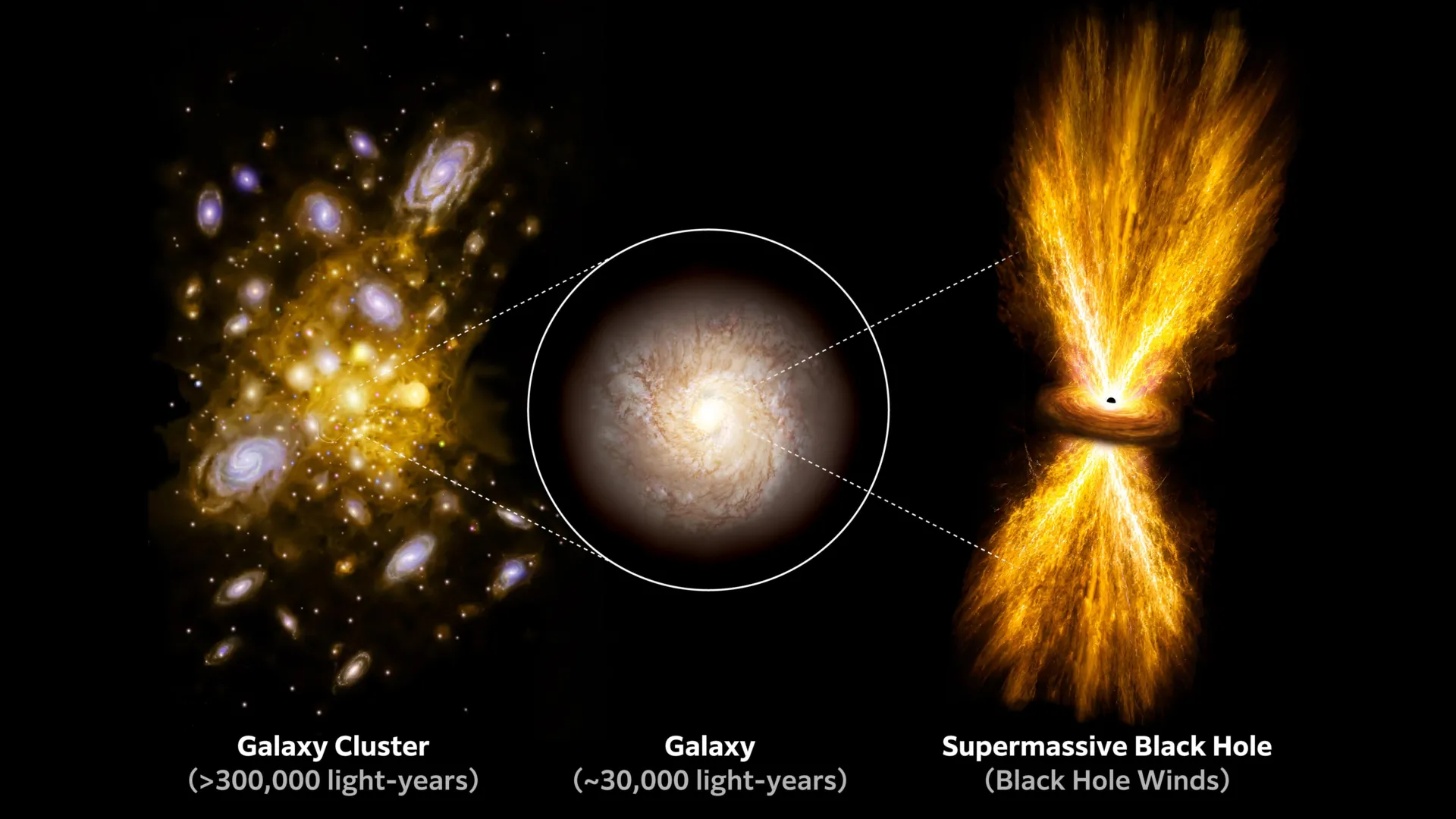
Supermassive black hole winds extend 300,000 light-years with energy rivaling billions of supernovas, reshaping understanding of galactic influence.
What to know
- Black hole winds carry 100 times more energy than previously thought, extending 300,000 light-years beyond host galaxies.
- Energy in the turbulence rivals several billion supernova explosions, establishing black holes as major cosmic energy transporters.
- XRISM satellite's high-precision X-ray measurements of quasar H1821+643 revealed this previously underestimated influence on galactic environments.
Satoshi Yamada Lead researcher, Tohoku UniversityXRISM (X-Ray Imaging Spectroscopy Mission) X-ray satellite instrumentTohoku University, Kanazawa University, Tokyo Metropolitan University Research institutions
How it unfolded 1 development · click the chart to see its coverage articlesposts
-
1
Study published showing black hole winds rival energy of several billion supernovas
Science Daily releases full findings showing the energy in black hole-driven turbulence is comparable to the output of several billion supernova explosions, demonstrating black holes' role as key drivers of gas flows and cosmic energy distribution across vast regions of space.
“For the first time, we have shown that black holes influence the broader cosmic environment through a shock wave of astonishing power. Black holes are key drivers of gas flows and motion in space, transporting vast amounts of energy to different regions of the cosmos.”
— Satoshi Yamada, Tohoku University -
first by Mirage News, 10d ago · also ScienceDaily
1 more headline
- Supermassive black hole winds are 100 times more powerful than scientists thought ScienceDaily · 10d ago
-
-
background
XRISM observations reveal black hole winds 100 times more powerful than previously thought — Researchers led by Satoshi Yamada at Tohoku University used the XRISM X-ray satellite to study quasar H1821+643 and found that supermassive black hole winds carry energy across roughly 300,000 light-years, extending far beyond the host galaxy. The energy contained in the turbulence was approximately 100 times greater than earlier estimates.