Webb finds smallest brown dwarfs ever, challenging star formation theory
NASA's James Webb Space Telescope discovers brown dwarfs just twice Jupiter's mass in IC 348, smaller than theory predicted.
What to know
- Webb discovered brown dwarfs with masses as low as twice Jupiter's mass in IC 348—smaller than any previously found and far below what star formation theory predicts.
- The findings challenge existing models of how stars and brown dwarfs form, suggesting the lower limit on brown dwarf mass may need revision.
- One of the lightest brown dwarfs shows signs of a planetary disk, implying planets could form around an object barely more massive than Jupiter itself.
- Spectroscopic analysis revealed an unidentified hydrocarbon feature in the atmospheres of the lowest-mass brown dwarfs, suggesting they may represent a distinct spectral class.
“One of the lightest newfound brown dwarfs showed signs of a disk, suggesting that small planets could be forming around an object that is itself only the mass of a planet.”
NASA · NASA official announcement ↗
NASA Space agency releasing findingsResearch team studying IC 348 Astronomers conducting the observations
How it unfolded 1 development · click the chart to see its coverage articlesposts
-
1
NASA releases Webb image and findings on IC 348 brown dwarfs
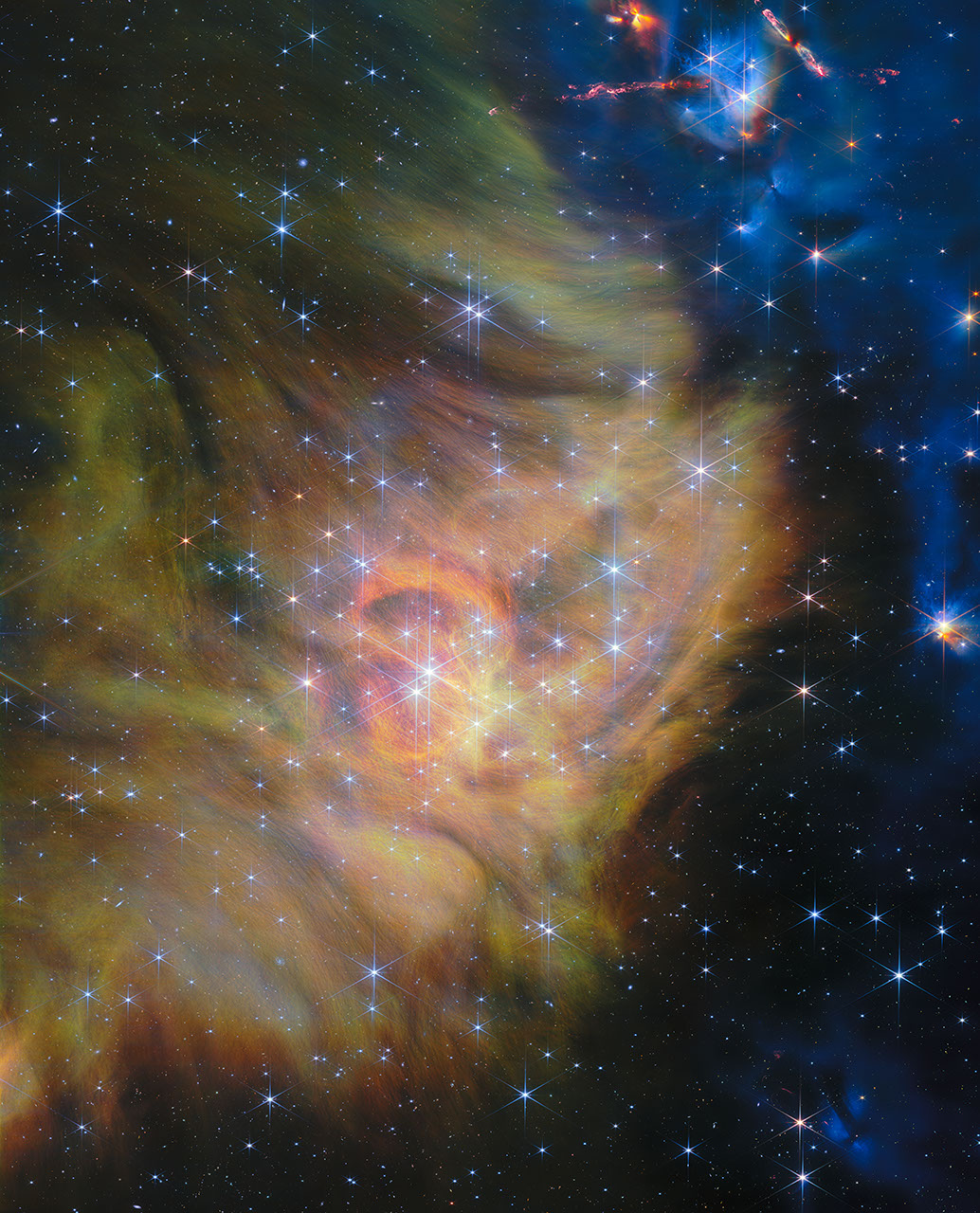
NASA officially publishes one of the largest images from Webb to date, showing IC 348 and revealing the unexpectedly small brown dwarfs that challenge star formation models. One of the lightest brown dwarfs shows signs of a disk, suggesting planets could form around an object only planetary in mass.
“brown dwarfs with masses as low as just twice the mass of Jupiter or only 0.19 percent of the Sun's mass — far smaller than theory predicts brown dwarfs should be…”
— NASA -
first by NASA breaking, 9d ago · also NASA
1 more headline
-
S
Webb reveals one of its largest images to date! 😲 This starry view shows the nearby star-forming region IC 348. Here, astronomers searched for brown dwarfs, objects which are less massive than the smallest stars. Read more 👉 www.esa.int/Science_Expl... 🔭🧪
2 more of the top 3 · 4 posts in this stretch
-
 C
C
Just in: A gorgeous new panorama of creation in our galaxy, taken by JWST. This image shows infant stars shooting out jets, baby stars emerging from dusty cocoons, young planet-like objects floating alone & starless, and one planet birthing planets of its own. https:// science.nasa.gov/missions/webb…
-
A
Stunning new #JWST image of a nearby star-forming region, where the smallest-ever brown dwarfs have just been found! Read more: science.
-
-
background
Webb's NIRSpec confirms brown dwarfs at twice Jupiter's mass — Follow-up spectroscopic observations with Webb's Near-Infrared Spectrograph reveal brown dwarfs with masses as low as twice Jupiter's mass—just 0.19% of the Sun's mass—making them the least massive brown dwarfs known.
-
background
Webb's NIRCam captures thermal signatures of young brown dwarfs — The same research team uses Webb's Near-Infrared Camera to capture the warm glow of young brown dwarfs and newborn stars in a deeper survey of IC 348, identifying new candidate objects based on their colors and brightness.
-
background
Webb team discovers brown dwarfs at 3-4 Jupiter masses in IC 348 — Researchers using the James Webb Space Telescope identify brown dwarfs in the nearby star-forming region IC 348 with masses as low as three to four times Jupiter's mass, marking an initial step toward finding the minimum mass for these objects.
What people are saying 1 voices from 1 site · best of 4 · verbatim
- Sep 15
-
I
Questa scoperta porta lo studio di questi curiosi oggetti in un nuovo intervallo di massa. Per saperne di più