Scientists discover 10-sided atmospheric structure at Saturn's south pole
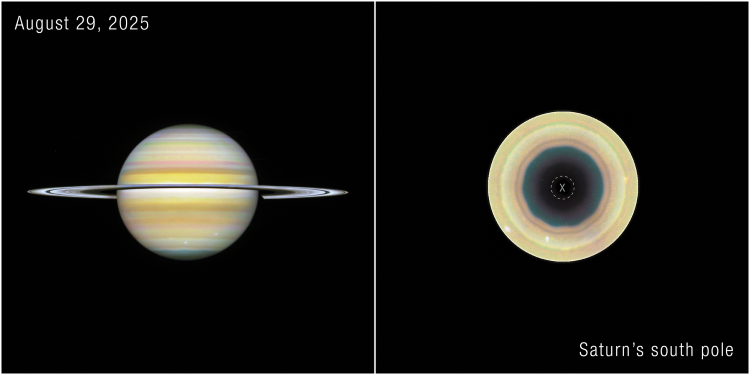
An international research team analyzing NASA Hubble images has identified a newly formed decagon-shaped jet stream pattern unlike Saturn's long-known northern hexagon.
What to know
- Scientists using NASA's Hubble Space Telescope have discovered a 10-sided atmospheric structure (decagon) at Saturn's south pole between 2023-2025, a first-time finding in that hemisphere.
- Unlike Saturn's stable northern hexagon, which has remained fixed for over 40 years, the newly discovered decagon is actively migrating eastward with faster jet stream speeds (250 mph vs. 200-220 mph) and oscillating in behavior.
- The decagon appears to be a newly formed and strengthening atmospheric pattern, giving researchers a rare opportunity to observe how giant geometric structures develop on gas giants in real time.
Dr. Amy Simon Senior Scientist for Planetary Atmospheres Research at NASA's Goddard Space Flight Center, OPAL principal investigatorNASA Goddard Space Flight Center Research institutionInternational research team Study authors
How it unfolded 2 developments, newest first · click a bar or a number to jump articlesposts
-
1
Researchers see opportunity to study atmospheric pattern formation
The discovery provides rare insight into how giant atmospheric structures form and evolve on gas giants. The decagon's recent emergence—absent during NASA's Cassini mission (2004-2017)—and active strengthening offer scientists an unprecedented chance to observe a major atmospheric pattern developing in real time.
“We've never seen anything quite like this in Saturn's southern hemisphere. The northern hexagon has been there every time we looked for more than 40 years. This feature is different—it appears to be strengthening, giving us the rare opportunity to watch a giant atmospheric pattern develop.”
— Dr. Amy Simon, NASA Goddard Space Flight Center Senior Scientist · source -
2
Study reveals decagon's dynamic behavior and contrast with northern hexagon
The research, published in Science Advances, shows the southern decagon is actively migrating eastward with jet stream speeds of 400-420 km/h (250 mph), faster than the northern hexagon's 320-354 km/h. The decagon's 10 corners oscillate every 32 days, causing it to behave like a meandering wave penetrating multiple atmospheric layers, unlike the fixed northern hexagon.
-
background
Hubble identifies decagon structure in Saturn's south pole — An international research team analyzing NASA Hubble Space Telescope images obtained between 2023 and 2025 discovered a newly formed decagon-shaped (10-sided) atmospheric structure in Saturn's southern polar region. This marks the first such discovery in Saturn's southern hemisphere.