T. rex had human-like body temperature, tooth analysis reveals
Scientists measured isotopes in fossilized teeth to show the dinosaur was warm-blooded and metabolically active, not a sun-basking reptile.
What to know
- Tooth enamel isotope analysis reveals T. rex had a core body temperature of ~36.3°C (97.3°F), comparable to modern humans and elephants, definitively establishing the dinosaur as warm-blooded (endothermic).
- Endothermy required higher metabolic rates and food intake but enabled T. rex to sustain activity, migrate, and thrive in variable and cold climates across most of North America.
- The finding consolidates prior anatomical and behavioral evidence and overturns the outdated image of dinosaurs as sluggish, sun-dependent reptiles.
“An example of science in action, converging upon a single, robust hypothesis, which in this case reveals T. rex as an active top predator.”
Thomas Carr, Carthage College paleontologist · New Scientist ↗ · Sep 15
Robert Eagle UCLA geobiologist, lead researcherAradhna Tripati UCLA geoscientist, senior authorScott Persons South Carolina State Museum paleontologistThomas Carr Carthage College paleontologist
How it unfolded 1 development · click the chart to see its coverage articlesposts
-
1
Expert paleontologists validate findings as convergent scientific evidence
Scott Persons at South Carolina State Museum and Thomas Carr at Carthage College endorse the study, noting it aligns with extensive prior evidence including bone growth rates, predator-prey ratios, and anatomical traits consistent with athleticism. Persons notes the finding contradicts the premise of Jurassic World films, which suggested dinosaurs could not survive outside equatorial climates.
“The opening to the last Jurassic World flick was one big pile of Hollywood bunk. That film premised that dinosaurs could not survive in the modern world, except near the equator. Not so.”
— Scott Persons -
first by Discover Magazine, 7d ago · also SCMP, The New York Times, NYT Science, CNN, NDTV, Daily Sabah +16
17 more headlines
- T. rex was warm-blooded and had body temperature close to ours, study finds SCMP · 7d ago
- T. Rex, King of the Dinosaurs, Had a Body Temperature of 97 Degrees The New York Times · 7d ago
- T. rex’s teeth reveal the dinosaur’s body temperature for the first time CNN · 7d ago
- Scientists Determine T. Rex’s Body Temperature for the First Time GreekReporter.com · 7d ago
- Scientists Finally Measure T. Rex's Body Temperature, And It's Surprisingly Close To Humans NDTV · 7d ago
- UCLA Researchers Estimate T. Rex Body Temperature at 36 Celsius Using Enamel Chemistry: 16 outlets compared newscord.org · 7d ago
- T. rex’s body temperature similar to humans: Scientists Daily Sabah · 7d ago
- T. Rex Had a Body Temperature of 97 Degrees HN Frontpage · 6d ago
- The T. rex had a body temperature similar humans, study finds NY Post · 6d ago
- T. rex had a body temperature similar to our own, study finds PBS NewsHour · 6d ago
- Study: The T. Rex Had a Body Temperature Similar to Our Own - ASHARQ AL-AWSAT English Google News · Science · 6d ago
- T. rex had humanlike body temperature, study finds Yahoo News Canada · 5d ago
- Tyrannosaurus rex Had Mammal-Like Body Temperature, Study Finds Sci.News · 5d ago
- The T. rex had a body temperature similar to our own, study finds navhindtimes.in · 4d ago
- T rex had body temperature of 36.3°C, almost the same as humans Times of India · 4d ago
- T Rex Body Temperature bdtonline.com · 4d ago
- Chemical bonds locked inside fossil teeth put T. rex’s body temperature at 36.3°C Science Blog · 2d ago
-
first by Science | AAAS, 7d ago · also CTV News, Nautilus, Newsroom | UCLA, Smithsonian Magazine, Smithsonian, Yahoo +1
7 more headlines
- Scientists have discovered the body temperature of the Tyrannosaurus rex CTV News · 7d ago
- We Finally Know Tyrannosaurus Rex’s Body Temperature Nautilus · 7d ago
- Scientists finally know the body temperature of the Tyrannosaurus rex Newsroom | UCLA · 7d ago
- Tyrannosaurus rex teeth reveal a body temperature close to the human average Phys.org · 7d ago
- Tyrannosaurus Rex Was a Warm-Blooded Dinosaur, With a Body Temperature Similar to That of Humans, Study Suggests Smithsonian Magazine · 5d ago
- Tyrannosaurus rex teeth suggest a body heat comparable to an elephant's, sharpening warm-blooded debate Yahoo · 2d ago
- Determining The Body Temperature Of Tyrannosaurus Rex Hackaday · 1d ago
-
 A
A
More evidence that T. rex was warm-blooded. New analysis of carbonates, with C and O isotopes in teeth enamel, indicates a body temperature of 36.3 ± 2.5°C. Modern elephants have body temps of 36.0° - 36.2°C, humans 37.0°. The mean temp. in Hell Creek, the location of the fossils, was estimated at 21°C, implying that T. rex was consistently warmer…
2 more of the top 3 · 20 posts in this stretch
-
S
T. rex was hot. Its body temperature, that is. Which was pretty close to our body temperature, as shown by an innovative new chemical study of its fossil teeth. Maybe so hot it was properly warm blooded like us. Maybe… My take for @nytimes.com
-
> Up until the early 2000s, dinosaurs were thought to be rather reptilian and therefore probably coldblooded, Dr. Wiemann said. That began to change as multiple lines of evidence from geochemistry studies and CT scans of fossils showed they were warm-blooded. Dr. Wiemann had previously found that T. rex had a fast metabolism, but she said the new…
-
-
background
Warm-bloodedness reframes T. rex as active apex predator — Researchers note that endothermy carries metabolic costs—higher food requirements and more active hunting—but grants T. rex sustained energy, stamina, and the ability to thrive in variable climates. Climate modeling suggests T. rex could have inhabited most of North America, including cold environments with freezing temperatures, making it far more mobile and adaptable than previously imagined.
-
background
Study confirms T. rex was endothermic, not ectothermic — The tooth analysis compared T. rex isotope ratios to those of modern crocodile teeth from the same geological formation and modern mammals (elephants, mammoths). Results show T. rex body temperature was significantly elevated compared to crocodile baseline and exceeded ambient Cretaceous-period Montana temperatures, establishing T. rex as a warm-blooded, metabolically active animal.
-
background
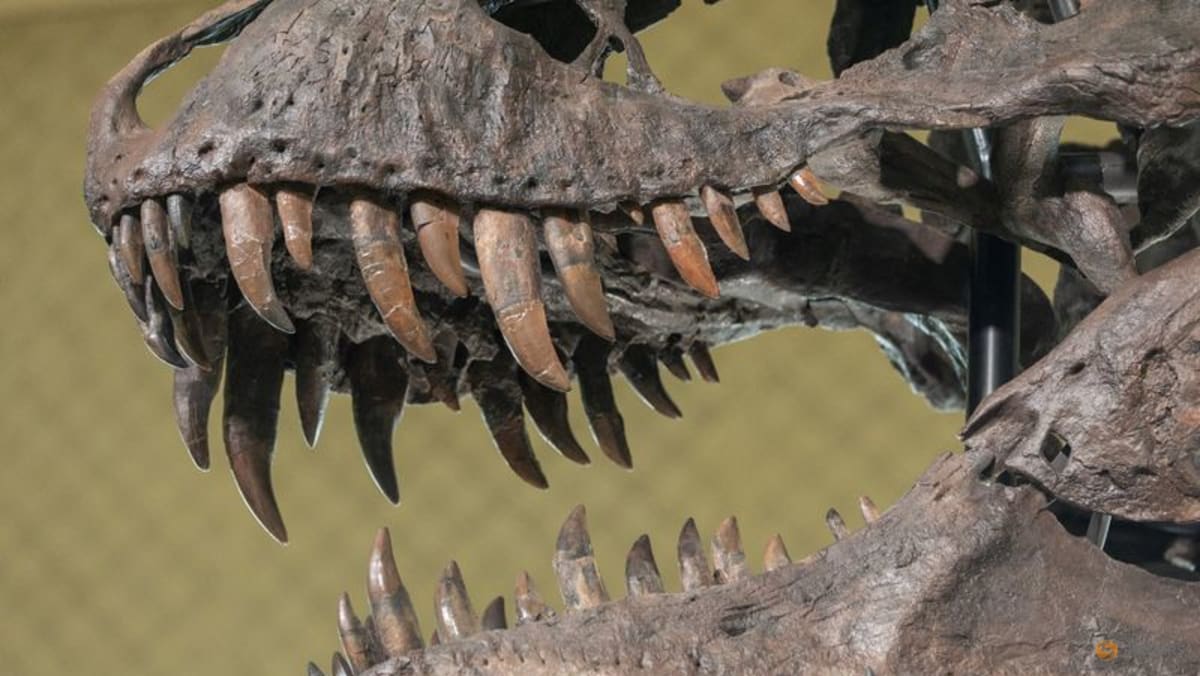
Scientists measure T. rex body temperature via tooth enamel chemistry — Researchers led by Robert Eagle at UCLA analyzed rare isotope bonds (carbon-13 and oxygen-18) in the enamel of three T. rex teeth from the Hell Creek Formation in Montana. The abundance of these bonds, which form more readily at cooler temperatures, allowed them to estimate the dinosaur's core body temperature at approximately 36.3°C (97.3°F), within 2.5°C of the measurement.
Also covered reported alongside — the timeline has no entry for these yet
-
first by LA Times California, 7d ago · also Good Morning America, ABC News - Breaking News, Latest News and Videos, CBC, LA Times
2 more headlines
- What’s the temperature of a T. rex? Hotter than you might think Good Morning America · 5d ago
- How do you take T. rex's temperature? These scientists did it CBC · 5d ago
-
first by Popular Science, 7d ago · also Scientific American, BBC, Nature World News
3 more headlines
- T. rex was as warm-blooded as humans, new study finds Scientific American · 7d ago
- T. rex dinosaurs were warm-blooded like humans, new study suggests BBC · 4d ago
- A Chemical Thermometer Hidden in Tooth Enamel Suggests T. Rex Was Warm-Blooded Enough to Survive Alaska Winters Nature World News · 2d ago
-
first by New Scientist, 7d ago · also ThePrint, Ars Technica, Ars Science
2 more headlines
- T rex was as warm as humans. Its teeth gave scientists the answer ThePrint · 5d ago
- T. rex teeth indicate it ran as warm as an elephant Ars Technica · 4d ago
-
first by Channel News Asia, 7d ago · also The Economic Times, The Japan News
2 more headlines
- T. rex was closer to a bird than a crocodile in body temperature? New fossil tooth study reveals how the The Economic Times · 7d ago
- Tooth Study Shows T. Rex Was Warmblooded The Japan News · 1d ago
-
first by Yahoo, 6d ago · also Jalopnik
and 2 smaller pieces
What people are saying 12 voices from 3 sites · best of 20 · verbatim
- Sep 20
-
T. rex teeth indicate it may have been warm blooded A team of researchers at the University of California has measured the T. rex body temp by analyzing its teeth. Analysis indicates a temp of about 36° Celsius—roughly the body temperature of a modern elephant.
- Sep 19
-
 U
U
https://www. europesays.com/us/1073147/ Tyrannosaurus rex Had Mammal-Like Body Temperature, Study Finds # Climate # Cretaceous # Dinosaur # Endothermy # Fossil # HellCreekFormation # Montana # NorthAmerica # paleoclimate # Science # teeth # temperature # Thermoregulation # Theropod # Tyrannosaur # Tyrannosauridae # Tyrannosaurus # TyrannosaurusRex…
- Sep 17
-
the best part of this kind of science is that there’s no way to reproduce it or prove if it’s actually true, but it makes a great pop science article
-
G
Isotope analysis of fossil tooth enamel suggests T. rex was a warm-blooded endotherm. The body temperature of the Tyrannosaurus rex, which lived on Earth about 66 million years ago was around 36 °C, similar to that of humans. www.dongascience.com/en/news/79956 #globalmuseum #dinosaurs #UCLA #fossils
-
 G
G
Isotope analysis of fossil tooth enamel suggests T. rex was a warm-blooded endotherm. An analysis has suggested that the body temperature of the carnivorous dinosaur Tyrannosaurus rex (Tyrannosaurus), which lived on Earth about 66 million years ago, was around 36 °C, similar to that of humans. https://www. dongascience.com/en/news/79956 #…
-
 V
V
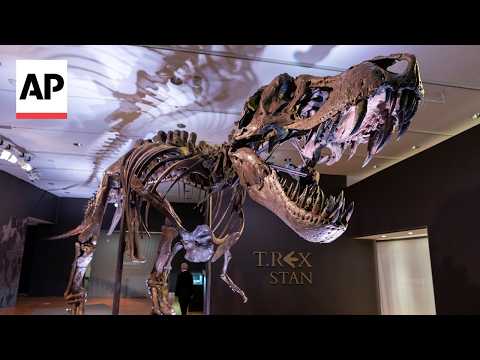
From AP: T. rex's body temperature was similar to humans, study finds https://www. youtube.com/watch?v=ObZYBWogRW 8&utm_source=dlvr.it&utm_medium=mastodon * VSN-GDPM c1996 # news # SupportIndependentMedia # vsn
-
It intuitively makes sense. A cold-blooded creature of that mass would take a long time to properly warm up or cool down. Most modern cold-blooded animals are small, e.g. frogs, snakes, lizards. They can move into the sunlight or shade as needed and pretty quickly change temperature.
-
Repost from a different thread: Related only topically, a 1hr YouTube talk I enjoyed a lot: "Hatchling T. rex and the Evolution of Vertebrate Parental Care" by Nick Longrich: https://www.youtube.com/watch?v=zd0dR2n9hLAHe's a paleontologist and the talk starts with some pretty interesting statistical analysis aiming to estimate T rex clutch sizes…
-
'Hotter than a crocodile, cooler than a chickennnnn....'is the opening line to a great song i'll never get to hear.
-
How do we know its body temperature was 97 degrees, and simply not the environment was 97 degrees?
-
This is really interesting, worth a read. Wouldn’t be surprised if the even larger dinosaurs had even higher body temps!
-
 E
E
https://www. europesays.com/3256194/ Tooth analysis confirms T. rex, like humans, was warm blooded # Data # DinosaurTeeth # TyrannosaurusRex