NASA's James Webb captures star-forming dust pillar in Carina Nebula
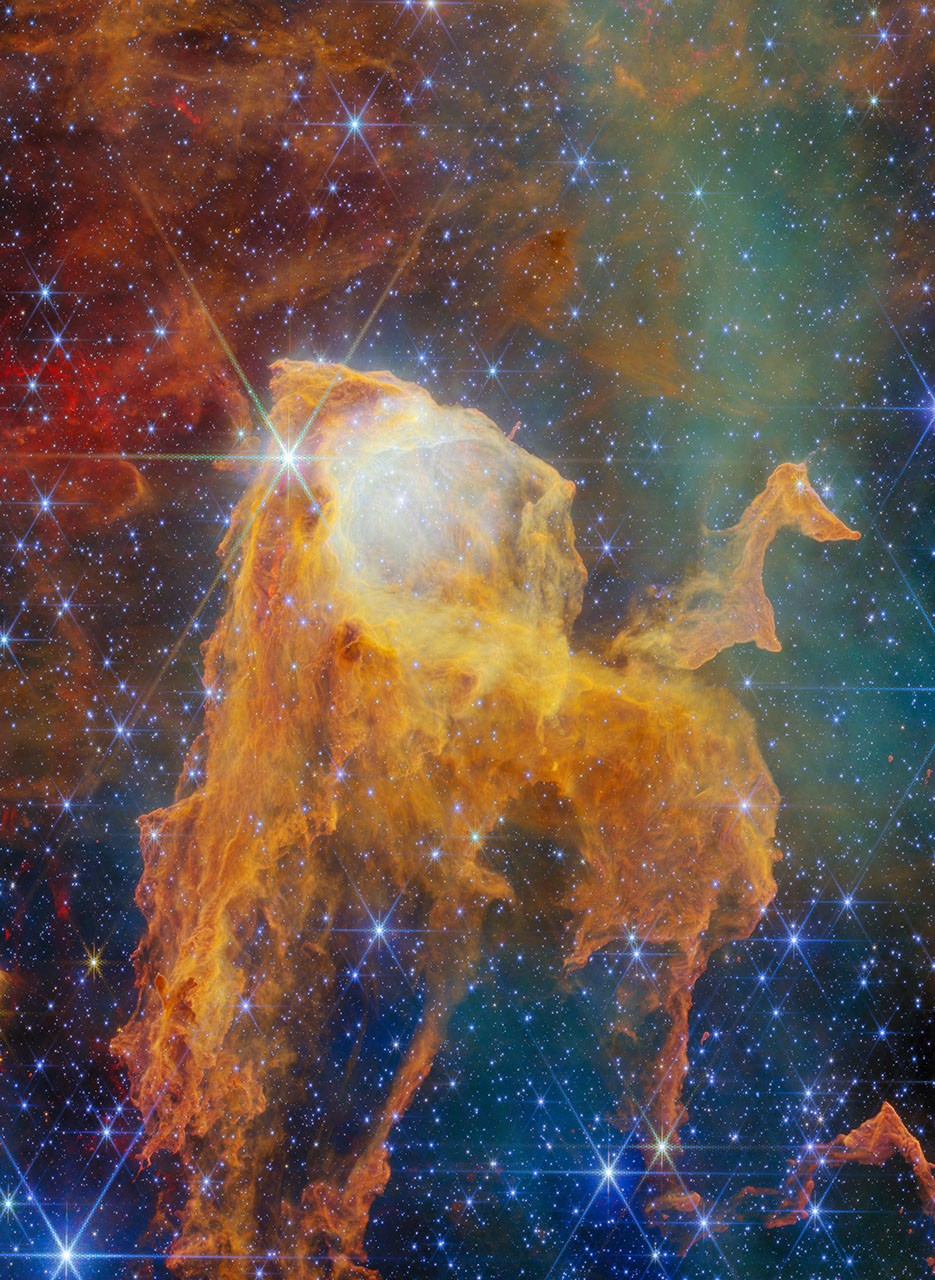
The telescope reveals a compact cluster of about 70 young stars, including one 19 times the Sun's mass, inside a dust pillar shaped by stellar winds.
What to know
- James Webb imaged a dust pillar in the Carina Nebula 7,500 light-years away containing a young star cluster with about 70 stars, including one roughly 19 times the Sun's mass.
- The cluster is only 1.3 million years old, making it extremely young in astronomical terms.
- Powerful stellar winds and radiation from nearby Eta Carinae (5 million times the Sun's luminosity) are actively shaping and excavating the pillar.
“More massive stars are rarer, shine brighter and evolve faster than less massive stars. They are the shiniest jewels in the treasure chest.”
NASA · NASA APOD ↗
NASA Space agency releasing observation
How it unfolded 2 developments, newest first · click a bar or a number to jump articlesposts
-
2
Astronomers estimate cluster age at 1.3 million years with stellar details
The compact star cluster within the pillar is thought to be only around 1.3 million years old, with star formation actively excavating the pillar's head and shaping it through powerful stellar winds from neighboring systems like Eta Carinae, which is more luminous than 5 million suns.
“Astronomers estimate that there are about 70 stars in a compact cluster inside the pillar. This cluster is now thought to be only around 1.3 million years old.”
— NASA -
#^ https://apod.nasa.gov/apod/ap260917.html A Treasure Chest in the Carina Nebula
-
-
1
NASA releases James Webb image of Carina Nebula dust pillar
NASA's Astronomy Picture of the Day features a James Webb Space Telescope image of a dust pillar in the Carina Nebula containing a young star cluster with approximately 70 stars, including a massive star about 19 times the Sun's mass.
“This treasure chest is full of stars. The featured image was obtained with NASA's James Webb Space Telescope and shows a dust pillar in the Carina Nebula inside our Galaxy, roughly 7500 light-years away.”
— NASA
Also covered reported alongside — the timeline has no entry for these yet
-
first by NASA Science (.gov), 7d ago · also Mirage News, NASA
1 more headline
- Carina Nebula's Treasure Chest: 2026 APOD Highlight Mirage News · 7d ago