Analysis: How SpaceX Stripped Down the Raptor Engine, Gaining 35% More Thrust
A Construction Physics deep-dive into Raptor 1-to-3's redesign draws a large Hacker News debate over Musk's part-elimination philosophy.
What to know
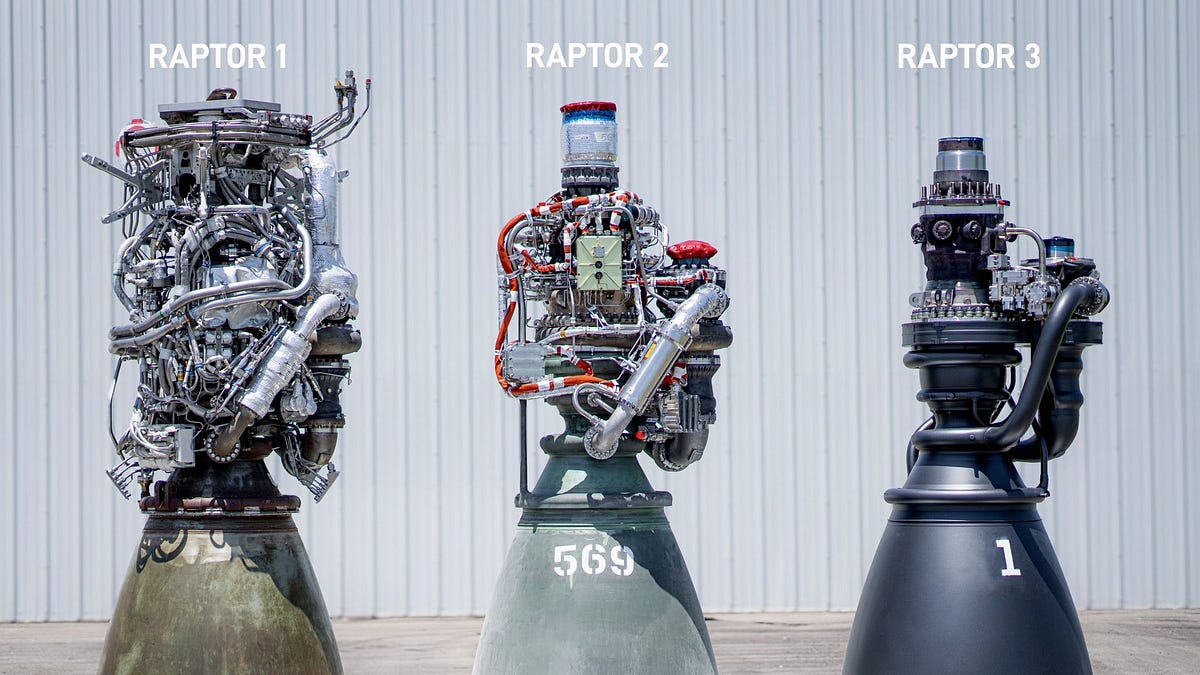
- Raptor evolved from the pipe-and-wire-covered Raptor 1 to the streamlined Raptor 3, which first flew in May 2026 and produces about 35% more thrust.
- SpaceX has never published official Raptor schematics and no teardown exists, so the analysis relies on Elon Musk's occasional comments and fan speculation.
- Hacker News discussion centers on whether Musk's ruthless elimination of unnecessary parts, rather than any single technical breakthrough, drives the design's cost and complexity reduction.
- Commenters note Raptor 3 engines failed to start or relight during the July Starship Flight 13 launch attempt, a reminder that the redesign hasn't eliminated all reliability issues.
The dispute Whether the Raptor's dramatic simplification is best explained by Musk's philosophy of eliminating unnecessary parts or by more specific engineering trade-offs like dropping thrust vector control. · positions read across 11 posts and comments
SpaceX's simplification gains stem mainly from Musk's relentless elimination of unnecessary parts and vertical integration.
-
“According to Isaacson's biography of Musk, Musk relentlessly challenges the existence of every part in Tesla and SpaceX machines.”
WalterBright · Hacker News ↗
The article's framing glosses over technical nuances, like what counts as part of the engine and precedent engines.
-
“Raptors can be used without TVC... Tory Bruno specifically explained that he meant - among other things - that absence.”
avmich · Hacker News ↗
It's unsurprising SpaceX withholds Raptor schematics given its competitive and export-control sensitivity.
-
“I'm surprised the author was surprised that a component of a multi-billion dollar company which is vital to it's future success in the industry and is covered by US regulations governing information export wasn't available as a cut-away…”
philipwhiuk · Hacker News ↗
Manufacturing details like 3D-printed parts and how engines are transported are surprising and noteworthy in their own right.
-
“I find it mind boggling that you can 3d print rocket engines. I thought that the standard line is that 3d printing metal wasn't developed enough for anything serious.”
ecshafer · Hacker News ↗
 Elon Musk SpaceX CEO
 Tory Bruno Then-CEO of United Launch Alliance
 Gwynne Shotwell SpaceX presidentSpaceX Company
How it unfolded 6 developments, newest first · click a bar or a number to jump postscomments
-
6
Commenters credit Musk's part-elimination drive for cost cuts
Hacker News commenters, citing Isaacson's Musk biography, argue that Musk's habit of challenging the necessity of every component, combined with vertical integration, explains much of the cost and complexity reduction seen across Raptor versions.
“This is how he managed to reduce the costs by 90%.”
— WalterBright -
> According to Isaacson's biographyIsaacson’s “biographies” are glorified puff pieces. Musk is as unrecognizable in his as Jobs was in his.Both Tesla and SpaceX had teams keeping Musk busy on bs just so that the engineering teams could do their work.The second he took control, we got the cybertruck and the starship, the worse products both…
2 more of the top 3 · 6 posts in this stretch
-
>"According to Isaacson's biography of Musk, Musk relentlessly challenges the existence of every part in Tesla and SpaceX machines."This removal of surplus-age is common in the automotive industry, and one of the reasons that cars are such an amazing value. It seems like Musk's remarkable ability to achieve cost reductions (at least in the…
-
Slight aside, he also has driven capability that was challenging to justify existence for, and was later removed re: Dragon 2 propulsive landing via SuperDracos, landing legs, and the ballast sled. I'm sure the Dragonfly programs matured their abort programs, but surely, that was a ton of time and effort wasted.You win some, you lose some.
-
-
5
Commenters flag technical nuances in engine classification
Users note that thrust vector control is usually considered part of an engine and that Raptor can operate without it, and question whether the Space Shuttle Main Engine/SLS engine also qualifies as full-flow staged combustion, complicating the article's framing.
-
> A full-flow staged combustion engine is very complex, and prior to the Raptor only two had been built, neither of which successfully flew on a rocket.Isn't the Space shuttle main engine / SLS engine a full-flow staged combustion engine?
-
-
4
Commenters recall Raptor 3 failures during Starship Flight 13
A commenter points out that several Raptor 3 engines failed to start or relight during the July Starship Flight 13 launch attempt, with ice in feed lines suspected as the likely cause.
“I believe ice in feed lines is viewed as the most likely cause.”
— thinkcontext -
> And the problems haven’t been completely ironed out: the first launch attempt of Starship’s flight test 13 was aborted automatically by the vehicle’s flight software at T-0 (right before liftoff) this past July when several Raptor 3 engines failed to startAnd several engines failed to relight on the booster for flight 13. I believe ice in feed…
-
-
3
Commenters react to 3D-printed engine parts and Cybertruck towing
Readers express surprise that metal 3D printing is mature enough for rocket engine components and note SpaceX transports Raptor engines on uncovered trailers behind Cybertrucks.
“I find it mind boggling that you can 3d print rocket engines.”
— ecshafer -
I find it mind boggling that you can 3d print rocket engines. I thought that the standard line is that 3d printing metal wasn't developed enough for anything serious. Not a mechanical/materials engineer, but if you can 3d print rockets what's off the table? Jet Engines and that's about it I think?From the article links, I am amused that SpaceX…
1 more of the top 2 · 2 posts in this stretch
-
> There turned out to be less detail available here than I hoped.I'm surprised the author was surprised that a component of a multi-billion dollar company which is vital to it's future success in the industry and is covered by US regulations governing information export wasn't available as a cut-away diagram.
-
-
2
Article gains traction on Hacker News with 181 points
A resubmission of the piece climbed to 181 points and 51 comments on Hacker News, generating a large technical discussion thread about Raptor's design evolution.
“no need to exaggerate this by showing a partially assembled engine…”
— Tory Bruno, Then-CEO of United Launch Alliance · source -
The thrust vector control (TVC) subsystem is usually considered a part of the engine. The major change the Soviet NK-33 underwent for a USA model was the addition of TVC, and the engine was named differently, so there are two engines, named differently, which mostly differ by the presence of TVC.Raptors can be used without TVC. Be that by using…
-
-
1
Construction Physics details Raptor engine's streamlining and thrust gains
The blog explains how SpaceX transformed the tangled Raptor 1 into the smooth Raptor 3, which first flew in May 2026 and delivers about 35% more thrust, while noting SpaceX has never released official schematics or allowed a teardown.
-
first by HN Best, 6d ago
-
What people are saying 2 voices from 1 site · best of 11 · verbatim
- What exactly caused several Raptor 3 engines to fail to start during Starship Flight 13's launch attempt?
- Sep 18
-
It’s extremely premature to celebrate something which hasn’t been shown to work in its intended application, nor at the original specs.
-
I've been inspired by that to refactor my code so that function parameters are minimized (many pass TMI).