OpenAI's GPT-6 Astra cracks two long-unsolved WWI and WWII German ciphers
Within days, the model is credited with breaking an 83-year-old Enigma message and a 1918 ADFGVX radio cipher that had defeated codebreakers for decades.
What to know
- OpenAI's GPT-6 Astra model is credited with autonomously solving two historically unsolved German military ciphers within days of each other: a 1941 Enigma message and a 1918 ADFGVX radio message.
- The Enigma solve, done by Bloomberg's Carter Leffen, used a known-plaintext crib ('Rosenow') and an Enigma design quirk to recover the daily key, with the model handling archive search, simulator-building, and cryptanalysis code over about ten hours.
- The WWI solve, decoded from a list of about 50 long-unsolved ciphers, was cross-checked against original ship logs (HMS Canterbury's arrival at Sevastopol) to support its historical plausibility.
- Both results are self-reported claims with supporting code and data released publicly, but neither has yet received independent expert verification.
“Sofort Funkantwort”
Unknown 1941 German soldier (decrypted message), Original message author · The Decoder · Sep 16
Carter Leffen Product development coach, Bloomberg LPGPT-6 Astra OpenAI AI modelOpenAI Developer of GPT-6 Astragwintrob (PrinzAI blog) Author of the WWI cipher case study@deredleritt3r Poster who announced the WWI cipher decryption on X
How it unfolded 5 developments, newest first · click a bar or a number to jump articlespostscomments
-
5
WWI cipher solve claim spreads further on Hacker News
A second Hacker News submission points back to the same X post announcing the 1918 ADFGVX decryption, extending discussion of the claim.
-
This article would be a lot more interesting if it included the prompts, transcript, and generated code from the session with the LLM.
2 more of the top 3 · 77 posts in this stretch
-
gemini 3.8 flash in anrigravitiy oneshoted the descryption in about 45min non-steered run (opus is still running with the task, has some script to run for about 100min)PromptDecrypt encrypted with enigma `ICRVSORMCCWQTATYEVFXDBZGGSNXWLPSYWZYTCBSWULRTBZCVGODVJUSLSOOMJQJZSXSEBZPEYMDNXJYTC`ResultRaw Decryption (verbatim from the machine)…
-
GPT-6 Astra cracked a previously unsolved 1941 German Army Enigma message from World War I So GPT-6 had to figure out the right key, reconstructing the ADFGVX transposition, and recognizing a plausible plaintext from only 170 ciphertext symbols. Astra autonomously: > Searched historical archives ...
-
-
4
PrinzAI blog publishes the full WWI cipher solution and method
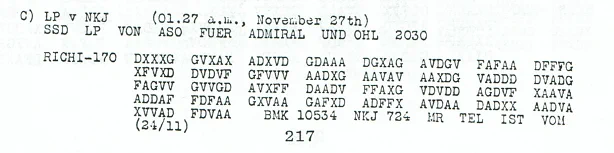
A detailed write-up explains how GPT-6 Astra identified 'TRUPPENVERSCHIEBUNG' as the encryption keyword, reconstructed the ADFGVX table, and decoded a November 27, 1918 message about British naval movements at Sevastopol, cross-checking the result against original ship logs.
“I am not aware of this particular message having ever been decoded before, so sharing it here as a minor (but I think really cool) result and illustration of the capabilities of this model.”
— gwintrob (PrinzAI) -
3 outlets GPT-6 Astra Breaks an Old Enigma Message
first by Schneier, 4d ago · also HN Best, HN Frontpage
1 more headline
-
JUST IN: GPT-6 Astra cracks an unsolved German Enigma message from World War II.
-
-
3
@deredleritt3r reports GPT-6 Astra decoded a 1918 WWI cipher
A separate post announces that GPT-6 Astra deciphered a previously unsolved 1918 German radio transmission encrypted with the ADFGVX method, giving the decoded German text and an English translation about an English cruiser arriving at Sevastopol.
“GPT-6 Astra deciphered a 1918 German radio transmission that, to my knowledge, has never been deciphered before.”
— @deredleritt3r -
first by HN Best, 7d ago · also RuntimeWire, prinz, HN Frontpage
2 more headlines
-
GPT-6 Astra deciphered a 1918 German radio transmission that, to my knowledge, has never been deciphered before. The message below translates to: "EIN ENGLISCHER KREUZER EINLIEG X SEWASTOPOL X S4STEN X EIN GESCHWADER DER X ALLIIERTEN FOLGT 26STEN X" or, in English: "AN
-
-
2
Enigma decryption claim circulates on Hacker News
The interactive case-study site for the Enigma decryption is submitted and discussed on Hacker News, with the solution and simulator made publicly available for review.
-
1
The Decoder reports the Enigma decryption claim and its methodology
The outlet details how Leffen's AI agents used a known-plaintext crib ('Rosenow', repeated in an already-solved same-day message) and Enigma's rule that a letter never encrypts to itself to narrow down the key, producing coherent German text including typos consistent with an authentic wartime operator error.
“99 times more effort into building the website that describes the problem and the solution than into actually cracking the code.”
— Carter Leffen -
Two days ago, GPT-6 Astra broke a yet unsolved German Army Enigma message from 1941. Amazingly Astra was able to autonomously: - Search historical archives - Compare uncertain letters - Find contextual clues - Build an Enigma simulator - Write cryptanalysis code - Run parallel
-
-
background
Carter Leffen uses GPT-6 Astra to break a 1941 Enigma message — Bloomberg developer Carter Leffen says GPT-6 Astra Extra High worked about ten hours to reconstruct Enigma daily key settings and decrypt an 82-character 1941 Wehrmacht message, tagged MVUEH, that had never been solved.
Also covered reported alongside — the timeline has no entry for these yet
-
first by Tom's Hardware, 7d ago
1 more headline
- ChatGPT-6 Astra cracks 108-year-old unsolved WWI German code for the first time … Tom's Hardware · 5d ago
and 1 smaller piece
What people are saying 18 voices from 3 sites · best of 80 · verbatim
- Sep 22
-
Neat, but "did it entirely on its own" is incongruous with "developing the necessary Python and C++ software for an Enigma simulator".I'd start by asking how much of that generated software is novel, or easily found on the web? Then, how much of the breaking process was offloaded to that software? If Astra is just handing off tasks to another…
-
Even if this is true, we must avoid falling into the trap of Kasparov of betting on Centaur Chess.Just like with Kasparov's Centaur Chess, the idea of a 'human in the loop' is just a necessity due to current limitations.There will hopefully (?) come a time one day when human beings provide only ultimate value judgments, and everything else is done…
-
I am in Rosenow, Rosenow. From the article: After trying many different approaches, GPT–6 Astra focused on using the repeated place name ROSENOW ROSENOW as a crib. This feels extremely underexplained! Why would Astra think to use that as a "crib"? Was it common to repeat the place name in these messages?(Is it possible that this is a misreported…
-
The correct title: Researcher brakes one specific stubborn historic enigma message with good help from Astra.Stubborn for a long time because the message used a completely different key from the rest of that day's traffic. Everyone assumed it shared the daily key. The original transcription had errors. The left rotor turned over at letter 72…
- Sep 21
-
But in this case its not important nor busywork, the key was already there. It's like they're standing on a ladder and dropping a basketball through the hoop, then bragging about how they got it in. And also claiming they built the ladder when someone else did.
- Sep 19
-
I disagree with the black and white stance here. I do agree that we sometimes do a bad job of this. Some recent advances in math have been headlined as "AI Solves ..." when there's a human driving. But sometimes a human writes a prompt and the AI really does the work autonomously. I don't think it's anthropomorphizing to say that my dishwasher…
-
> My screwdriver and mitre saw built my deck in two days.
-
Mildly interesting anecdote: when the Cyphral Distich solution popped up a few days ago, I spent about an hour with ChatGPT trying to solve it myself without looking at the proposed solution. ChatGPT opened by saying “the solution is disputed online,” and made the dispute sound fairly convincing, which struck me as odd because things like this are…
-
Yeah, the title makes it sound much more impressive than key reuse. Could be a good avenue to check for some other encrypted messages though.
-
Agents just eat these things. After last week's HN post about Cyphral Distich, I pointed Astra and Fable at some unsolved ciphers just to see whether some joker who knew nothing about the field could get the same results, and sure enough there's plenty of low hanging fruit.https://aaymeloglu.github.io/unsolved-ciphers/But I got nothing on Daniel…
-
To me an interesting example of storing all encrypted messages for a long time and then some day you’ll be able to crack and decipher them
-
It is irresponsible to misattribute these accomplishments to the AI agents. Every time, at least one person is involved in prompting and guiding the process. The headlines should be "[human] solves [challenge] using [tool]." The article author's use of anthropomorphizing phrases like "Astra's hypothesis for" and "Astra felt compelled" do not leave…
-
> Astra's hypothesis for why this particular message was previously unsolved is that “TRUPPENVERSCHIEBUNG” was used as the key starting on December 9, 1918 - whereas, as noted above, this message was transmitted earlier, on November 27, 1918. The reason for this discrepancy is unknown. I don’t know how such keys were managed (how/when distributed…
-
I'm no crypto expert at all but isn't TRUPPENVERSCHIEBUNG an actual word?Google says it translates to "troops shift"If so, I don't understand how this was difficult at all... Can't you just do a dictionary attack and then check if the resulting phrase forms a sentence?I don't understand how this couldn't be done by someone in their house with…
-
I don't get this type of comment. I like old ciphers and while I would probably enjoy reading about it more if it had been a (team of) people, I still think it's interesting to read about. I've so far refused to use LLMs for anything generative, still write code by hand, and am terrified of what lies ahead. But I still think it's interesting to…
-
(to be clear I agree with you) What makes you so confident?
-
Isn't that a very simple substitution cipher (any clear text letter is substituted by two letters of cipher text, with a fixed one-to-one correspondence)? And aren't they all amenable to very simple cryptanalysis, at least if the encrypted text is long enough, by counting how often certain letters appear, and then trying to plug in reasonable…
-
So..what??? I don't get this type of posts. Still not AGI and never-ish will be, AI;DR as always.