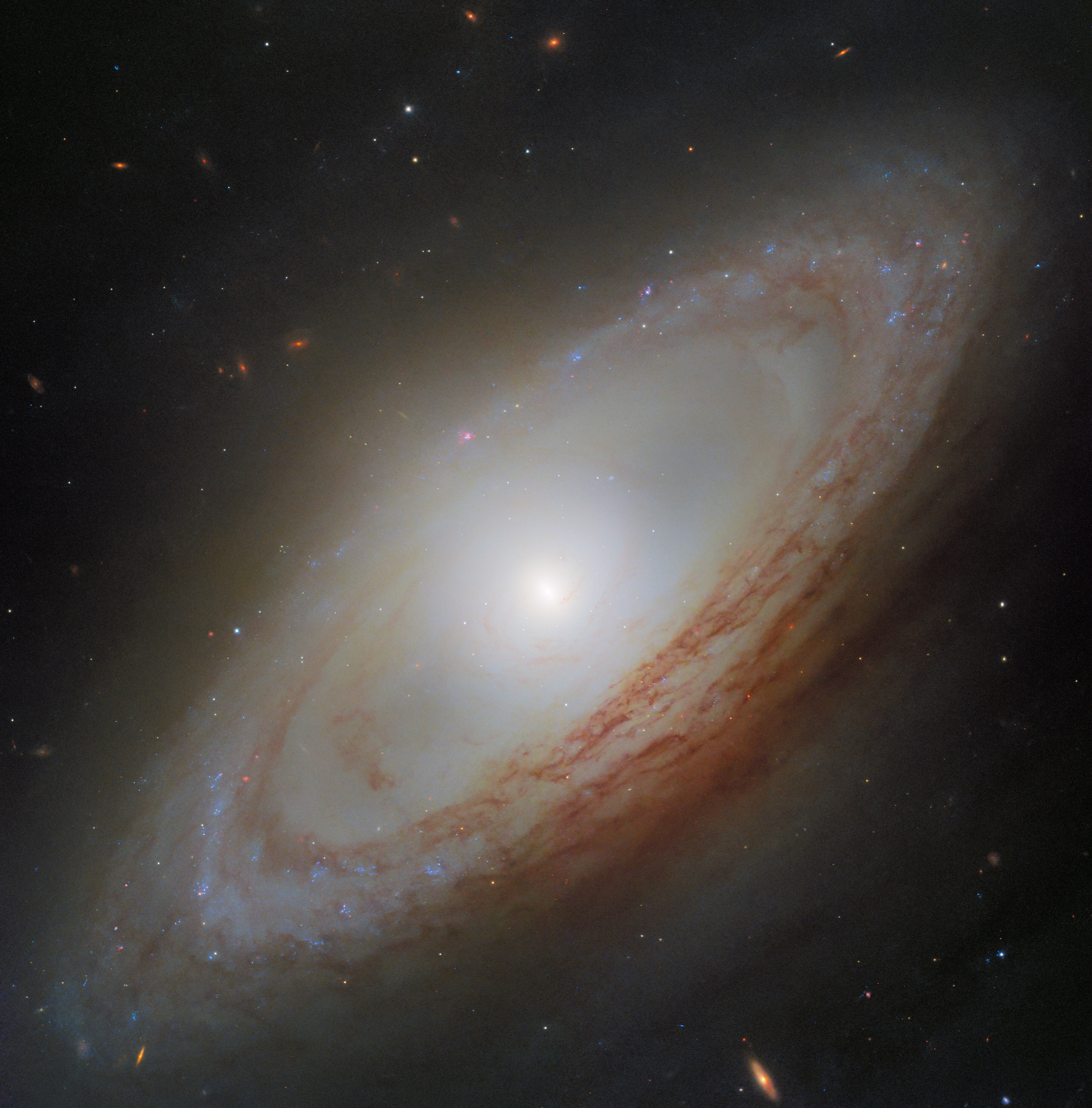
Hubble captures rare "out-of-sync" spiral galaxy NGC 4698
The distant galaxy's core rotates perpendicular to its disk, likely from past merger or external gas infusion.
What to know
- NGC 4698, a spiral galaxy 55 million light-years away in Virgo, exhibits rare structural anomalies: its bulge extends perpendicular to its disk, and its core rotates at a right angle to the rest of the galaxy.
- Astronomers attribute the misalignment to external causes—likely a past minor merger or influx of gas from outside the galaxy, evidenced by a hydrogen tail streaming from one side.
- The galaxy was imaged as part of a Hubble program studying how galaxies in clusters evolve and form new stars, with data zooming in on nearby cluster details.
“Though the spiral galaxy in this new image from the NASA/ESA Hubble Space Telescope seems serene, it hides a chaotic secret.”
NASA, Observatory operator · NASA Science ↗
NASA Astronomer/Observatory operatorClaire Andreoli Researcher, NASA Goddard Space Flight Center
How it unfolded 1 development · click the chart to see its coverage articlesposts
-
1
Astronomers propose past merger or external gas source caused NGC 4698's misalignment
NASA astronomers explain that NGC 4698's unusual structure likely results from external causes. The galaxy may have undergone a minor galactic merger or funneled in gas from an outside source, which could have formed a disk of gas and stars at an angle to the existing disk. Evidence of past merger activity includes a short tail of hydrogen streaming from one side of the galaxy.
“Astronomers have found that the culprit likely lies outside the galaxy. If NGC 4698 funneled in gas from an outside source, the newly collected gas could have formed a disk of gas and stars in the galaxy's center, at an angle relative to the rest of the disk.”
— NASA -
I
NGC 4698, a spiral galaxy around 55 million-light years away in the constellation Virgo may appear as a typical spiral galaxy akin to the Milky Way and other spiral galaxies — but that isn’t necessarily the case for NGC 4698.
-
-
background
NASA releases Hubble image of NGC 4698, reveals unusual galactic structure — NASA published detailed observations from the Hubble Space Telescope showing NGC 4698, a spiral galaxy 55 million light-years away in Virgo. The galaxy exhibits anomalous structure: its elongated bulge extends perpendicular to its disk, and the stars and gas near its center rotate perpendicular to the rest of the disk—a rare configuration among known spiral galaxies.
Also covered reported alongside — the timeline has no entry for these yet
-
first by NASA breaking, 5d ago · also NASA
1 more headline
- Hubble spots an out-of-sync galaxy Phys.org · 5d ago