Mathematicians Prove the Decades-Old "Sandwich Conjecture" for Random Graphs
A 2025 proof shows random regular graphs can be rigorously sandwiched between simpler random binomial graphs, unlocking easy proofs of their properties.
What to know
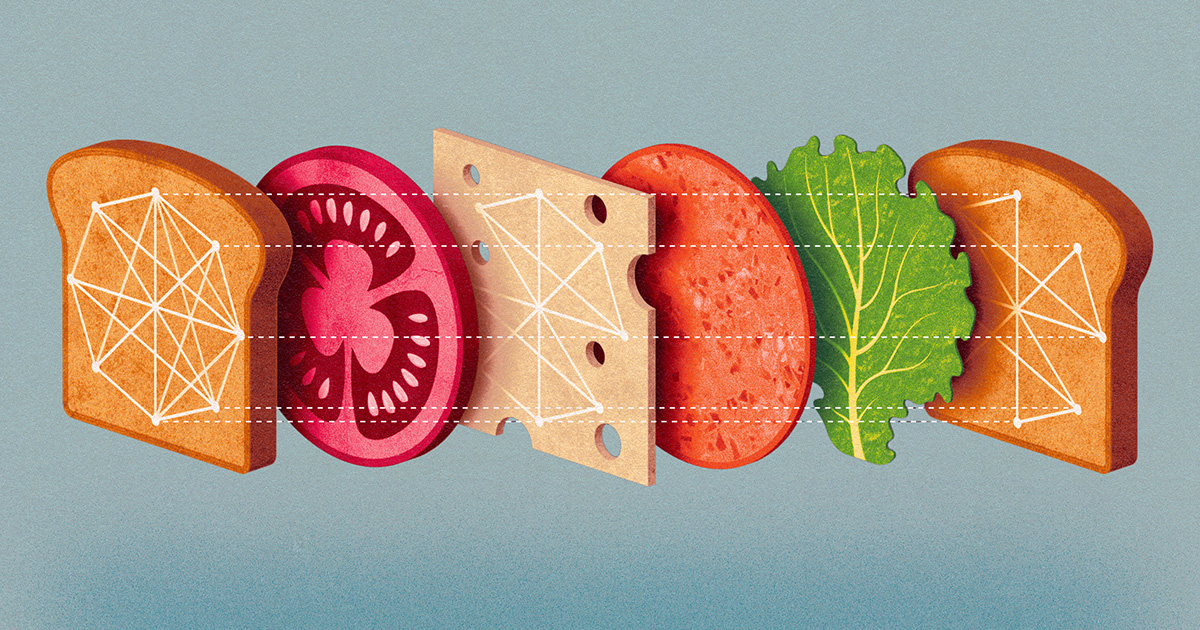
- The 'sandwich conjecture' says any sufficiently large random regular graph can be rigorously bounded between two simpler random binomial graphs.
- Random regular graphs better model real-world networks but are much harder to analyze than binomial graphs; the proof lets mathematicians transfer known properties from binomial graphs to regular ones.
- The full proof, completed in 2025 by three mathematicians, capped roughly two decades of partial progress following Kim and Vu's early-2000s approximation technique.
- Coverage of the result reached Hacker News and social syndication in September 2026, generating modest but active discussion.
Pu Gao Mathematician, University of WaterlooJeong Han Kim Mathematician, formerly Microsoft ResearchVan Ha Vu Mathematician, formerly UC San DiegoEdgar Gilbert Mathematician, Bell Labs
How it unfolded 3 developments, newest first · click a bar or a number to jump articlesposts
-
3
Article circulates further via social syndication
The Quanta piece was reshared on Mastodon via a Flipboard syndication account, describing it as giving researchers 'a new framework for understanding the structure of complex networks.'
-
 F
F
Mathematicians prove a decades-old conjecture about graph sandwiches, opening new ways to analyse complex networks https://www. quantamagazine.org/mathematici ans-build-long-awaited-graph-sandwich-20260918/ # science # mathematics # research
1 more of the top 2 · 2 posts in this stretch
-
Quanta Magazine reports on the proof of a long-standing conjecture in graph theory that gives researchers a new framework for understanding the structure of complex networks. # science # mathematics # research https://www. quantamagazine.org/mathematici ans-build-long-awaited-graph-sandwich-20260918/?utm_source=flipboard&utm_medium=activitypub…
-
-
2
Story reaches Hacker News front page
The Quanta article was submitted to Hacker News, where it drew 78 points and 19 comments, and was separately picked up by the HN Frontpage RSS feed.
-
1
Quanta Magazine publishes account of the proof
Quanta Magazine, in a piece by Paulina Rowińska, detailed the history of the sandwich conjecture and the 2025 proof, explaining its implications for analyzing complex real-world networks.
“The notion is so beautiful. What attracts me most is actually the beauty of it.”
— Pu Gao, Mathematician, University of Waterloo · source -
background
Three mathematicians complete the full proof of the sandwich conjecture — After two decades of partial progress, three mathematicians pushed the field's techniques to their limits and proved the sandwich conjecture in full: any sufficiently large regular graph can be sandwiched between two simpler binomial graphs.
-
background
Kim and Vu devise a way to approximate regular graphs with binomial graphs — Jeong Han Kim, then at Microsoft Research, and Van Ha Vu, then at UC San Diego, showed an early technique for approximating random regular graphs using random binomial graphs, motivating the general sandwich conjecture.
-
background
Same Hamiltonian-cycle question solved for regular graphs — It took roughly 20 more years of work to answer the analogous Hamiltonian cycle question for random regular graphs, which are harder to analyze because their edges form more constrained, interdependent patterns.
-
background
Mathematicians solve Hamiltonian cycles for binomial graphs — By the 1970s researchers had worked out under what conditions a random binomial graph contains a Hamiltonian cycle, a path visiting every vertex exactly once.
-
background
Gilbert, Erdős and Rényi introduce the random binomial graph model — Bell Labs mathematician Edgar Gilbert, studying telephone networks, devised a model in which vertices are connected at random by a biased coin flip; Paul Erdős and Alfréd Rényi independently created a similar model around the same time.
Also covered reported alongside — the timeline has no entry for these yet
-
first by HN Frontpage, 5d ago · also Quanta