Study reveals brain develops from two distinct neural progenitors
Research shows forebrain and hindbrain arise from separate lineage-committed progenitor cells rather than a single common ancestor.
What to know
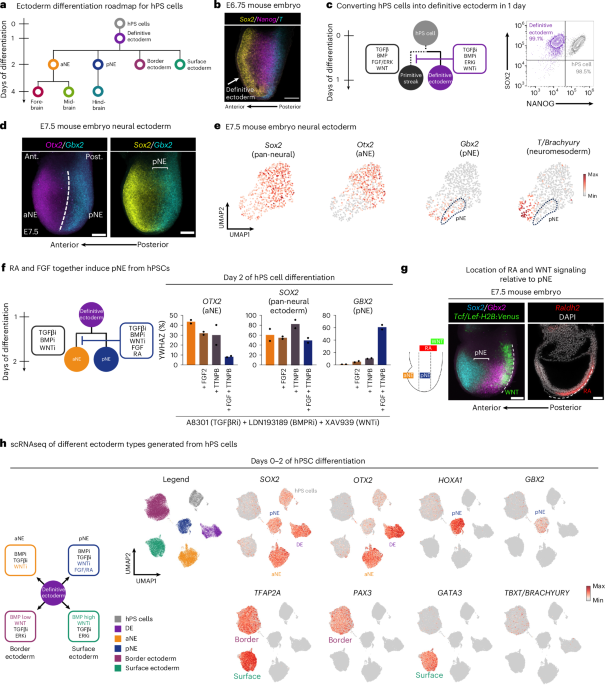
- Brain develops from two distinct neural ectoderm progenitors (anterior and posterior) that emerge simultaneously during gastrulation, not from a single common ancestor.
- Each progenitor is lineage-committed: anterior generates forebrain/midbrain, posterior generates hindbrain, with diverging chromatin landscapes confirming their different fates.
- Study achieved successful in vitro generation of hindbrain-specific motor neurons, previously difficult to produce in laboratory conditions.
- Dual-progenitor model may be evolutionarily conserved across 550 million years, suggesting this mechanism is fundamental to brain development across animal species.
Study authors (affiliated with Loh Laboratory) Researchers
How it unfolded 1 development · click the chart to see its coverage articlesposts
-
1
Authors propose evolutionary conservation of dual-progenitor model
Researchers postulate that the brain is a composite organ from two lineage-restricted progenitors, suggesting this mechanism may be evolutionarily conserved across 550 million years from hemichordates to mammals.
“These dual progenitors may be evolutionarily conserved across 550 million years from hemichordates to mammals.”
— Study authors -
background
Researchers generate motor neurons from hindbrain progenitor — The study achieved in vitro differentiation of human pluripotent stem cells into hindbrain rhombomere 5/6-specific motor neurons, a cell type previously difficult to generate in laboratory conditions.
-
background
Study demonstrates lineage commitment in human stem cells — Differentiation of human pluripotent stem cells into anterior or posterior neural ectoderm-like cells confirmed they were lineage committed to forebrain/midbrain or hindbrain fates respectively, with diverging chromatin landscapes.
-
background
Nature publishes study on dual neural ectoderm progenitors — Researchers publish lineage tracing studies showing the brain arises from two parallel neural ectoderm progenitors rather than a single common progenitor. The anterior neural ectoderm generates the forebrain and midbrain, while the posterior neural ectoderm generates the hindbrain.
Also covered reported alongside — the timeline has no entry for these yet
-
first by Nature, 5d ago
1 more headline