BepiColombo measures solar particle impact on Mercury's surface
ESA/JAXA spacecraft's close September 2024 flyby caught a solar eruption hitting Mercury, offering insights into space weather threats to Earth.
What to know
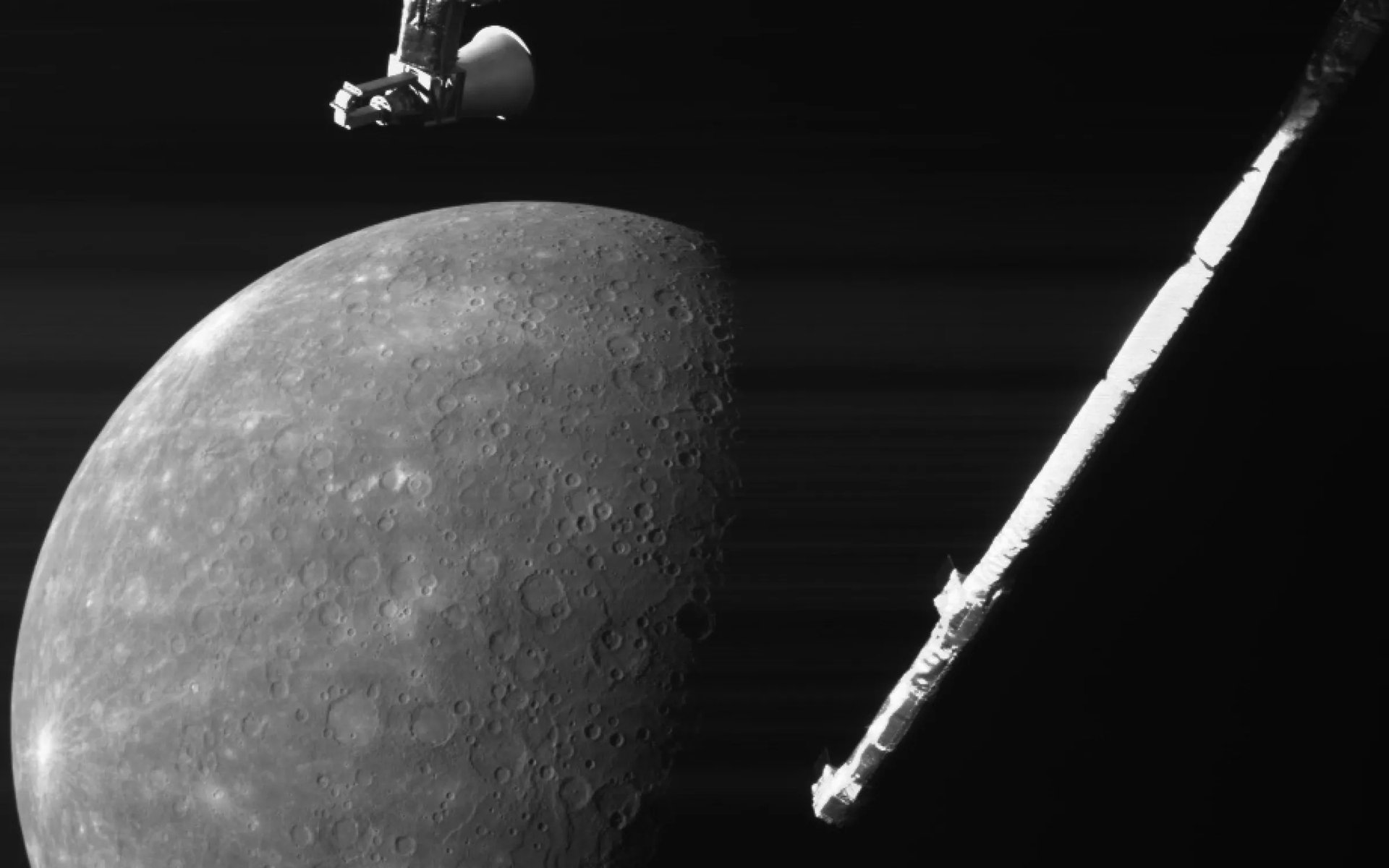
- BepiColombo's September 2024 Mercury flyby at 165 km altitude coincided with a major solar particle eruption, providing rare data on how charged particles penetrate weak magnetospheres.
- The SIXS instrument measurements show solar particles reaching Mercury's surface over wide areas and generating X-rays, offering insights into space weather impacts.
- Mercury's weaker magnetosphere compared to Earth's provides a natural laboratory for understanding how extreme solar storms could affect Earth's satellites, power grids, and infrastructure.
- The Center of Excellence in Space Resilience will use these findings to improve predictions for protecting operations in Low Earth Orbit during severe space weather events.
Mercury's magnetosphere and solar impacts are scientifically fascinating and relevant to Earth's safety.
-
“TIL: Mercury has a magnetosphere. 🤯”
fname@kamloops.social · Mastodon ↗
Emilia K. J. Kilpua Lead researcher, Principal Investigator for SIXS instrumentRami Vainio Co-Principal Investigator of SIXS, space physics professorUniversity of Helsinki Lead research institutionESA/JAXA BepiColombo mission Space exploration mission
How it unfolded 1 development · click the chart to see its coverage articlesposts
-
1
University of Helsinki team publishes Nature Astronomy study on Mercury solar impacts
Researchers led by Emilia Kilpua present findings showing how particles interact with Mercury's surface to generate X-rays, and how these observations help assess space weather risks to Earth's magnetosphere and infrastructure.
“Mercury's magnetic field is weaker than Earth's, and its magnetosphere is much smaller than Earth's. SIXS's observations help us assess how destructive particle radiation would penetrate Earth's near-space environment and atmosphere during the most powerful space storms.”
— Rami Vainio -
The BepiColombo spacecraft has made the first close-range measurements of the charged particle bombardment Mercury experiences from the Sun, data that will help scientists assess space storm impacts o # science # mercury # astronomy https://www. universetoday.com/articles/bep…
2 more of the top 3 · 3 posts in this stretch
-
 F
F
TIL: Mercury has a magnetosphere. 🤯 Mercury's magnetic field is weaker than Earth's, and its magnetosphere is much smaller than Earth's. SIXS's observations help us assess how destructive particle radiation would penetrate Earth's near-space environment and atmosphere during the most powerful space storms. BepiColombo Makes Up-Close Measurement…
-
 U
U
https://www. europesays.com/us/1072046/ BepiColombo Makes Up-Close Measurement of Mercury’s Solar Bombardment # Science # Space # UnitedStates # UnitedStates # US
-
-
background
BepiColombo fourth Mercury flyby captures solar particle eruption — During its closest approach to Mercury at 165 km altitude, the SIXS instrument detected a large solar eruption with high-energy charged particles penetrating Mercury's magnetic field and impacting the surface over a wide area.