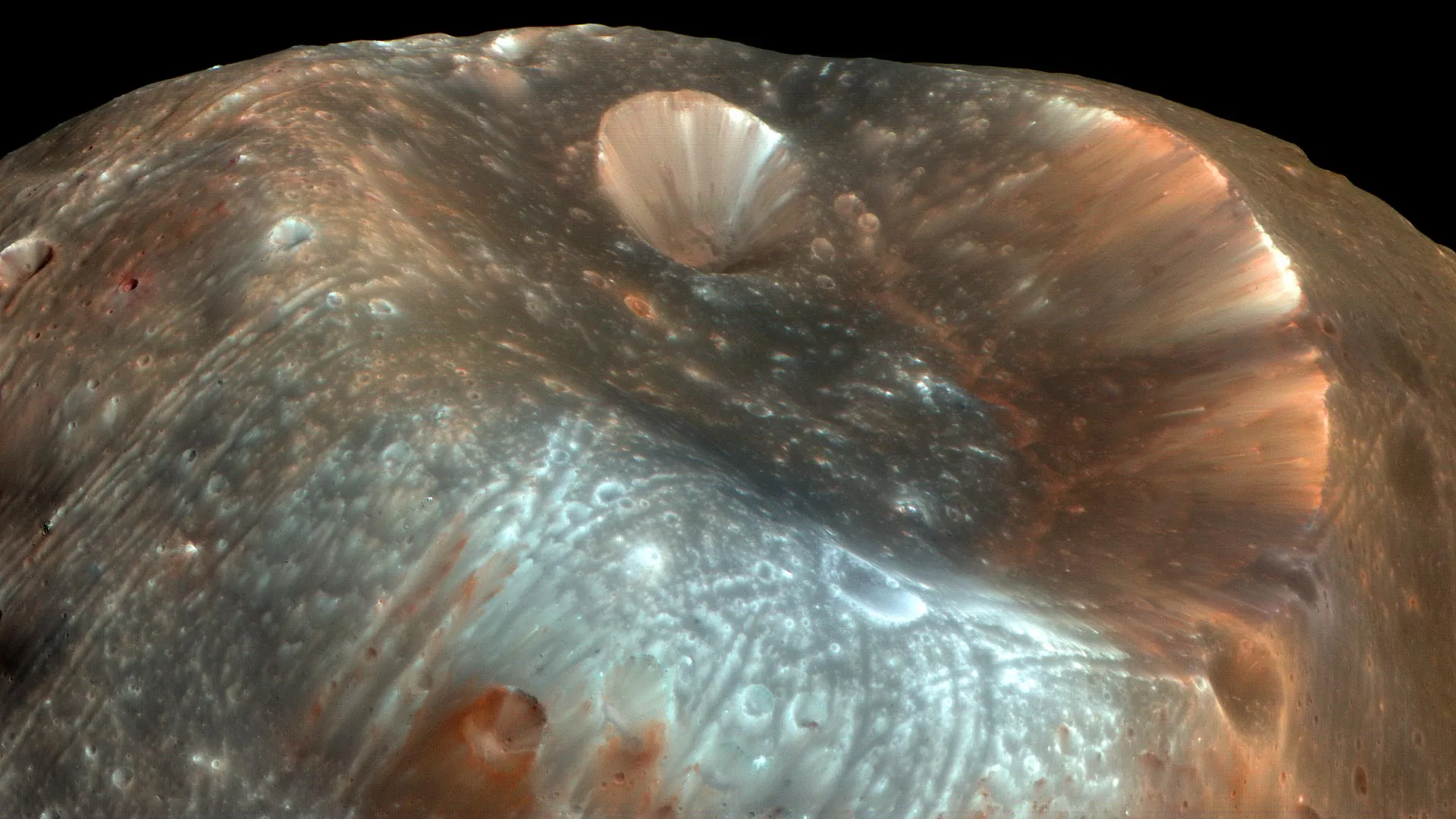
Stickney Crater on Phobos may reveal if Mars' moon is captured asteroid or impact debris
Researchers studying gravity around the massive crater hope Japan's MMX mission can determine Phobos' origin.
What to know
- Scientists are studying Stickney Crater on Mars' moon Phobos to determine if the moon is a captured asteroid or formed from impact debris—two competing origin theories.
- Detailed gravity mapping of the crater could reveal internal density distribution, particularly whether the impact created a dense region of compressed material beneath it.
- Phobos' small size and the crater's enormous scale raise questions about how the moon survived the impact unless it has unusually low, uniform density.
- Japan's upcoming MMX sample return mission is expected to provide the precise measurements and physical evidence needed to resolve the decades-old mystery.
“A massive crater on Mars' moon Phobos may hide a dense region of compressed material that could reveal whether the moon is a captured asteroid or debris from an ancient impact on Mars.”
ScienceDaily, Science publication · ScienceDaily · Sep 18
Benjamin Haser Doctoral student in planetary scienceThomas Andert Co-author of MNRAS paperJapan's MMX mission Upcoming sample return mission
How it unfolded 2 developments, newest first · click a bar or a number to jump articlesposts
-
2
Japan's MMX mission positioned to provide definitive evidence
The upcoming MMX sample return mission from Japan could provide the detailed gravity measurements and physical samples needed to determine whether Phobos is a captured asteroid or formed from debris thrown into orbit by an ancient Mars impact.
-
1
Stickney Crater offers clue to competing origin theories
The 9 km diameter crater holds different implications depending on Phobos' history: if the moon formed from Mars impact debris, the collision occurred ~4.2 billion years ago; if Phobos was captured as an asteroid, the impact happened ~2.6 billion years ago. Mapping gravity around the crater could reveal whether it created a dense region of compressed material beneath it.
“You would assume that such an impact would have shattered Phobos, unless it has a very low homogeneous density, like a sponge that can absorb that kind of impact.”
— Benjamin Haser, Doctoral student in planetary science · source -
first by ScienceDaily, 4d ago
-
-
background
Researchers present gravity models of Stickney Crater at EGU assembly — At the European Geosciences Union general assembly in Vienna, scientists including Benjamin Haser presented work modeling geophysical measurements around Phobos' largest crater, Stickney, to determine whether it reveals the moon's origin.