AI firms push self-regulation while enforcement of existing laws stalls
Amid panic over AI dangers, major companies advocate new safety standards, but critics say existing laws go unenforced against the powerful.
What to know
- AI firms are calling for new safety regulation (FDA-style oversight) amid a surge in AI safety panic, but they may be pursuing regulatory capture to lock in market dominance.
- Existing federal and state laws already prohibit many harmful practices by AI companies, but enforcement collapsed under Biden and was rolled back under Trump.
- Critics argue new regulation will fail to protect the public without addressing systemic enforcement failure against powerful firms.
- Debate centers on whether proposed AI regulation genuinely protects public safety or primarily benefits leading companies by raising barriers only they can afford.
The dispute Whether proposed AI regulation protects the public or primarily serves incumbent firms, and whether new rules would be sensible even if they do benefit large companies. · positions read across 38 posts and comments
AI firms are pursuing regulatory capture to lock in dominance through rules only they can afford.
-
“What AI firms are trying to do is regulatory capture. They try to make the right friends in government and pull the right levers to lock in their leading position in the market.”
BenjaminRi · Lobsters ↗
Enforcement of existing laws has failed; new regulation won't help without addressing systemic non-enforcement against the powerful.
-
“we already have a set of regulators at a Federal and state level with a mandate to look at industrial practices…But those laws are mostly not being enforced sufficiently to make a meaningful difference”
The Big Newsletter · The Big Newsletter ↗
Skeptics should specify which proposed rules harm the public; much AI regulation may be sensible regardless of capture.
-
“Regulatory capture is meant to describe a mechanism that leads to bad regulation. What I am asking for is for someone to tell me what rules they are pushing that are good for them and bad for the people.”
wmurra · Lobsters ↗
Lina Khan FTC enforcerAlex Bores Former Congressional candidate Bernie Sanders U.S. SenatorAnthropic, OpenAI, Google AI firms
How it unfolded 2 developments, newest first · click a bar or a number to jump postscomments
-
2
Debate over whether regulation should protect public or companies
Commenters dispute whether proposed AI regulation serves public protection or corporate interest, with some arguing that if AI companies themselves acknowledge existential risk, operations should halt immediately rather than be regulated.
“If we take the AI companies fears at face value, they should be shut down immediately. Having thousands of well paid intelligent people working on a technology they themselves say have a 10% chance of ending the human race is insane.”
— gerikson -
The point of regulatory capture is that the entities being regulated dictate that regulation, unlike regulation imposed on them from the public or representatives of the public. This means that the regulation is less about protecting the public and more about protecting the companies. If we take the AI companies fears at face value, they should be…
2 more of the top 3 · 36 posts in this stretch
-
The proposed theory is that the big AI startups demand and get regulation that enforces constraints on them, but crucially, constraints that only they can afford to pay for. This is presented as a reasonable deal which enables them crucially to declare that only companies with these constraints may bid for government contracts. Or that products…
-
Because, so far, no jurisdiction has determined that a model trained on copyleft code is itself a derivative work of that code. I think that's a shame, personally.
-
-
1
Commenters identify regulatory capture strategy
Lobsters commenters argue that AI firms are pursuing regulatory capture—seeking to embed themselves in government to lock in market dominance through regulation that only they can afford to comply with, despite lacking competitive moats.
“What AI firms are trying to do is regulatory capture. They try to make the right friends in government and pull the right levers to lock in their leading position in the market.”
— BenjaminRi -
What AI firms are trying to do is [regulatory capture](https://en.wikipedia.org/wiki/Regulatory_capture). They try to make the right friends in government and pull the right levers to lock in their leading position in the market. The reason they do this is because they [have no moat and no secret…
1 more of the top 2 · 2 posts in this stretch
-
This feels like it is right on the line for off topic here, but since we’re seeing calls for new regulation of AI firms from the firms themselves, I think it is worth pointing out that that is absurd. We have laws for these firms. They are not being enforced.
-
-
background
Commentary: existing laws adequate but unenforced — An analysis argues that current federal and state regulators already have mandates to address industrial practices, private lawsuits remain available, and numerous laws prohibit harmful activities by AI firms—but enforcement has failed because America does not enforce law against the powerful, making new regulation unlikely to succeed.
-
background
Trump administration rolls back AI enforcement — Following Trump's 2024 election victory, his administration canceled and rolled back attempts to enforce laws against powerful tech companies.
-
background
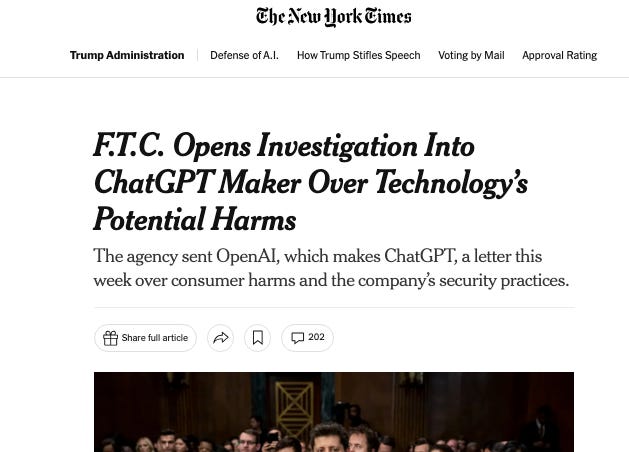
FTC initiates AI safety investigations — The Federal Trade Commission enacted a flurry of studies and investigations examining AI deployment, building on prior work investigating big tech.
-
background
OpenAI launches ChatGPT — OpenAI deployed ChatGPT, triggering FTC studies and investigations into the deployment of AI systems.
-
background
FTC blocks Nvidia-Arm merger — The Federal Trade Commission blocked the merger between AI chipmaker Nvidia and Arm, enabling both companies to grow independently. This action is characterized as the FTC's most important and successful intervention on AI.
What people are saying 19 voices from 1 site · best of 38 · verbatim
- Which specific AI safety regulations are the firms pushing, and do they actually protect the public or lock in their market position?
- Why would new regulation succeed where existing law enforcement has failed under both Biden and Trump administrations?
- Should open-weight models be regulated or banned, and how does that fit into regulatory capture theory?
- Sep 22
-
Due to managing to sometimes violate even CC-BY via recitals, it is unclear how much license-unencumbered is just a lie that manages to persist so far. Locally available amounts of compute is generally not fast enough for reverse engineering a printer driver in the afternoon. There is typically more garbage in the driver than can be sorted through…
- Sep 21
-
Because the end-user cannot modify the tool. Including for not resource-based reasons (fine-tuning is sometimes doable for end-users if they do have access)
- Sep 20
-
There's lots of descriptions of what they are, I'm not suggesting any of them are wrong, I'm suggesting we choose one that doesn't sound cool, because their behavior is decidedly uncool.
-
The degree of individualism that comes with today's somebow makes it worse. The feudal idea that some kind of magic sauce makes some lineages just better(TM) than others at least comes with a bit of responsibility to the everyman. The American ones all think "I did this _all by myself_, I don't owe anyone anything" which is objectively incorrect…
-
My current favorite is just "greedy bastards." It's not technically profanity, and it kind of jogs people enough that they stop asking themselves "why would these people do this??"
-
Also, regardless of whether it's politically untenable: at least some of the players in this space (e.g. Meta) have simply chosen to disregard existing laws in order to train their models (e.g. movie piracy). This is probably the most troubling aspect of it all: the blatant disregard for the law displayed by the major players, and the lack of…
-
Food for thought: the idea that the privileged electorate know best how to run a society is not new. Rather, there is a direct line in both etymology and semantics from [meritocracy](https://en.wikipedia.org/wiki/Meritocracy), where the people with the best [talents](https://en.wiktionary.org/wiki/talentum) determine how society shall operate…
-
I'm with you on the issue, and I use "oligarchs" for them. I found it easy to transition to that usage.
-
Not directly related but i'm kinda tired of calling these sociocarcinomas "elites" and "billionaires" and other cool sounding titles. They're not something we should deify, they're just dudes who are extremely greedy and a bit lucky.
-
Even if (and that's a huge if!) the models are ruled to be derivative works of their training data, this won't happen. Their training data isn't just copyleft code but everything else too. Code under GPL-incompatible FOSS licenses. Code with no license. Code under all kinds of proprietary licenses. Patent-encumbered code. Code that is a national…
-
They've been trained on things with incompatible licenses so the only two ways out are "any output of an LLM is not redistributable legally" or "license of source material doesn't apply to LLM output". It's pretty clear which way are the governments going.
-
Whether things being generated by the model are derivative works is different question than whether the model itself is a derivative work. Also in response to the comment above, whether you use a copyleft license has no bearing on the resulting model being a derivative work, that's a general concept in copyright. If it were to be deemed that the…
-
I think it would be the best way out of this entire problem: You can use this stuff but everything you make will be copyleft. Take it or leave it.
-
> What’s the proposed mechanism of action here? I think... They're trying to regulate the market so that Chinese LLM companies cannot sell services to western corporations and (later maybe) individuals, legally... Without going through these regulations (that they'll control tightly through a consortium or whatever, all this has been done time and…
- Sep 19
-
Curious how banning open weights might be considered sensible? Especially in a country that won't even ban guns, it seems like "good guy with a gun / open weight LLM" is a clear analogy, especially with the recent cybersecurity events.
-
Agreed! We have the same model of regulatory capture. Regulatory capture is meant to describe a mechanism that leads to bad regulation. What I am asking for is for someone to tell me what rules they are pushing that are good for them and bad for the people. I am actually open to being convinced, I’m just annoyed that I keep hearing people gesture…
-
Please somebody explain to me why these things and everything they produce are not copyleft?
-
I know I wrote an overly long comment but, did you only read the first sentence? I addressed this theory. That’s what I mean by fixed costs. This is true for regulation in general. it does not require capture. I agree that regulation could protect large firms from small ones. Why exactly is that bad in this case? How does a low-AI-regulation…
-
What’s the proposed mechanism of action here? Is the theory that they would ban open weights? If so I agree. Otherwise I don’t see how regulation would be in the interest of the large firms. unless you mean that regulation imposes fixed costs on all players that the larger firms are better resourced to absorb. That might be true but it doesn’t…