NASA features year-long analemma over Scottish Callanish Stones
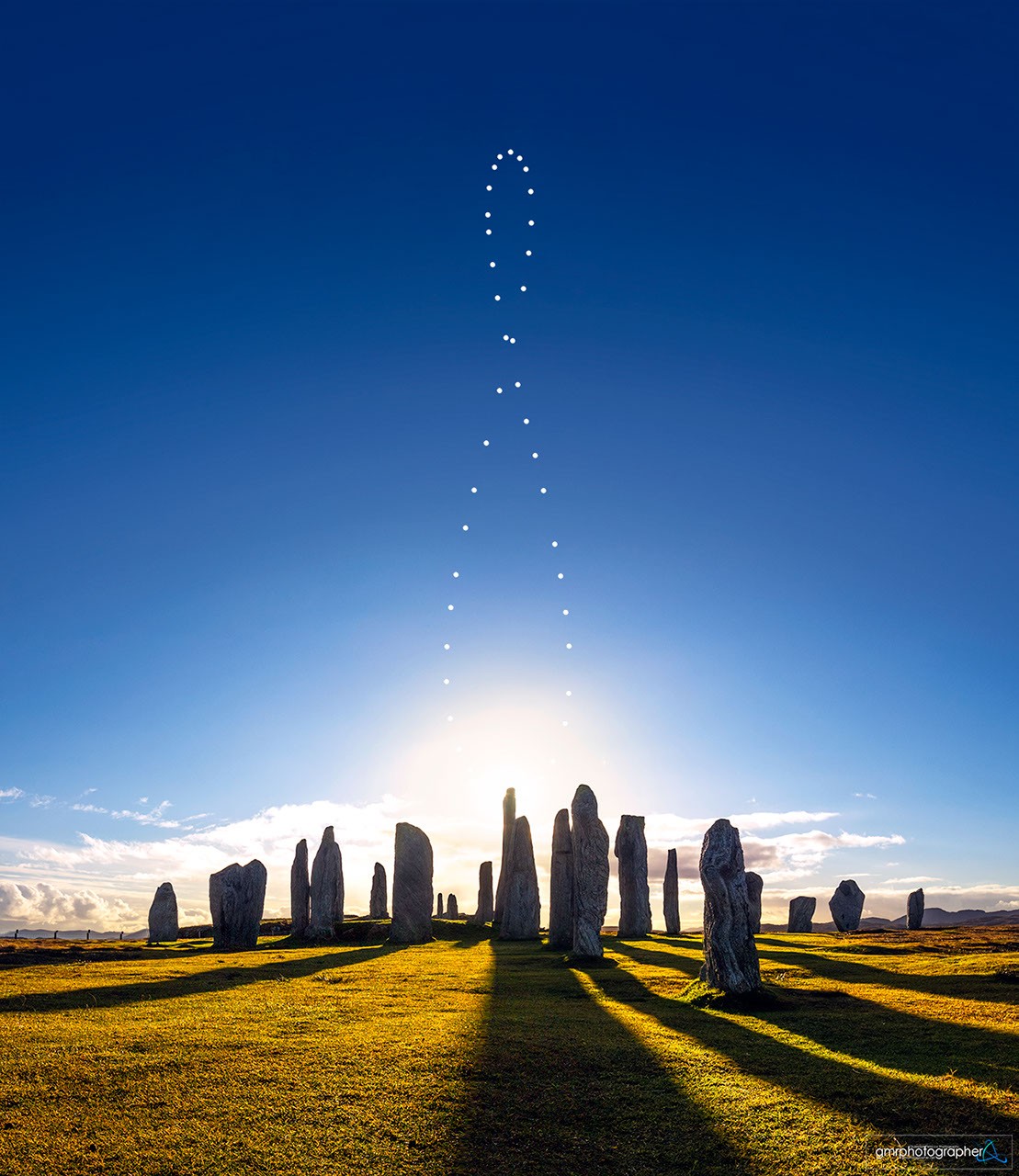
Photographer Giuseppe Petricca captures the Sun's changing position at the ancient stone circle through composite imagery.
What to know
- An analemma is a composite image capturing the Sun's position at the same time daily over an entire year, revealing Earth's orbital and rotational characteristics.
- Photographer Giuseppe Petricca documented the phenomenon over Scotland's Callanish Stones, a 4,700-year-old Bronze Age monument in the Outer Hebrides.
- The distinctive figure-8 shape results from the combination of Earth's axial tilt and elliptical orbit around the Sun.
“The ultimate causes for the figure-8 shape of this and all analemmas are the tilt of the Earth axis and the ellipticity of the Earth's orbit around the Sun.”
NASA, Publisher · Astronomy Picture of the Day ↗
Giuseppe Petricca PhotographerNASA Publisher
How it unfolded 1 development · click the chart to see its coverage articlesposts
-
background
NASA publishes year-long analemma over Callanish Stones — NASA's Astronomy Picture of the Day features a composite image of the Sun's position over Scotland's Callanish Stones, photographed at noon every few days for one year. The analemma shows the figure-8 pattern caused by Earth's axial tilt and orbital ellipticity.
-
1
Astronomy enthusiast praises Petricca's year-long dedication
A Scottish astronomy account on Bluesky highlights photographer Giuseppe Petricca's work, calling the composite image a 'beauty' and emphasizing the dedication required to photograph the Sun at noon every few days for a full year.
“NASA picture of the day today is a real 🏴beauty! The amazing Giuseppe Petricca has only gone and photographed the Sun at noon there, every few days, for a whole year. #Dedication…”
— astroroyalscot.bsky.social -
A
NASA picture of the day today is a real 🏴beauty! This is a composite image of the ~5000yo Callanish Stones on the Isle of Lewis. The amazing Giuseppe Petricca has only gone and photographed the Sun at noon there, every few days, for a whole year. #Dedication 🔭🧪👌 ℹ️: science.
1 more of the top 2 · 2 posts in this stretch
-
I don't understand how it can be noon, but the shadows are so long as if it's dawn/dusk? Why is there a big glowing sun behind the stones, but little dots in the sky (presumably each one the actual sun on different days)?
-
Also covered reported alongside — the timeline has no entry for these yet
-
first by NASA breaking, 4d ago · also NASA
What people are saying 22 voices from 1 site · best of 49 · verbatim
- Sep 20
-
The Callanish Stones are a magical place.
-
The Earth's orbit is mildly eccentric and combined with the tilting of the axis it causes a gap between the earliest sunrise and the latest sunset by several weeks.
-
The whole fam likes it too!!🐿🐿🐿😇😇😇
-
Yes. Planned. The pattern is called an analemma.
-
Whooooahh. Ive been to the Hebrides, and it’s pretty spacey up that way, but this, this gets it.
-
Beautiful photo. Maths diversion, I believe the "8" is a form of a conic section curve formed by the intersection of the double cones and the surface of a sphere. Where the tips of the cone come together is the crossing point of the 8 and the 2 cones and the sphere intersect at that point.
-
I can’t believe the sun was visible every day of the year! Lewis is grey!
-
I've seen a lot of analemma pictures, but this has to be in the top 5, if not the best. Absolutely amazing!!
-
this is stunning...a whole year of dedication for one image is wild...have you ever been to the stones yourself or just admire from afar?
-
1) Callanish is about 58 degrees north, so in mid-winter the sun is only about 90–58–23.5 = 8.5 degrees above the horizon at noon. Lo-o-ng shadows. 2) That's the sun. Folk have posted links to articles about the solar analemma, which explains what's going on.
-
“But how did prehistoric Scots etc manage to predict then build such highly accurate Henges? Simple. Just because they weren’t historically modern humans didn’t mean they weren’t modern humans..& didn’t have scientists,astronomers etc.It meant they didn’t have modern materials science, that’s all.
-
Beautiful picture. Am I the only one who is thinking “let’s go bowling”?
-
Nice proof that the Earth is football shaped and rotates on its axis, which is not perpendicular to the plane of its orbit around the Sun!
-
M
I don't wholly understand the science but I'm satisfied with the magic. 🙂
-
R
Illustrates how far north this is, as the highest point of the sun on the longest day of the year, still is not all that high.
-
We don't get a lot of sunshine in Scotland in the winter, the sun barely gets above the horizon for a lot of the time.
-
If we're ever in the same room Martin, we'll get an orange out, ram a pencil through it (Earth on it's axis), and then dance it around and around a candle (Sun) in an oval. Dinner parties with me are always so much fun 🤦♀️. Anyway using physical objects is the only way I can get my head around it!
-
No-one quite sure what the Callanish Stones were for... but most are convinced it was to do with the moon, rather than the solstice (i.e like its younger sibling, Stonehenge).
-
en.wikipedia.org/wiki/Analemma I've tried my best over the years to get my head around why this happens, but I just can't grasp it.🤔🫣 Very much like Alexander's Band in a double rainbow in that reapect - I can read the explanation but it just doesn't compute in my brain 🤷
-
I think the ancient people had a better idea watching the sun, moon, and the stars than today's people watching Lax News, which is propaganda 💩.
-
It beautifully shows that glorious time when the days are long and they stay long for ages before the plummet into fast shortening nights begins.
-
Most of the exposures were very short, just recording a disk for the Sun. Only one single shot is needed with sufficient exposure to record the landscape, and produce a bright patch where the Sun is. The shadows are long because ... well, look how low the Sun is in winter at midday.