Developer argues AI-written docs are unreadable, cites survey showing 78% stop reading
Colin Breck criticizes proliferation of machine-generated design docs, pull requests, and summaries as contextless and exhausting.
What to know
- Developers are increasingly using AI to generate technical documentation and communications, but the output is widely perceived as unreadable and contextless.
- Survey research shows 78% of developers stop reading content they suspect is AI-authored, and 71% avoid those authors in the future.
- The core complaint: AI-generated text lacks human voice, vulnerability, and perspective, treating writing as machine summaries rather than human communication.
- Breck distinguishes between AI as a writing tool (which he values) and AI as a replacement for original authorship (which he rejects).
Colin Breck Software developer, essayistCynthia Dunlop Researcher Bryan Cantrill Technology commentatorSimon Sarris Essayist
How it unfolded 2 developments, newest first · click a bar or a number to jump articlesposts
-
1
Bryan Cantrill frames reader resistance as self-preservation
Cantrill's essay 'The revolt of the reader' interprets the rejection of AI text as an automatic cognitive response to perceived machine authorship.
“our brains pull an LLM-triggered ejection handle, bailing us out mid-sentence in an act of self-preservation.”
— Bryan Cantrill -
It isn't the transfer of information at all. What's actually happening is you're prompting experiences in a human instead of an AI using text.Communication only works if you have multiple levels of representation and abstraction, including but not limited to - letter shapes, grammatical structures, style and register, stylometry, and subtext.All…
2 more of the top 3 · 68 posts in this stretch
-
 I
I
"Non voglio leggere quello che non hai scritto" - L'intelligenza artificiale aiuta a scrivere meglio e più velocemente, ma non sa scrivere! Gente che non ha mai scritto testi originali, all'improvviso produce proposte di design, piani aziendali, e altra roba generata dall'intelligenza artificiale. Tutta profondamente illeggibile! Ecco la mia…
-
I'm going to be a bit contrarian here. In general, I 100% agree, just send me the prompt; however sometimes I feel an LLM can help structure thoughts. It can be a good sparring partner. If you proofread your LLM content, re-prompt until it sounds right and no longer like AI content, and feel that it actually conveys the information incredibly…
-
-
background
Survey finds 78% of developers reject AI-written content — Cynthia Dunlop's research on developer reactions to AI-assisted articles shows that if readers suspect AI authorship, 78% will stop reading and 71% will avoid the author in the future. The strongest finding: 98% prefer authors' original writing, flaws included.
-
2
Colin Breck publishes essay on AI-generated technical writing
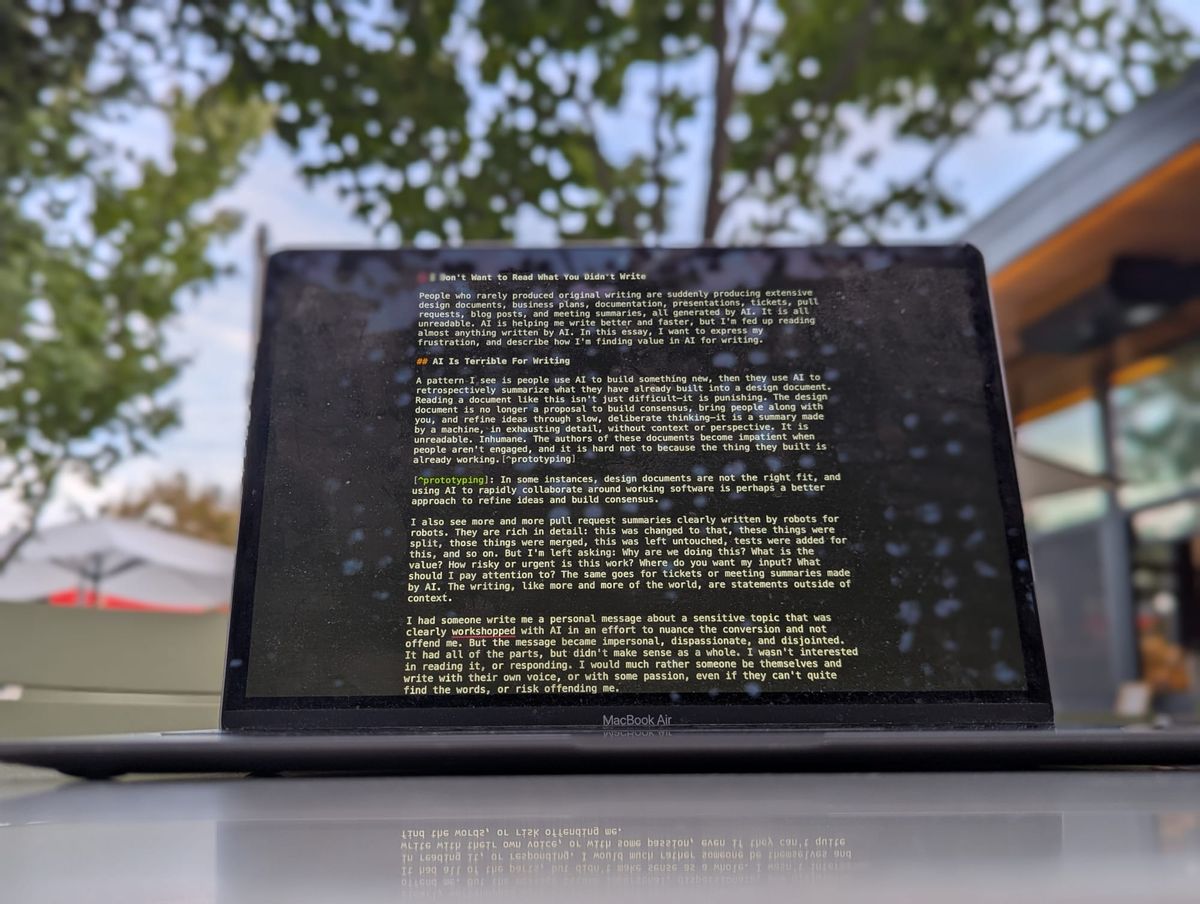
Breck argues that AI-generated design documents, pull requests, meeting summaries, and blog posts lack human voice, context, and perspective, making them punishing to read. He contrasts this with AI's value as a writing tool when used to enhance original human work.
“It is a summary made by a machine, in exhausting detail, without context or perspective. It is unreadable. Inhumane.”
— Colin Breck
Also covered reported alongside — the timeline has no entry for these yet
-
first by HN Best, 4d ago · also HN Frontpage
What people are saying 21 voices from 2 sites · best of 68 · verbatim
- Sep 23
-
While I acknowledge that this is meant to be framed in the context where the message is fully compressed, I think particularly when the medium is language (usually pretty compressable), then actually anti-aliasing the transfer of information is still 100% relevant! After all, AA is really about making better use of the information that you…
- Sep 22
-
I feel like this is more of a curation issue than an issue with using AI itself. If someone is using AI to distill information to the point where important context gets lost, then yeah, I think they are definitely doing it wrong.What I often notice in pull request descriptions isn't necessarily a problem with them being written by AI. It's the…
-
No, thanks. Depending on the type of information being transferred and just how uncertain the recipient's knowledge is, I may or may not need to add some amount of information to whatever I have to share. That information would be extra context you may need to have, on top of what new thing I am trying to explain. If I know I'm talking with…
-
Writing for yourself is crucial. Writing is in a way thinking and understanding. If you can't write for yourself, then don't write at all if you expect someone else to read it.I have a large and complicated project at $DAYJOB where I am the solo dev with a large team of domain experts. They AI dump me with suggestions (rather rarely, thank god)…
-
> If you have 1000 bits of semantic information you want to transfer, you can't give 300 bits of semantic information to an LLM and have it fill in the remaining 700, because it doesn't know what those 700 bits are.LLMs do inference or computation among other things, so the remaining 700 bits can be something like that. The hidden implication in…
-
My org, like every org, is struggling with this as well. We find ourselves writing skills like `/decomment` and often running several "minimize" passes on PR descriptions, etc.One thing that has markedly helped is tweaking our AGENTS.md prompt and prose-heavy skills like `/pr` or `/ticket` to specify that all technical output needs to be written…
-
I kind of agree with this, but I think it’s model specific and a temporary problem.Opus 5 and Fable 5.1 commit/PR messages are incomprehensible garbage.However, Astra messages are nearly perfect for a copy/paste to less-technical stakeholders. I maybe fix a line or two.Give it a year, and I suspect that I won’t even need to make those fixes.The…
-
> I also see more and more pull request summaries clearly written by machines for machines. They are rich in detail: this was changed to that, these things were split, those things were merged, this was left untouched, tests were added for this, and so on. But I’m left asking: Why are we doing this? What is the value? How risky or urgent is this…
-
> you can't give 300 bits of semantic information to an LLM and have it fill in the remaining 700, because it doesn't know what those 700 bits are. If it's able to guess those 700 bits correctly, then they aren't true semantic information, and you really only have 300 bits you want to transfer.It doesn't actually follow, because maybe the LLM is…
-
>If it's able to guess those 700 bits correctly, then they aren't true semantic information, and you really only have 300 bits you want to transfer.A math teacher only has "this class is about math" to transfer, the rest is known. ;-)Jokes aside, I think we're in a weird transition now where AI is used to generate text that looks good but is bad…
-
My take here is, I think the real issue is AI pretending to be human by mocking a human style.I'd always rather read an actual person's thoughts, clearly communicated and written down in their voice. But, there's clearly a subsection of people who don't want to (or aren't confident in / etc) writing their ideas fully.If they have a bullet point…
-
> Writing is fundamentally the transfer of information from your brain to my brain. If you have 1000 bits of semantic information you want to transfer, you can't give 300 bits of semantic information to an LLM and have it fill in the remaining 700, because it doesn't know what those 700 bits are.Sure you can. LLM doesn't know what those 700 bits…
-
A good code or commit comment should succinctly explain the subtle details or motivation not obvious from the content itself. AI comments tend to wax poetic about surface details.The same goes for articles. I want the author to distill the material using their own voice and hard earned expertise. I don't want a generic text which sort of tells the…
-
> People who rarely produced original writing are suddenly producingthese posts are beginning to make me wince. ai is giving voice to a lot of folks we probably wouldn't even be hearing from otherwise - because not everyone does their thinking in articulate prose, and extracting their realizations as shareable language takes effort, or long…
-
I agree. But there's still a valid use here for LLMs: If I have 1 Million bits of information and I want to communicate a synthesis of 500 bits to you, LLMs can be a viable helper. It is rarely done that way - I agree, but the way I use LLMs: Drop in all the relevant context information (PDFs, HTML, Markdown, Pictures etc. - up to usually 200-300k…
- Sep 21
-
 M
M
https:// blog.colinbreck.com/i-dont-wan t-to-read-what-you-didnt-write/
-
It's worse than that. If it takes others longer for others to consume and understand what you're producing than it does for you to produce it, you'll never be able to communicate with someone efficiently. Communication breaks down at a fundamental level if if you can't keep up with the other side if outputting and they won't slow to allow you do…
-
There's a lot of misunderstanding here. The quality of LLM writing has not plateaued, it has dropped significantly. They've cut it to the point where people start noticing.Do a search on "Claude Sonnet 4.5" on Reddit and you'll see lots of disappointed users [1]If I could give out ratings,Average human with a degree: 5/10Sonnet/Opus 5: 2/10GPT 6…
-
If you have 1000 bits of semantic information that you want to transfer but your default communication combines it with 10,000 bits of noise. Giving it all to an LLM and iterate on reducing that noise while making sure the 1000 bits is still present would enable you to communicate more effectively.Overall, ideas are ideas. I'm not overly concerned…
-
For a long time after the internet arrived on the scene, a lot of online news stories would reference websites, papers, polls, etc. without linking to them. There are still news sources doing this today. Sometimes such articles interpret or place context around their hidden references, but a lot of the time they just summarize.Giving someone the…
-
These last few days, there has been a small stream of blogposts on HN expressing similar things, and I have enjoyed them all.My question recently has been how to broach this subject with colleagues who really enjoy producing prose with AI. There is not yet a better cultural shorthand for this sort of thing than "slop" which is a harsh-sounding…