California AGs approve Paramount-Warner Bros merger with Trump-aligned Ellisons
California and 11 states allow $110 billion deal after signing consent decree with commitments critics say are largely unenforceable.
What to know
- California and 11 state AGs cleared the $110 billion Paramount-Warner merger controlled by the Trump-aligned Ellison family after negotiating a consent decree with commitments on film production, investment, and news editorial oversight.
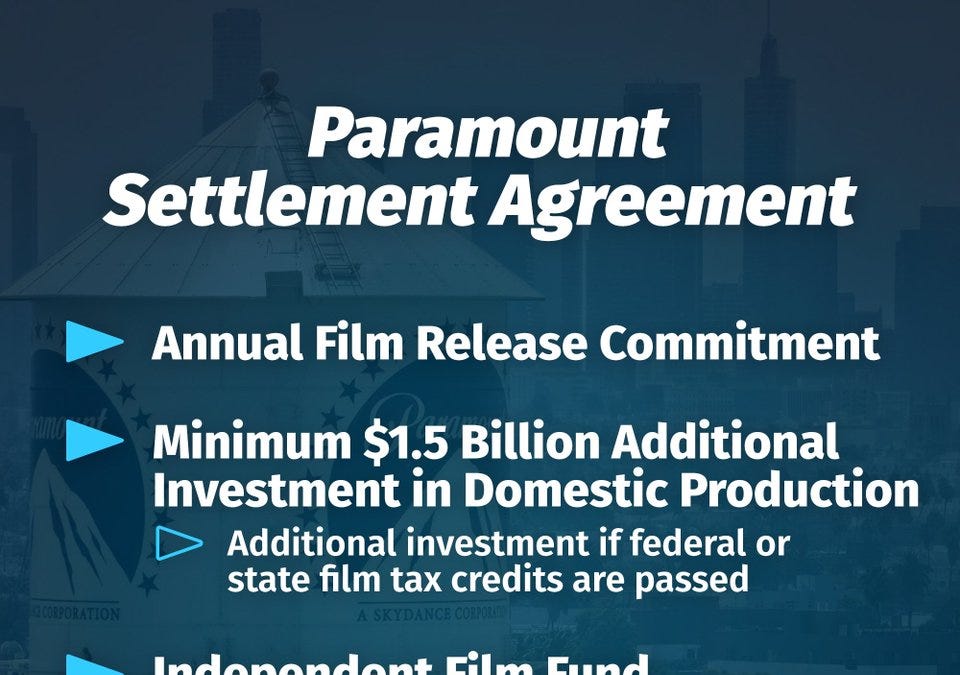
- Critics argue the settlement's terms are unenforceable and filled with loopholes: film production commitments can be halved if co-produced; the editorial board overseeing CNN and CBS is appointed entirely by Ellison; and a Force Majeure clause allows cancellation during recessions or labor disruptions.
- The fundamental weakness is that all commitments depend on California's Attorney General voluntarily enforcing them—the same office that lacked the will to block the deal despite having maximum leverage.
The settlement is essentially meaningless—loopholes render commitments toothless and unenforceable.
-
“it's basically impossible to enforce, since it essentially requires state attorneys general to bring the case they are unwilling to bring now, when they have maximum leverage.”
Matt Stoller · BIG Newsletter ↗
“the consent decree… it's basically impossible to enforce, since it essentially requires state attorneys general to bring the case they are unwilling to bring now, when they have maximum leverage.”
Matt Stoller, Media critic · BIG Newsletter ↗
David Ellison CEO, Paramount-Warner (post-merger) Rob Bonta California Attorney GeneralWilliam Tong Connecticut Attorney General
 Matt Stoller Media critic and legal analyst
How it unfolded 2 developments, newest first · click a bar or a number to jump articlesposts
-
2
Critics emphasize enforcement gap in settlement
Analysis highlights that every commitment in the settlement depends on California's Attorney General's office choosing to enforce it—a concern given their reluctance to block the deal even with maximum leverage. The enforceability issue undermines the practical value of all promised obligations.
“every one of the "commitments" in the settlement only matter if Bonta's office *enforces* them.”
— Cory Doctorow (citing Matt Stoller) -
 M
M
The Dem capitulation that allows the Warner / Paramount merger to proceed is worse than you thought. "… it’s downright comical they demanded that David Ellison not corrupt CNN by having David Ellison appoint a board ensuring that David Ellison not do that…" Happy Oligarch Day as Trump-Aligned Billionaires Take Over Hollywood https://www…
1 more of the top 2 · 2 posts in this stretch
-
 P
P
For a breakdown of how *fucking useless* this settlement is, read (who else?) Matt Stoller, whose piece breaking it down is titled "Happy Oligarch Day!" https://www. thebignewsletter.com/p/happy-o ligarch-day-as-trump-aligned The first thing Stoller points out is that every one of the "commitments" in the settlement only matter if Bonta's office…
-
-
1
Force Majeure clause threatens to void most commitments
The consent decree includes a Force Majeure provision that voids commitments if events beyond the company's control occur, unusually defined to include economic recessions, strikes, and labor disruptions. Critics note this provides an easy exit from obligations if an economic downturn materializes.
“when you look at the fine print, they only have to distribute that many films, they can make half as many.”
— Matt Stoller (citing former FTC Commissioner Alvaro Bedoya), Media critic · source -
background
Editorial board for CNN, CBS criticized as toothless — The settlement establishes an editorial board to oversee CNN and CBS, which Connecticut Attorney General William Tong and Bonta promoted. However, all board members are appointed by Paramount-Warner's board, which is controlled by David Ellison, undermining the independence the commitment purports to guarantee.
-
background
Settlement terms analyzed as largely unenforceable — The consent decree requires Paramount-Warner to produce and distribute 30 films annually for two years, then 32 thereafter, but fine print permits them to produce half as many if co-produced. Critics including former FTC Commissioner Alvaro Bedoya note this results in fewer films than Paramount and Warner currently produce. A $300 million domestic filmmaking investment commitment ratchets upward only if tax credits are offered.
-
background
California and 11 state AGs clear Paramount-Warner merger — California Attorney General Rob Bonta and eleven other state law enforcement chiefs approved the $110 billion merger between Paramount and Warner Bros Discovery, conditional on commitments outlined in a consent decree. The approval came after about a year of legal dispute over the deal's media and industry consolidation.