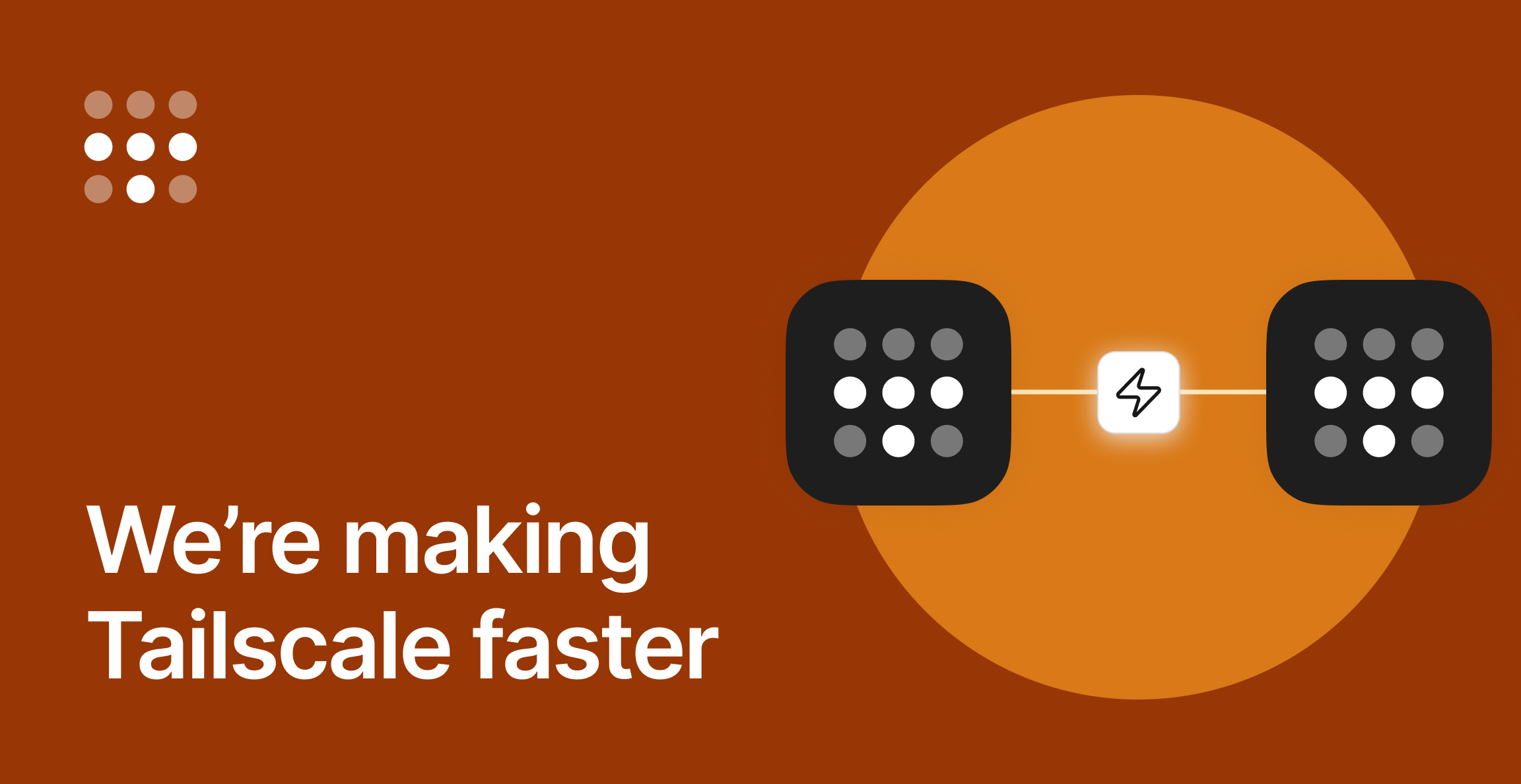
Tailscale ships performance upgrades for Linux, Android, and exit nodes
The VPN company details packet-handling optimizations and previews multi-queue technology arriving in late 2026.
What to know
- Tailscale optimized packet handling on Linux and Android to avoid redundant copying, achieving a 5% speed-up by keeping small packets in place rather than moving them to separate buffers.
- The company shortened packet queue depths after finding most buffer space went unused, reducing both latency and memory overhead.
- Multi-queue technology for app connectors, subnet routers, and exit nodes is coming in the second half of 2026, with memory savings from earlier optimizations allocated to these high-traffic nodes.
Tailscale VPN and networking platform company
How it unfolded 3 developments, newest first · click a bar or a number to jump articlesposts
-
3
Tailscale reduces packet queue depths to lower memory and latency
Tailscale shortened packet queues after testing showed most queue depth went unused, reducing waiting time and memory overhead while freeing space for harder-working nodes.
“On Linux and Android, Tailscale now leaves those packets where they landed. It identifies where each one starts and ends inside the single large read instead of copying it somewhere new.”
— Tailscale · source -
(Tailscale cofounder) I see a few comments here that using kernel wireguard would make it faster; it’s not really that simple. In fact, for a while (and we wrote a blog post about it), our optimizations made wireguard-go faster than kernel wireguard because it was better optimized. They adopted some of those improvements and now we’re on to the…
2 more of the top 3 · 12 posts in this stretch
-
 H
H
Making Tailscale Faster L: https:// tailscale.com/blog/making-tail scale-faster C: https:// news.ycombinator.com/item?id=4 9819880 posted on 2026.09.23 at 13:49:07 (c=0, p=3)
-
In my opinion, this is Tailscale's largest issue.It is slow. It cannot achieve speeds of greater than 1Gbps on clients systems (Windows & Mac), where you'd normally see it being used. On Linux, it struggles to achieve 10Gbps even when using a synthetic large packet benchmark [1]. With an IMIX benchmark, it would not be competitive whatsoever.This…
-
-
2
Tailscale describes packet-handling optimizations achieving 5% speed-up
Tailscale detailed how on Linux and Android, it now avoids copying small packets into separate 64 KiB buffers, instead identifying packet boundaries within a single large read. The approach keeps small packets small in memory and reduces copying overhead, yielding a roughly 5% speed-up in many network configurations.
-
1
Tailscale publishes performance optimization details
Tailscale detailed how it is boosting throughput for app connectors, subnet routers, and exit nodes through multi-queue technology arriving in the second half of 2026, and previewed improvements to throughput and memory overhead rolling out in upcoming stable client releases.
“Today we'll detail how we're boosting throughput for app connectors, subnet routers, and exit nodes, with some multi-queue technology (landing in the second half of 2026).”
— Tailscale -
We think Tailscale is fast. Unfortunately, we’re also the kind of people who look at “fast” and ask, “but could it be faster?” Yes. Yes it could. Here’s what we’ve been changing under the hood 👉 https:// tailscale.com/blog/making-tail scale-faster/?utm_source=Mastodon&utm_medium=owned-social&utm_campaign=blog
-
What people are saying 9 voices from 2 sites · best of 13 · verbatim
- Today
-
Hey why do you hard code certain android apps to be excluded from Tailscale with split tunneling without giving users any way to disable split tunneling for these apps? It doesn't matter how you think VPN does or does not affect these apps, it's really awful anti-user behavior.
-
Re: Tailscale and speeds, I wish Tailscale had a better story about relay / DERP flexibility.Assume we have devices a, b and c, which are basically in different segments of the same network and have nice pings to each other. We're trying to ssh from a to c, but NAT traversal isn't possible. Both a and c can do NAT traversal to b.Instead of a going…
- Yesterday
-
 H
H
Making Tailscale Faster Link: https:// tailscale.com/blog/making-tail scale-faster Discussion: https:// news.ycombinator.com/item?id=4 9819880
-
Any chance the Apple TV can get a performance boost? Specially as an exit node. It always gives very little bandwidth. Thank you!
-
> But, wireguard also needs to update to support post-quantumIt's quantum-resistant if you define a PSK. You still have to distribute the key out of band, but you already have to do that anyways for the public keys of the peers.
-
Wireguard with PQ won't be Wireguard, anymore. It'll just be a rehash of IKE+IPsec. What made Wireguard better was the very simple handshake and minimal state, but no PQ algorithms can support that simplicity because the keys are too large and/or not as simple to use as ECC.Might as well switch to IPsec. Everything is already in place, including…
-
I used to LOVE tailscale. Then I put wireguard on my home network exposed to the internet with a dynamic DNS provider and it immediately became irrelevant. Not only is raw wireguard more stable (I don't have to fight the DNS issues on my mobile phones) it feels faster and is amazingly simple to set up.
-
In our use case latency went parabolic at 250 sessions pumping just 60 mb/s through a tunnel.
-
I wonder if the post's focus on Linux/Android is just because that's where they started, or because they're leveraging techniques that are only possible on Linux/Android?