Bruker ships GAIA, first super-cold electron microscope for quantum materials research
The cryogenic scanning electron microscope can image materials at 7 kelvin for 30+ hours, opening new avenues for materials science.
What to know
- Bruker will ship GAIA, the first scanning transmission electron microscope that stably operates near absolute zero (7 kelvin), to three labs by early 2027.
- The instrument maintains stable atomic-resolution imaging for 30+ hours using liquid helium cooling, solving a decades-long technical challenge in cryogenic electron microscopy.
- GAIA enables researchers to observe quantum behaviors and properties in materials that only emerge at ultra-cold temperatures, opening new avenues for materials science research.
“a process that he says requires 'a huge amount of optimization', and 'fighting the system all along the way'.”
Noah Schnitzer, Electron microscopist, Imperial College London · Nature News ↗
Bruker Instrument manufacturerTracy Lovejoy Vice-president and general manager, Bruker divisionShelly Conroy Electron microscopist, Imperial College LondonNoah Schnitzer Electron microscopist, Imperial College London
How it unfolded 1 development · click the chart to see its coverage articlesposts
-
background
Electron microscopists express enthusiasm for GAIA's capabilities — Researchers working with ultra-cold imaging systems praised GAIA's stability as a major breakthrough. Shelly Conroy at Imperial College London, who has secured time on the GAIA microscope going to Jülich, and Noah Schnitzer, who demonstrated the device at a microscopy conference in Salt Lake City, highlighted that stability and reliability have been the central challenge in cryo-electron microscopy.
-
1
Bruker announces GAIA will ship to three labs by early 2027
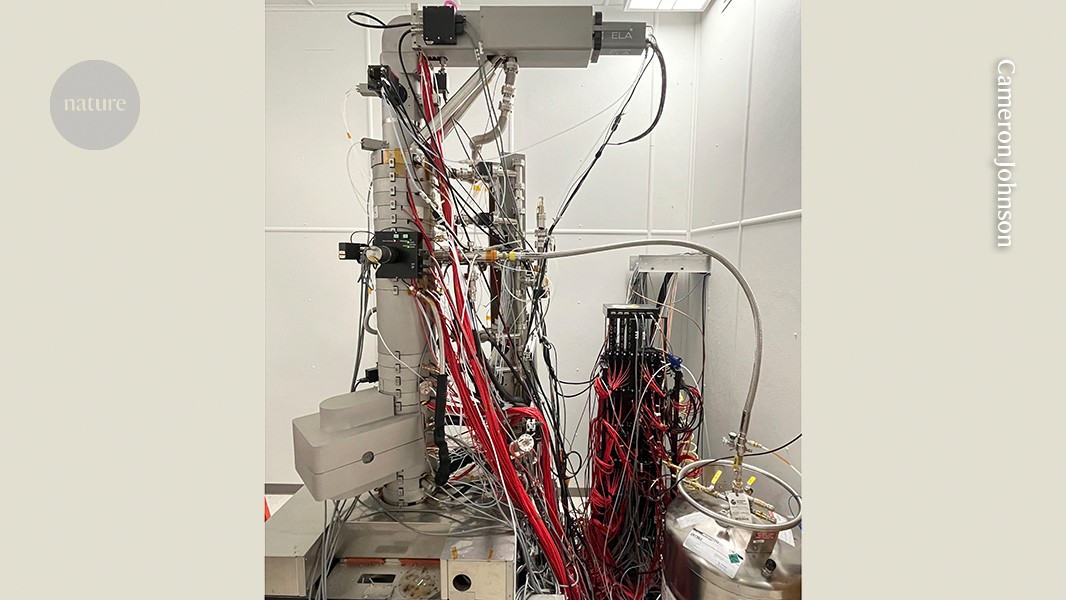
Bruker, based in Billerica, Massachusetts, announced that by early 2027 it will ship GAIA (Generational Advance in Instrumentation for Analysis), the first scanning transmission electron microscope (STEM) that stably operates near absolute zero. The device can image materials at temperatures as low as −266 °C (7 kelvin) for 30 hours or more using liquid helium cooling. The three initial instruments will go to Oak Ridge National Laboratory in Tennessee, the Ernst Ruska-Centre for Microscopy and Spectroscopy with Electrons in Jülich, Germany, and the Canadian Centre for Electron Microscopy in Hamilton.
“It's a little bit non-humble to name your microscopes after gods, but we're pretty confident in its abilities.”
— Tracy Lovejoy -
background
US researchers demonstrate cryo-TEM attachment enabling 10+ hours of ultra-cold imaging — Researchers in the United States reported using an attachment for transmission electron microscopes (TEMs) that cools samples to −253 °C (20 kelvin) using liquid helium, enabling stable atomic-resolution imaging for more than ten hours.
Also covered reported alongside — the timeline has no entry for these yet
-
first by Nature, 1d ago · also Nature News