AI output costs plummet 47% quarterly as price war intensifies
Analysis shows generative AI becoming cheaper faster than any transformative technology in history, outpacing chip shortage paradoxically.
What to know
- AI model output has become radically cheaper—down 47% per quarter over three years, with a 725-fold drop in some reasoning task costs in just 18 months.
- A neural network researcher argues this spending growth may be driven by structural economics: unlike traditional software, AI systems have no saturation point and can always theoretically benefit from more compute.
- The price collapse creates a paradox: AI chips and electricity remain scarce and expensive inputs, yet the output users buy is deflating faster than almost any technology in history.
The dispute Whether rapid cost-per-performance improvements validate the economic case for AI investment or mask an underlying incentive structure (unlimited capacity absorption of compute resources) that ensures spending continues regardless of practical gains. · positions read across 2 posts and comments
AI price collapse reflects real technological progress and efficiency gains in model training.
-
“It is like the sticker price on a new car falling from $50,000 to $69.”
Epoch analysis · Epoch AI ↗
Massive AI spending is driven by structural economic incentives to consume compute, not demonstrable practical progress.
-
“One which I have written about recently is the idea that it's all a cover story for stockpiling chips in case China invades Taiwan in 2027.”
rossdavidh · Hacker News ↗
Ross David Harthorn Neural networks researcherEpoch Research organizationOpenAI AI model developer
How it unfolded 2 developments, newest first · click a bar or a number to jump articlesposts
-
2
Epoch reports AI output costs fell 47% quarterly over three years
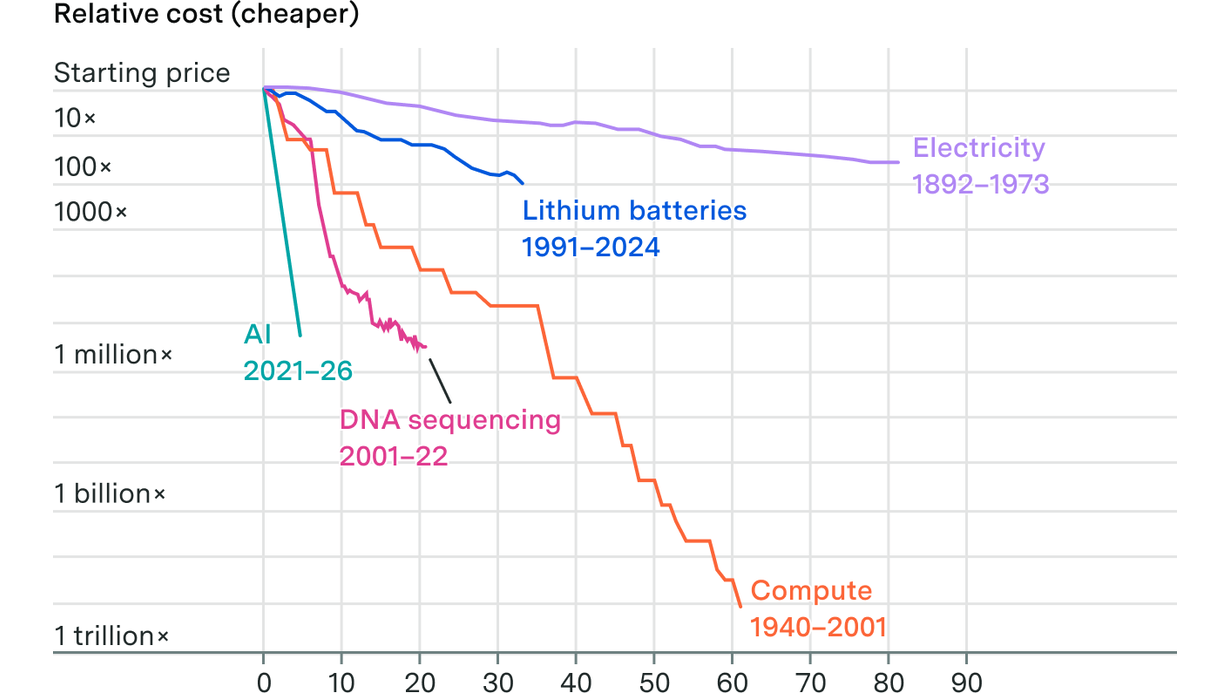
Analysis of five AI performance benchmarks spanning mathematics, hard sciences, and game-based puzzles shows a 47% per-quarter cost decline for a given level of performance. The study highlights a 725-fold price drop in 18 months: OpenAI's o3 model (January 2025) achieved a 75% score on GPQA Diamond for 30 cents per question; GPT-5.6 Luna achieved the same score for $0.0004 per question. The authors note that initial performance breakthroughs command premium pricing before competition drives costs down.
“No other general-purpose technology in history appears to have gotten so cheap so fast.”
— Epoch analysis -
 R
R
"AI has gotten cheaper more quickly than any other transformative technology in history. The cost of achieving a given level of AI performance has fallen about 47% per quarter since 2023, or 13× per year. That price drop is four times faster than DNA sequencing, six times faster than compute, 18 times faster than lithium batteries, and (in the…
-
-
1
Researcher questions economics of AI spending
Ross David Harthorn, with a background in neural networks since the mid-1990s, argues that unlike conventional software, neural networks have no point of saturation—they can always use more hardware, training data, and epochs. He suggests this structural incentive to buy ever more compute (combined with the ambition of reaching AGI rather than solving specific tasks) may explain why so much money flows into AI regardless of practical performance gains.
“Neural networks, are not like that. They never say 'no thanks, I'm full'. You can always add more neurons, more hidden layers, more epochs of training, or more data to train on.”
— Ross David Harthorn, Neural networks researcher · source