Center for Land Economics challenges California's billionaire wealth tax
Analysis argues land value tax would better fund California's budget than fleeing billionaires.
What to know
- California certified a 5% billionaire wealth tax for November ballot targeting $20 billion annually, but the Center for Land Economics argues it will fail because billionaires can relocate—seven worth $760B have already done so.
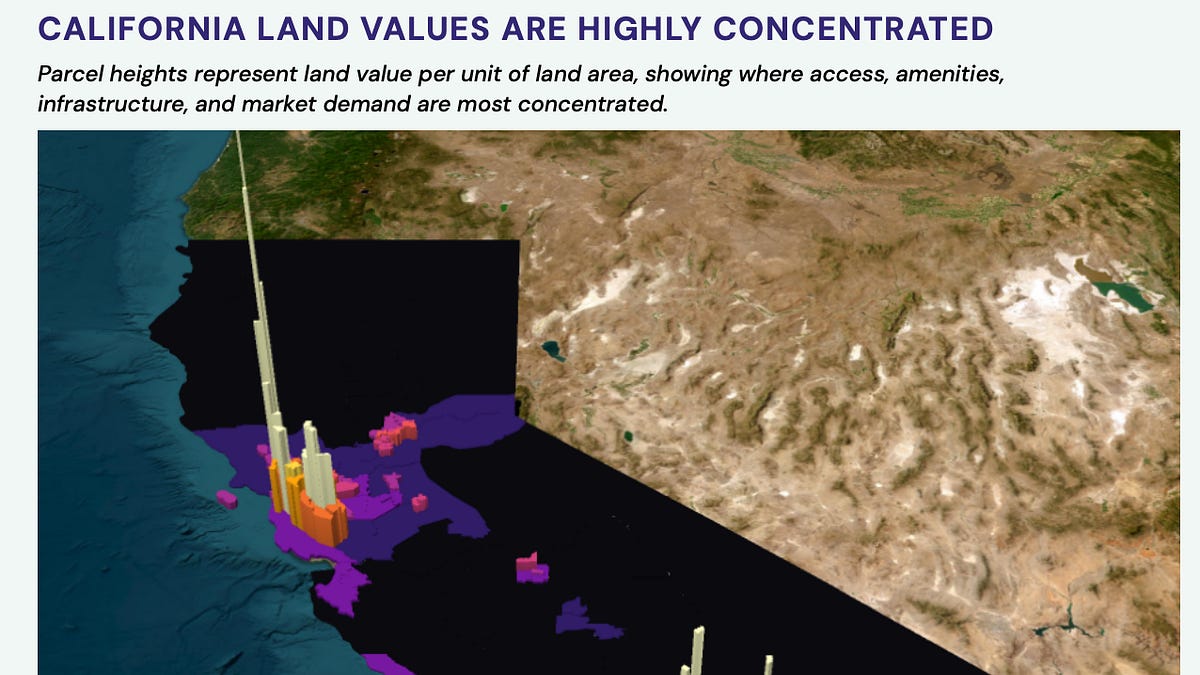
- The report estimates California's land value at $8.14 trillion and proposes a 0.25% land value tax as an alternative that would raise the same revenue on an immobile, growing base.
- Hacker News commenters split on whether billionaires actually flee (some say no), whether land taxes hurt ordinary homeowners (acknowledged concern), and whether either proposal addresses the core issue of Prop 13's constraints on property tax assessment.
The dispute Whether billionaires will actually relocate in response to higher taxes: skeptics cite the appeal and infrastructure of California; believers note seven have already left and argue rising rates will push more out. · positions read across 54 posts and comments
Billionaires won't actually leave despite tax threats; the wealth tax is viable.
-
“If wealth was only motivated by taxes and was going to leave, it would've left already. Fact is, billionaires don't want to live in Tennessee”
jmyeet · Hacker News ↗
Land value tax is theoretically superior but won't happen; Prop 13 and political constraints make it infeasible.
-
“Property tax increases are hamstrung by Prop 13 and until that's repealed, will continue to be.”
dhosek · Hacker News ↗
Land value tax will hurt ordinary homeowners and renters despite claims it cannot be passed on.
-
“Most land I bet is leveraged (hence the high price!) and taxing it will put pressure on home owners and investors…for someone with a typical house $1m it is $7500 which is less money for food and other household expenses.”
qwertyhjkl · Hacker News ↗
The wealth tax is flawed but better than nothing; a land tax is unproven and unavailable on the ballot.
-
“This is one of those, don't let the perfect be the enemy of the good situations…we have a one-time billionaire's tax proposal on the upcoming ballot, and we don't have an LVT proposal on the ballot.”
abeppu · Hacker News ↗
Center for Land Economics Policy research organization Larry Page Billionaire tech founder
 Mark Zuckerberg Billionaire tech founder
How it unfolded 1 development · click the chart to see its coverage articlespostscomments
-
1
Hacker News discussion contests billionaire mobility and alternative tax approaches
Comments on Hacker News surface multiple competing views: some argue billionaires won't actually leave despite tax threats; others contend land taxes could hurt ordinary homeowners and renters; others defend the billionaire wealth tax as preferable to an untested alternative; and some raise concerns about accurately assessing land value separately from improvements under Prop 13's framework.
“billionaires, unlike land, have feet.”
— Center for Land Economics · source -
Two things:1. If wealth was only motivated by taxes and was going to leave, it would've left already. Fact is, billionaires don't want to live in Tennessee;2. Nobody is doing the right thing to tackle any of this, including California.The article mentions California has land and that's the key point. Unfortunately, California homeowners have been…
2 more of the top 3 · 54 posts in this stretch
-
The article contains significant inaccuracies. Individuals in the lower and middle economic strata need not advocate for the interests of billionaires or those with assets exceeding $100 million; these individuals have already benefited disproportionately.Over the past 50 to 60 years, wealth concentration in many Western nations—coupled with the…
-
I think the author may be right about multiple points but I think it doesn't matter? This is one of those, don't let the perfect be the enemy of the good situations. A state-level, one-time wealth tax _is_ something that billionaires can run away from. And this law seeking to apply to people who lived in the state _before its passing_ seems…
-
-
background
Analysis proposes land value tax as alternative revenue source — The report proposes a land value tax—a property tax that falls only on land value, not improvements—as a superior alternative. It argues a 0.25% land value tax on California's $8.14 trillion land base would raise the same $20 billion annually on a vastly larger, immobile, and growing tax base. At 1%, such a tax could reportedly cover California's entire $87 billion health and human services budget perpetually.
-
background
Op-ed argues wealth tax will fail due to billionaire mobility — An op-ed published in the San Francisco Chronicle (accompanying the report) contends that California's newly certified billionaire wealth tax—a 5% one-time levy intended to raise $20 billion annually—will underperform because billionaires can relocate their tax residency, while land cannot move. The piece notes seven billionaires worth roughly $760 billion combined had already moved residency out of state before the January 1, 2026 cutoff, or planned to challenge the measure in court.
-
background
Center for Land Economics releases land valuation report — The Center for Land Economics published research calculating California's total land value at $8.14 trillion using parcel-by-parcel analysis and cross-checked against federal housing data and sales trends. The estimate is described as the first credible bottom-up calculation of the state's land value.
Also covered reported alongside — the timeline has no entry for these yet
-
first by HN Best, 4d ago · also HN Frontpage
What people are saying 21 voices from 1 site · best of 54 · verbatim
- How would California accurately separate land value from property improvements given historical Prop 13 assessment practices?
- Will billionaires truly flee California for lower-tax states, or is the threat overstated?
- Would a land value tax ultimately be passed on to renters, undermining the goal of taxing immobile wealth?
- Sep 27
-
As I see it, the value in a wealth tax isn't just in a cash grab. It's about reining in the behaviour of the wealthy.If you can cap individual wealth to eight or maybe nine figures, you take options like "bankroll major state/national elections on a whim" and "buy up major media and communications brands" off the table. As far as I'm concerned…
- Sep 25
-
I don't think this assessment is connected with reality. Land on its own isn't valuable, its the labour and investment people put in while on the land that produces taxable value. Just because the land can't leave doesn't mean the value of the land stays. As long as the government spends more than it can collect, simply charging more people to…
-
So a data center pays the same taxes as a homeowner, foot for foot? It seems unfair at first, but then it occurs to me that data centers would not be so desirable if they were not paying higher taxes. If land value tax helped to pop the data center bubble it would make the more off-putting aspects (organic farming is a less efficient use of land…
-
The land value tax is a good idea, but the pure conceptualization that die-hard Georgists have, in which it's a flat tax, doesn't seem in the same line as the billionaire tax. What'd like is just a (drastically) revised version of Prop 13 in which those protections apply only to the first $N of property value. We can effectively tax the real…
- Sep 24
-
The billionaire tax is an experiment, they did put the bar pretty high to measure how many families will relocate (that's super easy to track); once that's measured, it's easy to build a model to adjust this threshold to whatever is advantageous for the state and keep things in balance this way, where the outflow is carefully measured and weighted…
-
> Economist Henry George in the 1800's, pointed out that taxing land, but not the property on it, incentivizes efficient use of land, because holding land for its passive (parasitic) return even when underused, becomes unprofitable when the land is taxed in proportion to the value it can enable.That sounds like a terrible idea to me. Efficiency…
-
Property tax increases are hamstrung by Prop 13 and until that’s repealed, will continue to be.And while the wealthy always threaten to leave when faced with higher taxes, the fact is that they never seem to actually do so.The site is based around georgism whose fundamental premise is that taxing land is the universal solution (much like for…
-
“ Larry Page, Sergey Brin, Peter Thiel, Don Hankey, Travis Kalanick, and Steven Spielberg, worth roughly $540 billion combined — had already moved their tax residency out of state before the measure”Imagine being worth billions USD and rather than being a part of the solution to support the state that helped build your wealth, you spend your money…
-
Most land I bet is leveraged (hence the high price!) and taxing it will put pressure on home owners and investors. It is great for the truely rich who have a $50m mansion because it is chump change and will pay $375k which is approx zero but for someone with a typical house $1m it is $7500 which is less money for food and other household expenses…
-
I don't live in California but the article mentioned Proposition 13 which capped property tax rates and the reassessment is only when the property changes ownership?Is that right?That seems unfair to people who recently moved compared to the people that stay in their house for decades.Reading more it looks like California created alternative types…
-
Not sure if anyone could get such a policy change made given that California politics is now just "Whatever the California Democratic Party Wants" and they are very rigid in the ideas they accept.But I think the proposal being discussed is 1000% more consistent with the principles of a free, non-communist society than the crazy "wealth tax," which…
-
>If we view raw nature as a common inheritance of mankind, then paying a tax on land is how the exclusionary use of itThis will have some of the unfortunate effect of collectivism. We don't want the govt to tax you into poverty.A simpler overall approach (I've left out the nuances) would be to have an equal amount of land per person completely tax…
-
The hard part is that we've structured life such that you are on a fixed income at the end of your life in no position really to deal with inflation. At least when you are still working, in theory at least your wages will go up with inflation. This is really why prop 13 happened to pass at all: the idea of being displaced at the end of your life…
-
I was talking to a friend about the billionaire's tax and this issue came up. Here's how I see it: either individually wealthy people stay here, and we take their money to build state capacity to even out the distortions created by their wealth, or, they leave, and the distortions fix themselves.The easiest one to point to is property prices…
-
"None of this is really about billionaires; California reaches for exotic taxes because its normal one has been broken since 1978."The author then goes on to talk about CA's property taxes ... but LAND HAS NOTHING WHATSOEVER TO DO WITH THE BILLIONAIRE'S FORTUNES!!! Zuckerberg did make his money trading property, he made it through…
-
The greatest feat that Mao achieved was to take the land that had been tightly gripped by generations upon generations of owners and to shake up the distribution of it so that the land could produce again. People naturally want to work the land, but you end up with suboptimal inertia because owners just end up letting it sit fallow if it doesn't…
-
The effectiveness of other taxes aside, the argument that billionaires will leave if taxed at a higher rate isn't compelling.Billionaires are not struggling to meet their expenses. If you raise their taxes, they aren't suddenly unable to afford things. They don't need to change their behavior just to get by. A carbon tax forces average people to…
-
Land, as apposed to the property on it, is raw nature. If we view raw nature as a common inheritance of mankind, then paying a tax on land is how the exclusionary use of it, balances with the common interest in it.Economist Henry George in the 1800's, pointed out that taxing land, but not the property on it, incentivizes efficient use of land…
-
That cost will, of course, be passed on to renters unless the rental prices cannot be raised at all.If they can't be raised, and the costs end up being ruinous to the landlords, they will find other solutions like mass arson. That isn't hyperbole; this was a serious problem in the 1970s…
-
Rent is a function of supply and demand, not a landlord's costs, otherwise we would expect changes in e.g. mortgage interest rates to be passed on to, but in practice we don't see this effect. We also don't see landlords who own their properties outright (and thus don't have mortgage interest costs) charging lower rents than landlords in the…
-
I think the point of the article is correct; the issue with CA is everyone wants to live there, including rich people. If we try and tax them then they'll leave just long enough to not pay state income tax, if we tax property values then the state actually gets the tax and doesn't miss out on job creation or future revenue.Red states have…