ScienceQuiet 20d · day 20
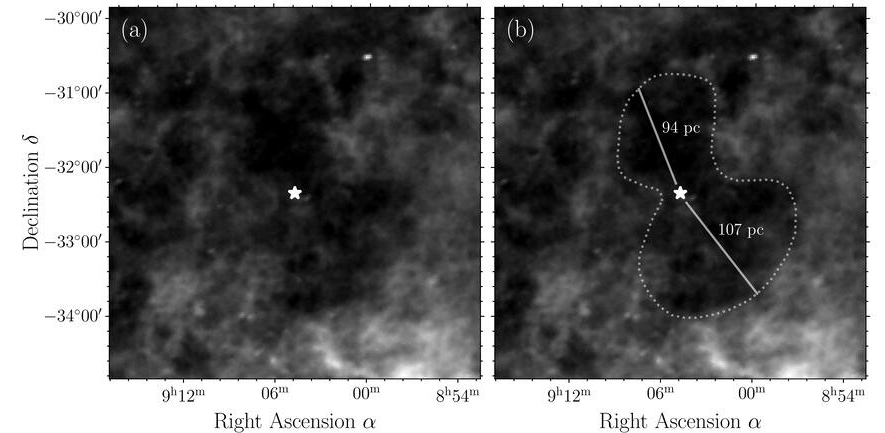
Astronomers discover massive cavity carved by repeatedly exploding white dwarf
Infrared observations reveal T Pyxis has blown a 650-light-year hole in space over thousands of years of recurrent nova explosions.
What to know
- Astronomers discovered a 650-light-year cavity around T Pyxis, a white dwarf that has exploded repeatedly for thousands of years as a recurrent nova.
- The cavity was found using infrared data from NASA's 1980s IRAS mission, a novel detection method that reveals these superremnants in dust-filled regions.
- The discovery adds to a growing catalog of superremnants—far larger than typical supernova remnants—created by recurring thermonuclear explosions in binary star systems.
- The elongated peanut shape reflects the orbital dynamics of the white dwarf and its companion star, which feeds material to the white dwarf's surface.
T Pyxis Recurrent nova system Phil Plait Astronomy communicatorHealy-Kalesh and Darnley Astronomers
The record 2 articles and posts · last 20 days
What people are saying 1 voices from 1 site · best of 2 · verbatim
- Oct 19
-
P
A tiny white dwarf has been exploding over and over and OVER again for thousands of years and has now carved a hole in space well over 600 *quadrillion* kilometers across! badastronomy.beehiiv.com/p/a-star-can... 🔭 🧪