Human brain organoids identify Braille letters with 83% accuracy
Researchers at Bristol University demonstrate neural tissue can process tactile information, marking progress toward biological computing.
What to know
- Human brain organoids—neural tissue grown from stem cells—successfully classified Braille letters, with accuracy ranging from 61% for single organoids to 83% for ensembles of three.
- The research advances organoid intelligence, an emerging field exploring biological neural tissue as computing hardware that could consume far less energy than artificial systems.
- Researchers converted Braille tactile patterns into electrical stimuli and fed them to organoids smaller than a millimeter, demonstrating real biological networks can process external sensor information.
Tianyi Liu PhD candidate, Bristol University; study leadBristol University Research institution
How it unfolded 1 development · click the chart to see its coverage posts
-
1
Study details emerge on organoid mechanism and ensemble performance
Researchers explained that organoids classify Braille by converting tactile sensor data into electrical stimulation patterns. The improved accuracy with multiple organoids stems from each responding to stimuli in slightly different ways, allowing complementary pattern recognition.
“Our hypothesis is that different organoids respond to the same stimulation in similar, but not identical, ways.”
— Tianyi Liu -
4
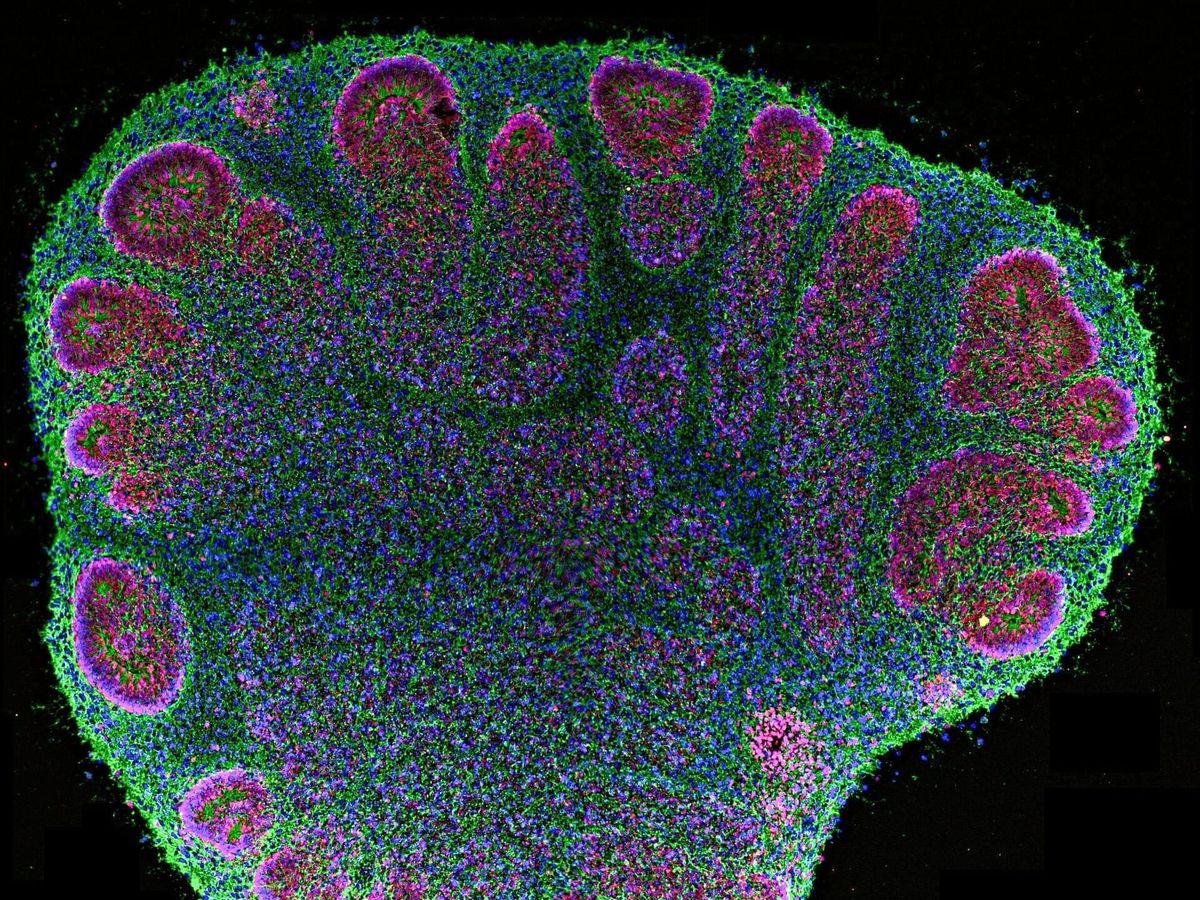
Scientists discovered that human brain organoids, which are small neural clusters derived from stem cells, could identify the Braille alphabet with a high degree of accuracy.
-
-
background
Bristol University team publishes organoid Braille recognition study — Researchers led by PhD candidate Tianyi Liu published findings in Frontiers in Artificial Intelligence demonstrating that human brain organoids can classify Braille letters. A single organoid containing about 10,000 neurons achieved 61% accuracy; three organoids working together reached 83% accuracy.