Stone availability, not water alone, determined early human desert settlement
A 1,500-km survey of Arabia's Empty Quarter reveals early humans required both water and tool-making stone to settle deserts.
What to know
- A 1,500-km survey of Arabia's Empty Quarter found ancient lake beds but zero stone tools, despite high ground visibility and abundant freshwater—contradicting climate-only settlement models.
- Early human desert occupation required both water and tool-making stone; 57% of water-accessible terrain in Arabia lacked knappable rock formations.
- Similar constraints appear in Africa, North America, and Asia, suggesting stone availability is a fundamental, overlooked factor in dispersal models for stone-tool-dependent populations.
“Fresh water in deserts often points to sites with signs of early humans and stone tools. But, in Arabia's Rub' al Khali region, water alone does not predict occupation.”
Emanuele Cancellieri, Commentary author · Nature News ↗ · Oct 27
Rudolf W. Dellmour Lead researcherEmanuele Cancellieri Commentary author, ICArEHB
How it unfolded 3 developments, newest first · click a bar or a number to jump articlesposts
-
3
Nature publishes commentary contextualizing Rub' al Khali findings
Emanuele Cancellieri provides accompanying analysis in Nature News, noting that while climate and freshwater availability are expected to shape human dispersal in deserts, the Rub' al Khali study demonstrates water alone does not predict occupation.
-
first by Nature News, 11d ago
-
N
Fresh water in deserts often points to sites with signs of early humans and stone tools. But, in Arabia’s Rub’ al Khali region, water alone does not predict occupation go.
-
-
1
Research challenges climate-only dispersal models across multiple continents
Convergent patterns from Africa, North America and Asia indicate the constraint is not unique to Arabia, suggesting dispersal models that omit raw-material geology may systematically overestimate the habitable range of stone-tool-dependent populations.
-
background
Study reveals stone availability operated as independent settlement factor — Spatial modelling of the Arabian Peninsula demonstrates that settlement tracked the co-occurrence of water and lithic raw materials rather than water alone. Adding raw-material availability to predictive models raised site-location discrimination from 0.695 to 0.768 area under the curve.
-
2
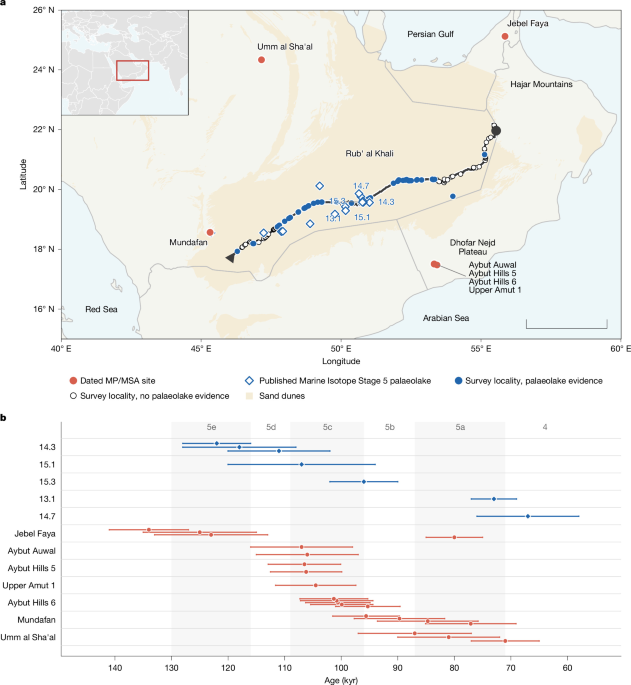
Dellmour team publishes 1,500-km geoarchaeological survey of Rub' al Khali
Researchers report findings from a systematic survey of Arabia's Empty Quarter showing that palaeolake deposits were found at 55 of 125 localities investigated, yet no lithic artefacts or knappable raw materials were discovered despite ground-surface visibility exceeding 95%.
“Palaeolake deposits were recorded at 55 of 125 localities investigated, yet no lithic artefacts and no knappable raw materials were found along the transect, with ground-surface visibility exceeding 95%, despite abundant freshwater…”
— Rudolf W. Dellmour et al.
Also covered reported alongside — the timeline has no entry for these yet
-
first by HeritageDaily, 10d ago · also Nature, Archaeology News Online Magazine
2 more headlines
- Stone and water governed early human settlement of the desert Nature · 10d ago
- Stone and water together shaped where early humans settled in Arabia’s desert, study finds Archaeology News Online Magazine · 4d ago
-
first by New Scientist, 10d ago
1 more headline