Scientists culture archaea closest to eukaryotes, revealing origins of complex life
Two newly isolated archaeal strains hint at how cells evolved from simple microbes to complex organisms.
What to know
- Scientists isolated and cultured two strains of Heimdallarchaeia, the archaeal lineage closest to eukaryotes, offering first direct look at the physiology of eukaryotes' closest living relatives.
- The cultured archaea are internally simple, anaerobic, and depend on symbiotic partnerships—suggesting the ancient archaeal ancestor of eukaryotes was similarly structured.
- Early interactions between the archaeal host and mitochondrial ancestor likely occurred under low-oxygen conditions and involved oxygen detoxification rather than respiration.
- The findings reshape understanding of eukaryogenesis by showing the transition from simple archaea to complex eukaryotic cells involved a dramatic shift in cell structure and oxygen metabolism.
“Eukaryotes probably evolved from a lineage closely related to members of the archaeal group Asgard archaea, which has now been formally classified as the phylum Promethearchaeota.”
Imachi et al., Research authors · Nature ↗ · Oct 27
Hiroyuki Imachi Research lead, JAMSTECMasaru K. Nobu Research co-lead, JAMSTECSatoshi Nakagawa Researcher, Kyoto University
How it unfolded 3 developments, newest first · click a bar or a number to jump articlesposts
-
3
Findings suggest archaeal ancestor of eukaryotes was anaerobic and structurally simple
The conservation of anaerobiosis, lack of internal membranes, and membrane protrusions across Promethearchaeota suggests the archaeal ancestor of eukaryotes shared these features. The transition to complex eukaryotic cells likely involved a steep shift in cell structure and physiology from anaerobiosis to aerobiosis, with early archaeal-mitochondrial interactions occurring under low-oxygen conditions.
“The archaea–eukaryote transition would involve a steep transition in cell structure and physiological shift from anaerobiosis to (facultative) aerobiosis.”
— Imachi et al. -
1
HC1 strain possesses aerobic genes but functions only for oxygen detoxification
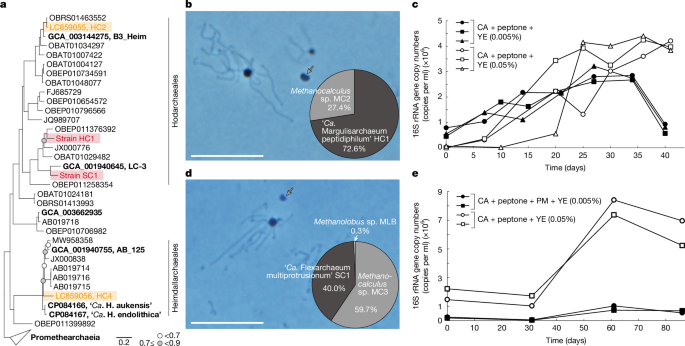
Strain HC1 carries genes like cytochrome c oxidase (Cox) associated with aerobic lifestyles, but comparative genomics shows these archaea likely do not respire oxygen. Cox appears to support oxygen detoxification rather than respiration, allowing growth in the presence of aerobes under microoxic conditions.
-
background
Study reveals archaea lack internal membrane structures and live anaerobically — The cultured strains are obligately anaerobic, peptide-degrading archaea that produce surface protrusions and vesicles but lack persistent internal membrane structures. Both strains demonstrate behavior focused on cell construction rather than division, contrasting with typical prokaryotes.
-
2
Researchers isolate and culture two archaeal strains closest to eukaryotes
A team led by Hiroyuki Imachi and Masaru K. Nobu isolated two strains, HC1 and SC1, belonging to Heimdallarchaeia, the archaeal lineage that branches closest to eukaryotes. The isolates were cultivated in pure and mixed cultures with methanogenic partners.
-
first by Mirage News, 10d ago · also The National Tribune
1 more headline
-
Also covered reported alongside — the timeline has no entry for these yet
-
first by Nature, 10d ago · also Nature News
and 1 smaller piece