Nature study links 1-minute power grid oscillations to synchronized software
Researchers identify clock-synchronized control in UPS and battery systems as the source of worldwide grid frequency disturbances.
What to know
- Researchers traced 1-minute oscillations observed in power grids worldwide to clock-synchronized software in UPS and battery storage systems creating coherent demand peaks.
- Pattern amplitude has grown substantially, causing wear on hydropower infrastructure and prompting tighter frequency-control requirements.
- Expansion of battery storage, data centers, and IoT devices risks amplifying the problem further without improved control design.
Nature Energy researchers Study authors
How it unfolded 2 developments, newest first · click a bar or a number to jump articlesposts
-
2
Researchers warn expansion of battery storage and data centers could amplify problem
The study highlights systemic risk: rapid growth in battery storage, data centers, and Internet-of-Things devices may further amplify cyber-physical power oscillations, calling for improved control design in modern power systems.
“The rapid expansion of battery storage, data centres and the Internet-of-Things may further amplify such cyber–physical power oscillations, highlighting the need for improved control design.”
— Nature Energy -
The corresponding concept in gears is to avoid meshing two gears unless the number of teeth are co-prime, because this will cause uneven wear patterns. If the tooth counts are coprime, then each tooth will contact every tooth on the other gear the same number of times, effectively "wear leveling" the teeth.In this instance, one fix is to fire the…
2 more of the top 3 · 15 posts in this stretch
-
Work at a very, very large factory. Had a power outage, city level, but the plant is...seriously massive. I thought it was considered standard operating procedure to do a staged power up at most facilities. After power cut, we go around and throw all the mains off, flip breakers, and wait until power restored. Wait an hour for everyone else in the…
-
I'm skeptical that this one minute jitter period is solely attributable to one minute timers in power inverter equipment. It's likely the net scale effect of all cron-like scheduling of actions in everything with a microprocessor. All the long-term scheduling that is done with minute precision (i.e. seconds field is implicitly :00) regardless of…
-
-
background
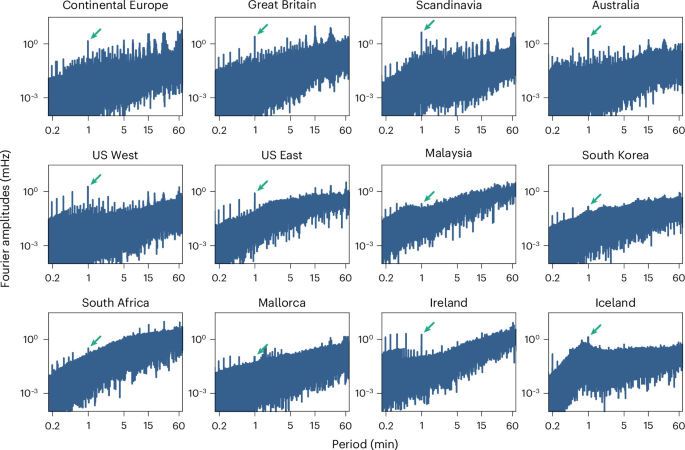
Study shows pattern amplitude increasing and worsening infrastructure wear — The research documents that the pattern amplitude has increased substantially in several grids over recent years, contributing to wear and tear in hydropower systems and prompting stricter frequency-control requirements.
-
1
Nature researchers identify source of 1-minute grid frequency oscillations
A Nature Energy study reveals that clock-synchronized control software in digitally controlled energy devices—particularly uninterruptible power supplies and battery energy storage systems—generates periodic power-demand peaks responsible for the 1-minute oscillatory pattern observed in power grids worldwide.
“Clock-synchronized control software in digitally controlled energy devices, particularly uninterruptible power supplies and battery energy storage systems, generates periodic power-demand peaks that propagate across voltage levels.”
— Nature Energy -
first by Mastodon, 6d ago
-
first by HN Frontpage, 8d ago
-
What people are saying 12 voices from 1 site · best of 15 · verbatim
- Nov 3
-
When I was at GitHub, I once took upon myself to investigate if there was any pattern to the request rate seen by the platform at various frequency, by running a FFT over the events. My guess was that most people probably call GitHub in fixed-timed loops, no jitter or anything, and this would show up with patterns like an increase in power in 1hz…
- Nov 2
-
Absolutely fascinating comment regarding gears and coprimes. This is the first time I have heard of either.My mind goes somewhere completely unrelated to the comment though: cicadas!I believe it is a mystery why some species of cicada have have a 17-year life-cycle. Theories have included avoiding predation etc.However, I wonder if the 17-year…
-
Does this also apply to my small UPS here in my office?I just checked the power meter dashboard of the building and can see small peaks in the minute range.In this case it's not counting in too much on the grid level as there's a periodically charged batterie in between.
- Nov 1
-
Potentially related phenomenon: Across multiple locations >200km apart in France, I've personally noticed that mains powered lights reliably and visibly pulse a few times at the beginning of every hour, and half-hour throughout the day. From memory, it's roughly one or two 1-2s long sequences of pulsed dimming, at around 5-10 pulses/second. The…
-
Van Jacobsen TCP synchronisation at queue points in the Internet. Led to protocol changes to de-cohere with a small random backoff.
-
Maybe too many things are started from crontab. Public NTP servers observe large spikes in traffic on minute marks due to admins putting ntpdate in crontab instead of running a proper NTP service.
-
I get a disturbing amount of equipment that does not take into account the inrush current of starting many loads at the same time. While each individual device is protected by a breaker that can handle the inrush of it's load the main breaker for the equipment is not sized to handle every load starting at the same time. The fix is to include logic…
-
Cool, I thought grid stability attacks would rely on large numbers of IoT devices but it looks like computing infrastructure is the better target.Whether it's by buying and using a trillion tokens strategically or by inserting synchronized malicious jobs it should be possible to find some resonant frequencies in the line frequency control system…
-
59 seconds will still have second alignment. Maybe it needs to be prime milliseconds or microseconds.
-
Small nit: Wait(50+rand(10)) is probably closer to what you want to get about a minute between executions. As stated your proposed execution has an average about 30s execution interval with a variance of about 17s. If you’re talking about a random sleep on a 1 minute interval, this actually results in a possibility of 120s between tasks, also not…
-
I'm not sure I agree with the conclusion that this is merely caused by UPS system control logic. That is an extreme amount of coordination across a lot of makes, models and configurations.The FFT indicates this is a periodic signal, not a once a day or week thing. It's happening continuously all day every day. I don't know of any UPS systems that…
-
I know my older APC UPSes do weekly self tests, but I guess newer equipment does more frequent self testing? And of course they're all internet-connected meaning clocks are within a few hundred ms of each other.It also made me think about how many GitHub Actions I have that kick off on Sunday morning at a specific time. I try to vary the time/day…