NASA study finds interstellar comet 3I/ATLAS may contain 10-billion-year-old material
James Webb observations reveal the visitor comet has an unusually high deuterium-to-hydrogen ratio, suggesting ancient origins in a cold, radiation-rich environment.
What to know
- 3I/ATLAS contains a deuterium-to-hydrogen ratio in methane 13 times higher than any other measured comet, indicating formation in an ancient, radiation-rich environment.
- The comet's ices likely formed more than 7 billion years before the Sun, possibly in a prestellar core around one of the galaxy's oldest stars.
- James Webb's infrared observations provided the first-ever detailed chemical analysis of an interstellar visitor, offering insight into the chemistry of early Solar System formation elsewhere in the galaxy.
“And this is why 3I/ATLAS is so precious: it's a pristine sample ejected from the hidden depths of an ancient cosmic nursery, possibly around one of the Milky Way's oldest stars, and delivered directly to our doorstep by the caprices of gravity.”
ScienceAlert article, Science journalism · ScienceAlert ↗ · Oct 30
NASA Solar System Exploration Division Research team leadJames Webb Space Telescope Observational instrument
How it unfolded 2 developments, newest first · click a bar or a number to jump articlesposts
-
2
Findings suggest comet originated in ancient cosmic nursery
Analysis indicates 3I/ATLAS may have formed in a prestellar core or planet-forming disk around one of the Milky Way's oldest stars, possibly assembled more than 7 billion years before the Sun's formation, making it a pristine sample of early solar system chemistry.
-
1
NASA team publishes analysis in Nature Astronomy
Researchers led by NASA Solar System Exploration Division scientists published their findings on the comet's deuterium-to-hydrogen ratio in methane, finding it significantly higher than any Solar System body—13 times more than the only other local comet with secure measurements.
“The elevated D/H ratio for methane in 3I/ATLAS is consistent with the hypothesis that its ices formed in a cold, low-metallicity interstellar or protostellar environment under a high cosmic ray irradiation rate.”
— NASA research team -
background
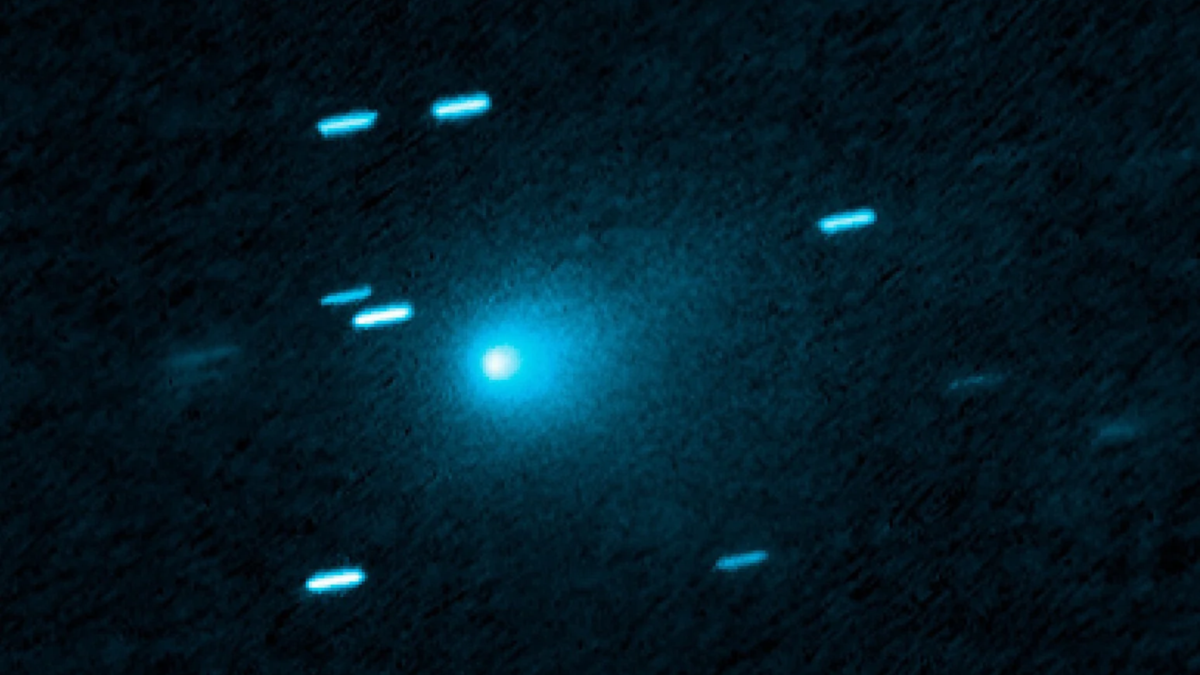
James Webb observes 3I/ATLAS comet in infrared — NASA researchers used the James Webb Space Telescope to view the interstellar comet when it was approximately 2.5 times as far from the Sun as Earth, passing through the asteroid belt between Mars and Jupiter.