EV Bidirectional Charging Remains Fragmented Across Automakers
V2H technology lets cars power homes during outages, but most manufacturers treat it as discharge-only mode without recharging capability.
What to know
- Most automakers' V2H systems only discharge during outages; they cannot recharge the car while powering the home—only Tesla with Powerwall 3 or Cybertruck currently supports true bidirectional charging.
- Lack of unified control protocol and interoperable standards forces each manufacturer to require proprietary hardware, blocking mass adoption and forcing consumers to buy entire ecosystems.
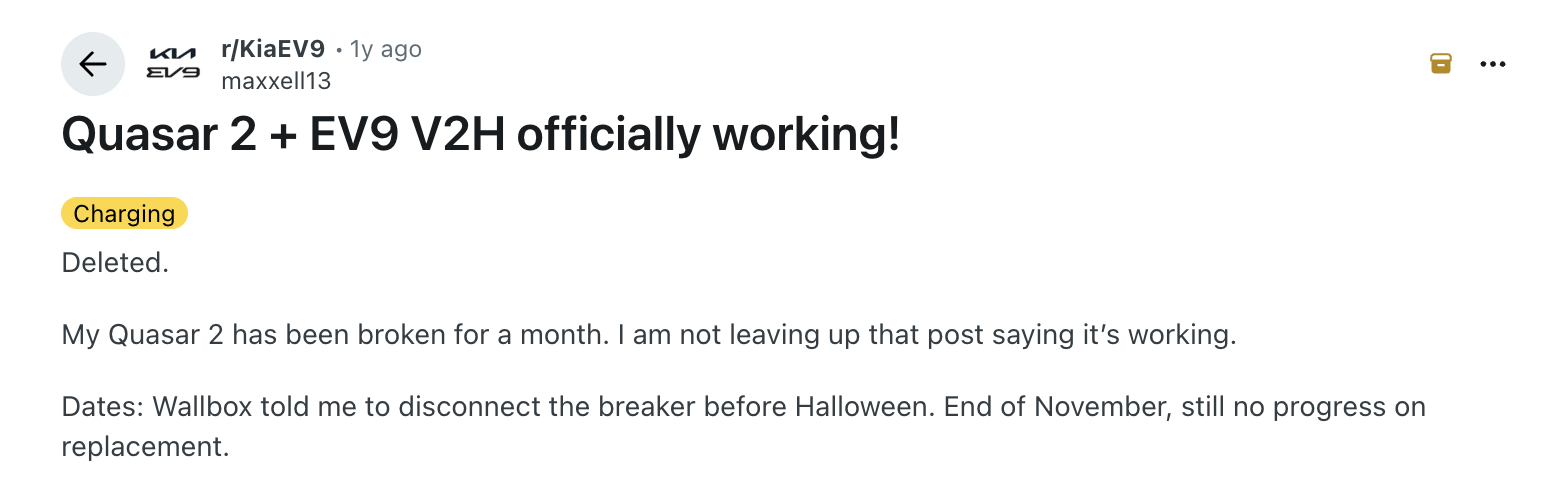
- Ford discontinued its backup power charger after killing the F150 Lightning; Kia's Wallbox solution has customer reliability issues; Enphase's promised 2026 charger faces delays and compatibility uncertainty.
- SAE is addressing the gap with J3400/2 standard revision, but standardization alone won't solve the problem if automakers continue requiring vertically integrated solutions.
The dispute Whether V2H for home backup is even economically or practically worth pursuing: some argue it's a niche use case relative to portable batteries and manual solutions, while others see standardization as the threshold for mainstream viability. · positions read across 29 posts and comments
Lack of standardization is the core problem; interoperable specs are needed before mass adoption can happen.
-
“What is missing is a spec that inverters and cars and chargers can all follow, then we will see mass adoption.”
declan_roberts · Hacker News ↗
Even motivated customers with resources cannot find vendors willing or able to deliver working bidirectional systems.
-
“I spent a year or so trying to get bidirectional charging set up at home in the UK…I even went to several of the vendors mentioned in that post and said 'I've got basically a blank cheque'…and nowhere could/would do it.”
1dom · Hacker News ↗
Practical workarounds exist (manual transfer switches, portable batteries, direct 120v outlets) but require technical skill and don't provide whole-home backup.
-
“I just run 120v extension cords from my EV during power outages (it has 2 15A capable outlets). I added a manual transfer switch to my furnace so it can be plugged into an extension cord, and I can power my furnace, blower, refrigerator…”
jerkstate · Hacker News ↗
Jeff Tuck Technology writer and homeownerTesla EV and energy storage manufacturerGM EV and home energy hub manufacturerFord EV truck manufacturerEnphase Solar and battery manufacturer
How it unfolded 1 development · click the chart to see its coverage articlespostscomments
-
1
Commenter notes SAE J3400/2 spec expected to address bidirectional gap
Discussion identifies that the current NACS J3400 standard omits bidirectional power, with the forthcoming J3400/2 revision expected to fix this omission.
“One of the biggest misses in NACS (J3400) is bi-directional power in the spec. SAE J3400/2 will fix it.”
— 1970-01-01 -
You complain about lack of V2H and bidirectional charging. Let me tell you how stupid are the straight grid connected battery laws here in Poland.For example the laws treat the output power of the inverter, the kWh capacity of the battery and peak kW capability of solar panels as a single number and they simply call it "capacity".The law states…
2 more of the top 3 · 29 posts in this stretch
-
My biggest problem with batteries for grid outages is that the only outages I am actually concerned with would drain them to zero before the outage is resolved. For short term, smaller/portable batteries are fantastic at bridging a few hours. Plug the wifi & fridge in and you can sometimes go for 2-3 days.I am not aware of any economically…
-
Batteries alone are not suitable for long duration outages, but solar+batteries, designed correctly, can not only supply enough power during long outages, it can get you to be off-grid entirely in the first place at a dramatically more cost effective number than your $500k quoted - perhaps 1/5 or less for a system suitable for your needs of 115kWh…
-
-
background
Commenters identify missing standards as core barrier to V2H adoption — Hacker News discussion surfaces that competing systems lack a unified control protocol; manufacturers require proprietary hardware (GM, Tesla inverters) rather than interoperable chargers. Users describe failed attempts to purchase working solutions and note V2G (vehicle-to-grid) paradoxically works better for energy providers than V2H for homeowners.
-
background
Jeff Tuck surveys V2H landscape, finds most systems don't support recharging during outages — Analysis of bidirectional charging across manufacturers reveals GM's V2H requires separate modes with no recharging capability, Ford discontinued its Charge Station Pro, Kia's Wallbox Quasar 2 has customer issues and solar-charging conflicts, and only Tesla's vertical integration makes true bidirectionality work. Tesla's Cybertruck solution adds substantial cost.
-
background
Tesla enables Powershare on Model 3 and Model Y with Powerwall 3 — Tesla extends bidirectional V2H functionality to new Model 3 and Model Y vehicles as of October 1, allowing cars to power homes and charge from solar during grid outages when paired with at least one Powerwall 3.
-
background
Enphase announces bidirectional EV charger targeting Q4 2026 launch — Enphase publicly targets volume production of a bidirectional charger beginning Q4 2026, though notes compatibility will depend on automaker enablement and vehicle software.
What people are saying 21 voices from 1 site · best of 29 · verbatim
- Will SAE J3400/2 standard revision actually compel automakers to implement interoperable V2H, or will Tesla's vertical integration remain the only working option?
- Why does V2G (vehicle-to-grid, helping energy providers) work more reliably than V2H (powering your own home) when the technical requirements are similar?
- Nov 5
-
This doesn’t have to have anything to do with BEVs. This could be about any other battery technology or power source.For me, put an ATS between your power provider and all your local equipment (solar panels, wind turbines, batteries, BEVs, generators, etc…) and then when the grid is down then you are now an island. On your island, you should be…
- Nov 2
-
This is the same as home photovoltaic or backup petroleum generator. The home kits don't have their own frequency generator. They lock on the grid frequency and just follow it. A system with own frequency generator needs to be able to bias its own frequency to get into phase with the grid before the breaker is closed. You need a controller that…
-
Not an issue on my system (or rarely) as it generates enough to not need grid at the moment even with EV charging. So simply don't charge the EV and avoid washing machine, dryer etc. until grid comes back will probably do it. Another tactic is run some stuff off the car to reduce load on house battery
- Nov 1
-
You're definitely right on the tinfoil hat angle. Vehicle to home is inevitable, but the rollout is intentionally slow / designed to fail, so the utilities can keep milking folks and justify their natural gas peaker plant investments. Also, once it works, vehicle to home will immediately tank the grid-storage and home-storage battery industry.Some…
-
>Doing the math, I'd need something approaching 800kWh of storage to ride through this kind of event (7+ days)How airtight is your House? You may be better off with a tighter house to reduce the infiltration load from the outdoor air and possibly section out the house so that post hurricane the primary living spaces are the only spaces that are…
-
> am not aware of any economically feasible way to run my 5+ ton HVAC system full-time on batteries after a hurricane just reset all the infrastructure, and you do need to run it full time because of the insane humidity and latent heat that follows a tropical system.Which region is this?Are hurricanes that reset all the infrastructure a recent…
-
I have a Tesla 3. There’s no good way to get a lot of power out of the car as an end user except via the wheels. You can get like ~1kW of 12VDC via the dc-to-dc computer/accessory system but even that is pushing it.I am saddened by this. I’d like to be able to access the large amount of power in it in a pinch.There is also no good way to charge it…
-
—- Types of V2G ——V2H - charger inverts DC to grid ACV2L - EV inverts DC to grid ACIn case of V2H it therefore doesn’t matter what supported EV you are using, rather what charger you are using.In general for changeover during a black out, V2L is probably better, because with V2H the charger itself needs POWER to boot up and request V2G whereas V2L…
-
The other problem with purely EV based home backup is that if you have to drive somewhere you house no longer has power.IMO such a system should be additive to a home based battery backup system with solar, which should be sized for a day of emergency (minimal) home usage.Such a system could top up from the EV when the EV is plugged in - assuming…
-
SAE-J2847 includes "how to convert your building side to supporting BPT grid works, and pairs well - it looks - with ISO 15118-20 BPT. (and reasonably well with ISO-15118-2 and the BPT extensions in SAE-J2847). Anyway, supporting AC grids requires some additional electronics both in battery systems and in the local hookups.I haven't explored the…
-
Is that the transfer switch just for the furnace or the whole house? I was staring at my furnace yesterday, trying to figure out what to do if power stops and temperature drops below freezing. Doing the whole house transfer switch is too much, esp given o don’t have a 30amp power source, but it never occurred to me to do just the furnace.
-
You average 100kWh of use per day?What’s 5 ton in new money, 5kW power draw max? Are you planning to run that full power for a week?Yes, that much in batteries would cost a lot but uk prices right now would be ~87.5k for the batteries themselves (so a shade over $100k I guess). £7k for 64kWh
-
Most Tesla models don't support bidirectional because they had free Supercharging, and also probably because having your car not full at all times is not always the best experience. Other brands like Nissan had always supported V2H and in fact it has always been a selling point of OG leaf that it could double as the Powerwall equivalent since back…
-
> My tinfoil hat [...] the relationship between energy providers and law makersMy local establishment's energy czar is also on the board of the electric company (itself a natural monopoly of course).No tinfoil hat required. They have re-elected her several times as well.
-
I just run 120v extension cords from my EV during power outages (it has 2 15A capable outlets). I added a manual transfer switch to my furnace so it can be plugged into an extension cord, and I can power my furnace, blower, refrigerator and freezer, wifi and internet for a couple of days.I really wanted to set up an automatic transfer switch for…
-
A fundamental problem here is that V2H during an outage requires a disconnection device (in the NEC this is a “microgrid interconnect device”), and the manufacturers of such things have made no effort whatsoever to standardize the control protocol. This means that you cannot build an islanded-V2H-ready house and just plug in a car. So the whole…
-
This entire area is a mess, I spent a year or so trying to get bidirectional charging set up at home in the UK. I even went to several of the vendors mentioned in that post and said "I've got basically a blank cheque and permission to do whatever you want however you want, even use it all as a case study to make this work" and nowhere could/would…
-
Assuming you have enough solar, how about running your 5+ ton HVAC system only when there is enough production? And properly insulating your home, of course, using it as a thermal battery of sorts.If there is a grid outage, surely one can shift consumption to solar production hours while using the battery for the always-on systems (fridge, lights…
-
I live rural and I'm hoping the next decade will bring a wave of cheaper safer sodium ion battery options. Something I'd feel a lot more comfortable with putting in or around my home since they don't have thermal runaway issues, their materials are theoretically cheaper, and they can withstand colder temperatures.While I'd like to use my EV as…
-
>I think a simple generator on an ATS remains undefeated from an engineering perspective.Let me just inject a bit of nuance here to avoid what I think is an unintentional sleight if hand...For the small sliver of the population that lives under threat of a large area week long blackout in a hot humid climate, I think a simple generator on an ATS…
-
One of the problems with companies like GM is that they still see this as a premium feature and require their hardware (not just a charger). Tesla requires not only their chargers but also their inverters and cars.What is missing is a spec that inverters and cars and chargers can all follow, then we will see mass adoption.