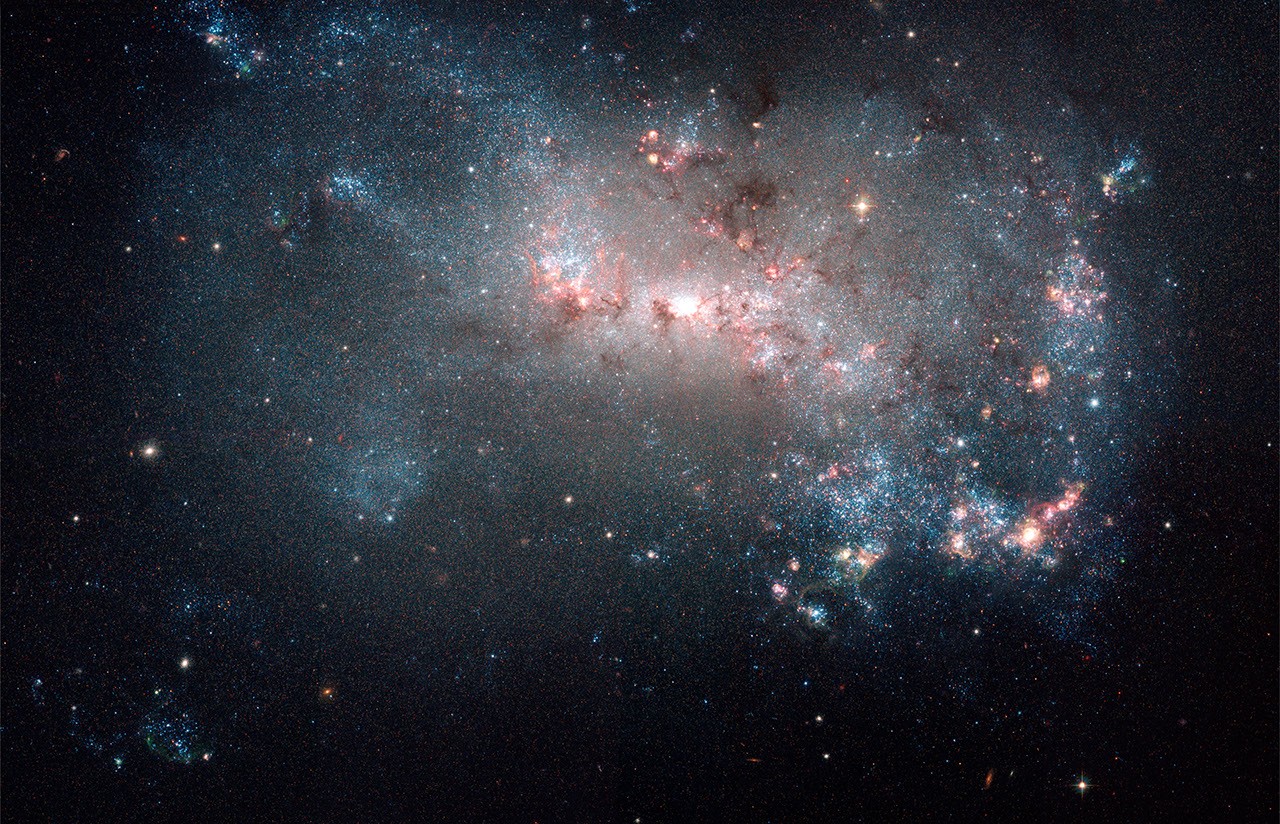
Hubble finds dwarf galaxies missing most oxygen produced by their stars
Study of 37 nearby galaxies shows supernovae eject oxygen far more efficiently than models predicted.
What to know
- Hubble's study of 37 nearby dwarf galaxies found they contain far less oxygen than models predict their stars should produce.
- Researchers conclude galactic winds from supernova explosions expel oxygen far more efficiently from low-mass galaxies than current simulations account for.
- The findings refine understanding of galaxy evolution and how chemical elements are distributed within and ejected from galaxies into intergalactic space.
“Oxygen is one of the primary elements formed by stars. Being able to trace how much oxygen gets made, and then how much is distributed inside and outside of galaxies, helps us understand galaxy evolution.”
Kristen Wingfield McQuinn, GLOW principal investigator, Rutgers University · NASA ↗ · Nov 1
Grace Telford Co-investigator, University of UtahKristen Wingfield McQuinn GLOW principal investigator, Rutgers UniversityNASA Research funder and mission operator
How it unfolded 2 developments, newest first · click a bar or a number to jump articlesposts
-
2
Supernova-driven galactic winds more effective than predicted
The study concludes that energy from massive stars and supernovae-unleashed galactic winds are apparently more effective at removing oxygen from low-mass galaxies than current models predict. The findings suggest existing simulations underestimate how efficiently dwarf galaxies lose heavy elements to intergalactic space.
“Being able to trace how much oxygen gets made, and then how much is distributed inside and outside of galaxies, helps us understand galaxy evolution.”
— Kristen Wingfield McQuinn -
 N
Hubble Study Measures Oxygen Loss From 37 Dwarf Galaxies A study of 37 nearby dwarf galaxies estimates that they retain between 4% and 25% of the oxygen their stars have produced, averaging approximately 11%. The results, reported by Rutgers University on November 2, 2026, indicate that these small galaxies have lost more oxygen than current…
1 more of the top 2 · 2 posts in this stretch
-
 C
GLOW - A Census of Oxygen in Low-mass Galaxies: https:// iopscience.iop.org/article/10. 3847/1538-4357/ae93a6 -> NASA’s Hubble Uncovers Case of Missing Oxygen in Nearby # DwarfGalaxies : https:// science.nasa.gov/missions/hubb le/nasas-hubble-uncovers-case-of-missing-oxygen-in-nearby-dwarf-galaxies/
-
-
1
Hubble study reveals oxygen deficit in 37 dwarf galaxies
NASA's Hubble Space Telescope research published Monday in The Astrophysical Journal examined 37 nearby dwarf galaxies and found significantly less oxygen than simulations predicted should be present. The galaxies retain only a small fraction of the oxygen produced by their stars.
“Oxygen is produced by stars, which are inside of galaxies. We know that the oxygen had to be inside of the galaxies at some point in the past, so the oxygen must have been ejected.”
— Grace Telford -
first by UPI, 5d ago · also NASA Science (.gov), The University of Utah, NASA, Times of India
4 more headlines
- NASA’s Hubble Uncovers Case of Missing Oxygen in Nearby Dwarf Galaxies NASA Science (.gov) · 5d ago
- Nearby Dwarf Galaxies are Missing Most of Their Oxygen, Hubble Data Show Sci.News · 5d ago
- Hubble Reveals Cosmic Mystery NASA breaking · 4d ago
- NASA's Hubble probes mystery of missing oxygen in dwarf galaxies Times of India · 2d ago
-
first by Phys.org, 5d ago · also Mashable
1 more headline
- Tiny galaxies lose most of their oxygen. No one knows where it goes. Mashable · 3h ago
-
S
Scientists used Hubble to study 37 nearby dwarf galaxies—small galaxies with a few thousand to hundreds of millions of stars—and found that much of the oxygen they expected to see is missing. Where did it go? https://news.stsci.edu/3W93ohU 🔭
-