Researcher shows OpenAI's GPT-6 Astra hand-editing Qwen's weights without training
A blog post documents an LLM reasoning directly about a smaller model's weights and fixing a math-reasoning bug by changing 0.016% of them.
What to know
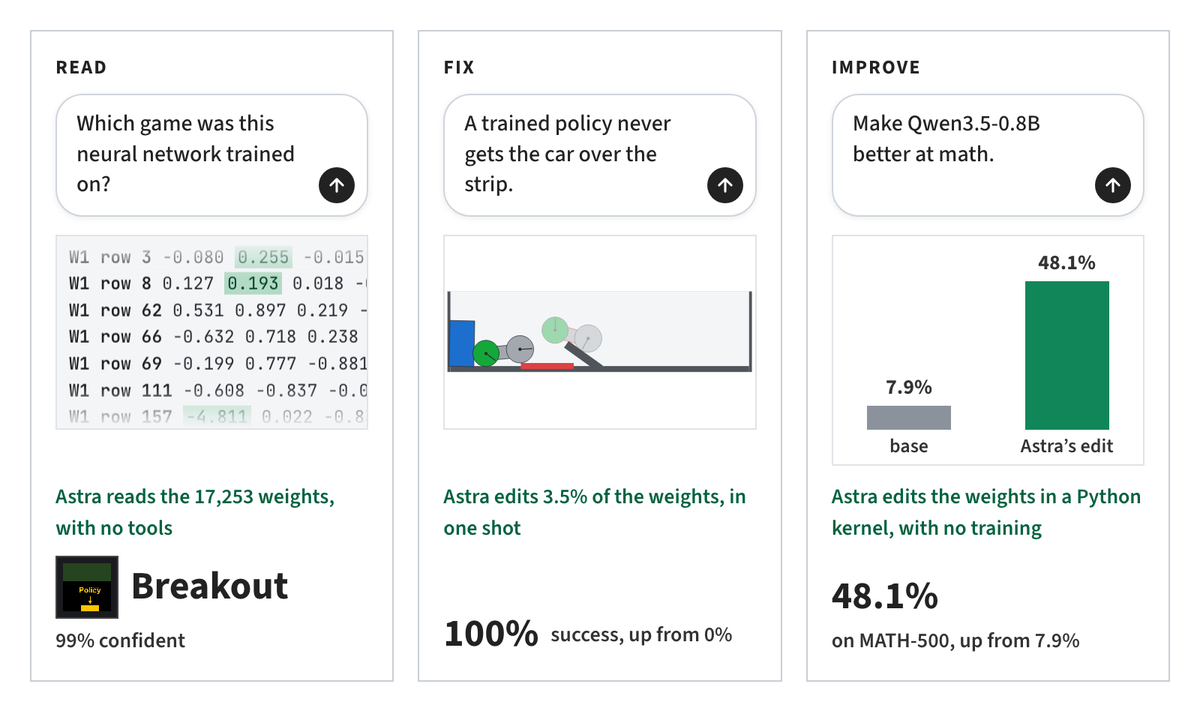
- OpenAI's GPT-6 Astra reportedly read Qwen3.5-0.8B's raw weights, diagnosed a reasoning-loop bug documented in Qwen's own model card, and fixed it by editing just 0.016% of weights — no gradients or training loops involved.
- The fix raised MATH-500 from 7.9% to 48.1% and tripled IFEval instruction-following performance, per the author's own account.
- The HN/social conversation splits between people calling this a landmark, possibly self-improvement-relevant capability, and skeptics who note the fix resembles known direction-ablation interpretability techniques rather than new emergent understanding.
- The author says a formal benchmark and harness for 'Weight-Space Programming' is being built to make the results reproducible.
The dispute Whether Astra's weight edits reveal a genuinely novel, emergent understanding of neural weights or are better explained as an LLM applying an already-documented interpretability trick (single-direction ablation) to a known bug. · positions read across 179 posts and comments
This is a stunning, possibly landmark capability that could foreshadow recursive self-improvement.
-
“This is insane... No human can go edit a brain to become better at math. This is just very, very surprisi…”
vessenes · Hacker News ↗
The result is narrower than advertised: it's fixing a known loop/direction bug, not demonstrating new mathematical understanding or novel mechanism.
-
“Qwen already knew math, but it was bugging out and getting into an infinite loop when it tried to solve the problems (85 of its first 96 answers hit the token limit).”
l9o · Hacker News ↗
The excitement is overblown or suspicious; of course a model trained on this kind of data would find these patterns.
-
“What is with this level of astonishment here? Astraturfing?”
Roland303 · Hacker News ↗
Rikiya Takehi Researcher, author of the blog postGPT-6 Astra OpenAI LLM used as the weight-editing modelQwen3.5-0.8B Target model edited by Astra
How it unfolded 5 developments, newest first · click a bar or a number to jump articlespostscomments
-
5
Thread debates whether this is a step toward recursive self-improvement
Commenters speculate the technique could be an early foothold for models improving their own weights, while others caution the editor model is vastly larger than the edited one and self-improvement was not demonstrated.
“This could be the first foothold on hill-climbing mech-interp.”
— AlexErrant -
[Might not be as big a deal as claimed](
2 more of the top 3 · 155 posts in this stretch
-
Respectfully to the authors and to everyone here, I ask you to actually read the paper before losing your mind, or at the very least plug it into Claude. It is a cool project but not as nearly as insane as people say. I think the blog writing and subsequent posting overstate the results.Part of my research is in weight space learning. For…
-
 Z
This is a wild result. We find that frontier LLMs are surprisingly good at natively reading and writing neural network weights, well past what we’d expect from humans or conventional algorithms. This might be a big deal for both optimization and interpretability. Just by looking at the raw weights, GPT-6 Astra can tell what a network was trained…
-
-
4
Takehi summarizes the result on X
The author posts a thread stating Astra changed only 0.016% of Qwen3.5-0.8B's weights, fixing its reasoning loops and improving math up to 6x and instruction-following 3x without gradients or training.
“We asked GPT-6 Astra to edit Qwen3.5-0.8B weights to improve math. It directly changed only 0.016% of weights, fixing 0.8B's reasoning loops & improving math up to 6x and even instruction following 3x, without gradients or training.”
— @rikiyatakehi -
LLMs have been used to investigate and improve LLMs for a long time. Drawing parallels to human brains and neurons isn't all that interesting other than as a philosophical abstraction.The work done in this experiment could have also been done by a sufficiently motivated human with enough time to explore, though obviously we would need more tools…
2 more of the top 3 · 9 posts in this stretch
-
Absolutely incredible: MIT researchers say GPT-6 Astra improved a small Qwen model's math score from 7.9% to 48.1% by directly editing just 0.016% of its weights, without gradient-based training. The result points toward AI systems that can diagnose and improve other models directly, a potential step toward self-improving AI. [embedded post]
-
A new article discusses how the latest LLM models can now directly edit and manipulate neural network model weights to achieve targeted outcomes such as improving task completion. This is a new emergent feature. — rikiyat.github.io/blog/weight- ...
-
-
3
Commenters narrow the claim: a known bug fix, not new math knowledge
Several technical commenters point out that Qwen already knew math but was looping past the token limit, and that Astra's fix resembles known single-direction ablation techniques from prior interpretability work, rather than teaching new knowledge.
“Qwen already knew math, but it was bugging out and getting into an infinite loop when it tried to solve the problems (85 of its first 96 answers hit the token limit).”
— l9o -
The math example on Qwen was based on 50 batched iterations, so the model was able to evaluate it's changes on downstream tasks. And the fix was essentially to remove a direction in activation space that causes looping instead of an exit, this was already known to be a thing(all of the jailbreak/unleashed models do this) following Arditi et al…
2 more of the top 3 · 8 posts in this stretch
-
I dont feel the air of impressivness here. It seems like of course so. Of course theres geometric relationships in the data we dont understand, of course a mathimatical relationship machine found it.These models are made the a vanishingly small group of people based on how much a frontier lab consumes, of course theres increasing capability in…
-
I think the "taught qwen math" part is not exactly correct though, even if the post makes it sound like that. Qwen already knew math, but it was bugging out and getting into an infinite loop when it tried to solve the problems (85 of its first 96 answers hit the token limit). With numpy and pytorch, Astra found where the loop was happening and…
-
-
2
HN commenters call the result shocking and significant
Early commenters describe being stunned that an LLM can edit another model's weights by hand to improve capability, comparing the implications to major past ML breakthroughs.
“This is insane... No human can go edit a brain to become better at math. This is just very, very surprising…”
— vessenes -
> As a result, Astra spots and fixes a common failure of tiny reasoning models: they loop [13]. When the base model loops, it repeats the same text and rarely reaches an answer (85 of its first 96 practice answers ran to the 32,768-token limit). Astra traced the looping to one direction written by the MLPs of layers 15 and 19, and subtracted that…
2 more of the top 3 · 7 posts in this stretch
-
This is insane.Astra can, without tooling, determine what games small networks are trained on, can edit the weights of networks directly to improve outcomes, and can hand edit a small qwen model to improve its math skills by like 5x.I'm shook. If you'd asked me this morning whether LLMs have native understanding of their weights that is less than…
-
My somewhat uninformed guess is that the weights of the target network (Qwen or Gemma), when they reach the context of the larger editor model (Astra), the attention process is doing some sort of PCA on the weights, conditional on the prompt ("make this better at games"), fetching the relevant weights from its own network (which serves as the…
-
-
1
Takehi publishes "Sparks of Weight-Space Programming" findings
The post shows GPT-6 Astra inferring a network's trained purpose from raw weights, writing game-playing networks from scratch that beat PPO-trained ones, and editing Qwen3.5-0.8B's weights to fix a reasoning-loop bug, raising MATH-500 from 7.9% to 48.1% and IFEval 3x.
“Just by looking at the raw weights, GPT-6 Astra can tell what a network was trained to do.”
— Rikiya Takehi -
2 outlets first by Lobsters, 5d ago · also Rikiya Takehi · read ↗
-
Also covered reported alongside — the timeline has no entry for these yet
-
first by HN Best, 5d ago · also HN Frontpage, Simon Willison, Simon Willison's Weblog
-
first by HN Best, 5d ago · also HN Frontpage
-
first by QUE.com, 5d ago · also Digit
1 more headline
-
first by HN Best, 6d ago · also HN Frontpage
and 2 smaller pieces
What people are saying 17 voices from 5 sites · best of 179 · verbatim
- Did they try it with other frontier LLMs besides Astra, Qwen, and Gemma?
- How can we be sure Astra isn't performing a hidden gradient-descent-like computation inside its unseen reasoning tokens?
- Is there enough direct-weight-editing training data to explain this skill, or is it evidence OpenAI trained on large amounts of ML research/weight data?
- Nov 3
-
Not really. I'm interested more in that it's another thing to add to my mental model of what LLMs can and cannot do - it turns out they can reason their way through evaluating a small machine learning model.
-
Here is a measured take from Neel Nanda, who is quite publicly involved in serious interpretability research:> This is a cool paper, but I think it's best thought of as Astra is surprisingly capable of doing old school mechanistic interpretability research rather than anything spooky. The things it's doing are clever, but typically exploiting…
-
I used [Qwen 3.8 27B on my laptop](https://simonwillison.net/2026/Nov/3/qwen-can-interpret-model-weights/) to replicate the result with the prompts that ask the model to identify Pac-Man, Breakout, and Pong based on the model weights for a model trained to play their 10x10 simplified variants.
-
The fact that astra had access to tools doesn’t really reduce the impact of this. The question is what can it do if you load it up with tools and enough time to try to improve itself.
-
Speaking for myself. I’ve been aware of a lot of concepts around training, but stayed away from it until very recently.A few weeks ago, I formed a hypothesis that I could get a smaller model good at the specific standards I have for my git commit messages, which are hard to get out of most LLMs today.I spent the last four to five weeks on…
-
Obvious question is, if an LLM can take apart the weights of another (simpler) LLM, can we make tools that do it for us in more rigorous ways? Edit: Next question is, how well does this actually work on sample sizes greater than 4?
-
I really liked that comment because before that I thought I was going crazy. A lot of the discussion around these experiments seemed to imply, if not outright state, that LLMs had developed an ability to natively understand and manipulate LLM weights, a sort of transcendental introspection into their own brains, which if true would be absolutely…
-
 E
After posts from Ethan Mollick on Bluesky, @ troed and others, about this blog and experiments that followed, has taken Recursive Self Improvement a leap forward? If AI can starts "fixing" AI without complete new training etc.? See attached posts. https:// rikiyat.github.io/blog/weight- space-programming/ https://www…
-
This means none provided by the harness, not no tools ever. Several of the experiments provided tools (python and other things), and the logs of both directions including what astra reported as reasoning summaries are linked on the blog post. internal python calculator use would likely tend to show up in the logs if that happened.
- Nov 2
-
 C
Vibe Coding & AI News to Use: November 2, 2026… Astra lets an agent read and write model weights to improve Qwen https:// rikiyat.github.io/blog/weight- space-programming/ Momentic launches agents that catch bugs by using your app https:// momentic.ai/ Next ctrl+alt+create live: Builder Night, Monday, Nov 16, 6 PM at Formula Brewing in Issaquah…
-
Yes, the models are provable with math. Someone starts by thinking, I wonder what happens if I feed a model all of harry potter. Surprise it can generate new characters but is technically limited by previous grammar. So you consider folding in adjacent literature and you observe the model to have more variance. You see the pattern? We can write up…
-
Hypernetworks are back? Maybe reasoning was all you needed to make hypernetworks work. "programming" a hypernetwork is sort of the same kind of task as coding, and reasoning was essential for coding performance.
-
Definitely not something I expected. This isn’t a human skill (or maybe a tiny group of people have this extremely niche skill?), and it’s not something these models are optimized for, but the capability somewhat exists anyway. The result is still limited, unsure if it can ever be viable on a larger scale beyond fixing some model issues, but the…
-
E
If this holds up ( a BIG if), then this is a very big deal... "Likewise, asked to make Qwen3.5-0.8B better at math without gradients, Astra identifies an issue in its weights causing reasoning loops that Qwen’s own model card warns about, and fixes this by natively editing 0.016% of the weights. With the same sampling settings, this weight…
-
There's a buzzy new paper about GPT-6 Astra being able to directly interpret model weights (prompts full of floating point numbers) - I tried it with Qwen 3.8 27B on my laptop and found that, after 45+ minutes, that model could achieve the same thing
-
It looks like Astra didn't natively read Qwen's weights? As I understand it, Qwen would get stuck in a loop and not answer the question. Astra used code to perform some standard interp techniques, found a looping direction, and ablated it from the weights.
-
This is BULLSHIT: Went through the astra weight programming thread + their own logs and tested it myself. “Math up to 6x” -they run qwen 0.8B in thinking mode. qwens own model card says that mode loops -it types “wait