Astronomers discover 'mega-Earth' GJ 523b, 23 times Earth's mass but defies formation models
The dense exoplanet challenges theories of how rocky planets grow by gas accretion.
What to know
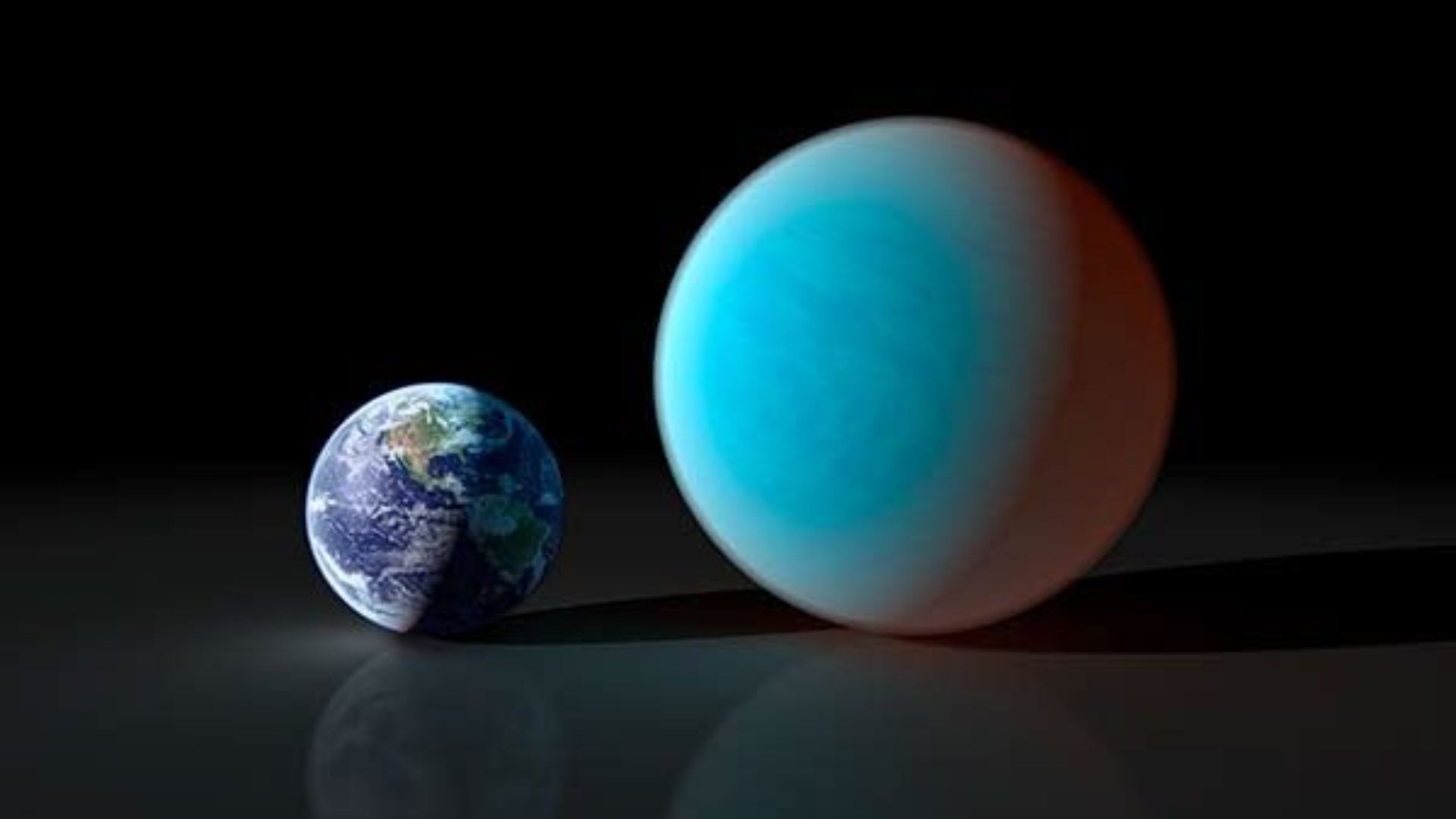
- GJ 523b is 23.5 times Earth's mass but only 2.5 times its diameter—an unusually dense 'mega-Earth' for its size.
- The planet challenges planetary formation theory: it exceeds the mass threshold at which planets typically accumulate hydrogen and helium envelopes, yet remains predominantly rocky.
- At nearly 170 million years old, GJ 523b is young, making its anomalous composition a puzzle for models of how rocky planets grow.
“It's nearly 170 million years old. It's more than 2.5 times the size of Earth. And it's the first exoplanet discovered and cataloged by researchers with the Wisconsin Center for Origins Research (WiCOR).”
Phys.org, Science publication · Phys.org ↗
Max Kroft Lead author of the studyWisconsin Center for Origins Research (WiCOR) Discovering research institutionUniversity of Wisconsin–Madison Research institutionNASA's Transiting Exoplanet Survey Satellite (TESS) Space telescope instrument
How it unfolded 2 developments, newest first · click a bar or a number to jump articlesposts
-
2
Study details GJ 523b's anomalous density and challenge to planet formation theory
Detailed analysis shows GJ 523b has a mass of 23.5 times Earth's, a radius 2.55 times larger, and unusually high density of 126.82 grams per cubic inch. The planet orbits its star every 17.75 days and defies expectations: at its mass, it should have accumulated a substantial hydrogen and helium envelope like Jupiter or Saturn, but instead remains predominantly rocky.
“This isn't what we expected at all. Dense planets like this aren't uncommon, but they're usually small rocky planets similar to Earth or Mercury. This planet is two and a half times bigger than the Earth.”
— Max Kroft, lead author -
first by Space.com, 57d ago · also Inshorts, NewsBytes, Space
2 more headlines
-
"This isn't what we expected at all." View article View summary #^ Astronomers discover a giant, rocky 'mega-Earth' 23 times more massive than our planet Astronomers have discovered an unusually massive, dense exoplanet that challenges conventional ideas about how rocky planets form. Called GJ 523b, the exoplanet is about 2.5 times wider than…
2 more of the top 3 · 22 posts in this stretch
-
Removing the atmosphere eliminates aerodynamic drag. Only. You still have a surface gravity that is roughly 3.5 times that of Earth. Combining that with an escape velocity of 75,000 mph (3 times that of Earth), and you have a situation well beyond the capabilities of any chemical rocket. The real question is, with this big, iron ball orbiting so…
-
 D
D
Ouch. I weigh ~130 lbs. 23 x mass, means that I would weigh close to 3000 pounds on the surface. (Minus adjustment for distance from the center of mass) If we had been born there we would be a lot shorter, a lot wider, and our bones would be VERY dense. https://www. space.com/astronomy/exoplanets…
-
- 1 day quiet
-
1
Wisconsin Center for Origins Research catalogs first exoplanet discovery: GJ 523b
Astronomers with the Wisconsin Center for Origins Research discovered GJ 523b, a rocky mega-Earth nearly 170 million years old, measuring 2.5 times Earth's size.
-
first by Phys.org, 59d ago
1 more headline
-
What people are saying 19 voices from 1 site · best of 22 · verbatim
- Aug 20
-
Whatever atmosphere this planet has is presumably super thick, right? Could that somehow allow a jet powered launch platform/first stage to gain significant speed?
-
Given how much close is to its star ( a year there is 17 days long ) is most likely a chtonian planet, a former ultra hot Jupiter who lost his gas and now has only its rocky/metallic core
-
...and a density of about 126.82 grams per cubic inch Can someone convert that for me to a number of jumbo jets per olympic-size pool?
-
It’s made of the same stuff as the earth. It probably does have some very nice ores, but it would still be absurdly expensive compared to mining here.
-
Astronomers typically use 3 planets as their comparison: Earth for rocky planets, Neptune for mid-sized planets, and Jupiter for massive planets. They will occasionally also use Mercury and Saturn and rarely Mars.
-
Not really. Those jokes were written decades ago and have been repeated ad nauseam since, by people who think they are hilarious.
-
I don't want to meet those inhabitants. With that gravity they must be strong af.
-
you will still need to thrust at highest point anyways to get into orbit (otherwise you will still fall back into the atmosphere) so you still do kinda need a rocket
-
Unfortunately some people do see Venus as greenhouse Earth and Mars as depleted Earth.
-
Just build one big tower into the heavens. Perhaps their super planet has super alloys.
-
17 days?! Oh wow, I didn't think anything could get more extreme than Mercury's 88-day revolution. And a far greater mass and volume than Mercury to boot. Now this is some high-quality science news!
- Aug 19
-
Ran numbers through the surface gravity calculation and got back a gravity of 36.13m/s 2 or 3.68g
-
I'm sure that's what the Balloon people of Planet 'Float' thought when discussing the possibility of the humans of Earth ever reaching orbit.
-
The force of gravity is a far more significant obstacle to overcome than the force of air resistance. I’m sorry, but your understanding of this topic is poor.
-
The average density is between stainless steel and pure iron.... that's a whole lot of raw metal. They might be able to build an entire ring instead of a swarm.
-
Atmospheric drag is significant, but not the majority of energy spent reaching Earth's orbit.
-
At 23x I don't think you need to reference Earth in size any more. You can just call it a rocky exoplanet.
-
There's a physical limit, regardless of atmosphere. Beyond a certain amount of gravity there are no chemicals that exist that can provide enough energy to get a rocket into space, as adding more fuel also adds more weight. But there are nuclear options that could work.
-
A plant that doesn’t have an atmosphere removes a lot of the challenges. There isn’t over a mile of extra material to push your way through.