Linguist explores 1,000 Ancient Greek words with no Indo-European origin
A newsletter article traces mysterious Greek vocabulary to pre-Indo-European substrate languages, sparking debate over methodology.
What to know
- Hieber's article proposes that ~1,000 Ancient Greek words lack Indo-European origins and derive from pre-Indo-European substrate languages, but linguists debate whether this framing reflects current scholarship.
- Critics argue the article relies on outdated work by Robert Beekes and oversimplifies a complex field where the mainstream view is more nuanced than 'one Pre-Greek language.'
- Commenters question whether absence of etymology is sufficient evidence for substrate borrowing, noting that many common words across languages have no known origins without substrate explanations.
- The discussion highlights tension between accessible science writing and technical accuracy—some see the article as engaging pedagogy, others as misleading popularization.
The dispute Whether the article represents sound current linguistics or resurrects a discredited theory and relies on faulty reasoning about etymology and borrowing. · positions read across 13 posts and comments
The article misrepresents current scholarship by reviving a discredited theory associated with a declining scholar.
-
“The title is super-clickbaity, as no Indo-Europeanist working today believes in a single Pre-Greek language; this was the idée fixe of the scholar Robert Beekes well over a decade ago now, and very flawed research as Beekes was succumbing…”
TFNA · Hacker News ↗
The methodology is flawed: untraceable etymology is weak evidence for substrate borrowing since languages generate words endogenously and many common words have unknown origins.
-
“Also, "not having a known etymology" is weak evidence for borrowing, full stop, let alone for borrowing from a substrate language. There are lots of very common words in english (dog, pig, boy, girl) that have no known etymology which are…”
empath75 · Hacker News ↗
The article's use of a simpler framing to lead into more complex ideas is effective pedagogy, not misleading clickbait.
-
“What you see as clickbaity I see as using a reductive idea to set the stage for a more complex one. I just think this is good, engaging writing.”
lordleft · Hacker News ↗
The article correctly identifies a real linguistic phenomenon but undersells related areas like Thracian or Albanian substrate influence that deserve attention.
-
“The author does mention the possibility of more than one non-IE pre-Greek language, as well as the possibility of an Indo-European predecessor in the region.”
nephihaha · Hacker News ↗
Danny Hieber Linguist and newsletter authorTFNA Hacker News commenter
How it unfolded 4 developments, newest first · click a bar or a number to jump articlespostscomments
-
4
Commenter questions the evidential basis for substrate hypothesis
Linguist empath75 argued that lack of known etymology is weak evidence for borrowing from a substrate language, noting that many common English words (dog, pig, boy, girl) have no known etymology yet almost certainly did not come from substrate languages.
“"not having a known etymology" is weak evidence for borrowing, full stop, let alone for borrowing from a substrate language. Languages invent new words and sound patterns endogenously all the time.”
— empath75 -
Ya, barrrrmp! disagree, the main thesus is lingustic evolution as sort of hereditary characteristics whose exact origins are difficult to elucidate, kind of like apples and horses, that also share the same general geographic origins. Various lists of words show conclusivly how many words are conserved over very broad geographic, temporal, and…
1 more of the top 2 · 3 posts in this stretch
-
Also, “not having a known etymology” is weak evidence for borrowing, full stop, let alone for borrowing from a substrate. There are lots of very common words in english (dog, pig, boy, girl) that have no known etymology which are incredibly unlikely to impossible to have come from a substrate language.Languages invent new words and sound patterns…
-
-
3
Defender argues article uses effective pedagogical framing
Commenter lordleft pushed back against criticism, characterizing what critics saw as clickbait as effective use of a reductive idea to set up more complex analysis, describing the piece as engaging writing.
“What you see as clickbaity I see as using a reductive idea to set the stage for a more complex one. I just think this is good, engaging writing.”
— lordleft -
The author does mention the possibility of more than one non-IE pre-Greek language, as well as the possibility of an Indo-European predecessor in the region.There are similar arguments over Pictish, but at least with Greek there is a substantial body of vocabulary, which Pictish lacks.
1 more of the top 2 · 2 posts in this stretch
-
I don’t agree with this characterization of the article at all. What you see as clickbaity I see as using a reductive idea to set the stage for a more complex one. I just think this is good, engaging writing.
-
-
2
Commenter identifies potential error in article's examples
Commenter kgeist noted that the article's claim that Greek μύρμηξ (ant) has no Indo-European etymology appears incorrect, presenting evidence of cognates across multiple Indo-European language families suggesting an alternative explanation involving sound changes rather than substrate borrowing.
“Greek murmēx could be an assimilation murw- => murm-, and Latin had dissimilation morm- => form-…”
— kgeist -
>Words borrowed from a Pre–Indo-European language into Mediterranean languages> [...] Greek μύρμηξ mýrmēx ‘ant’, Latin formicaMust be an error: Proto-Celtic *morwos Proto-Balto-Slavic: *marwis Proto-Indo-Iranian: *marwiš Proto-Germanic: *mauraz Old Armenian: mrǰimn Greek murmēx could be an assimilation murw- => murm-, and Latin had dissimilation…
2 more of the top 3 · 5 posts in this stretch
-
From what I understand, and I might be oversimplifying here; many of the differences between Indo-European languages today are a result of the languages that were there before. So the reason Proto-German and Latin were different is in part because of the pre-IE languages in each of those regions. But we don’t have a ton of information on those…
-
One aspect the article seems to overlook is Albanian. Since Albanian is a unique branch of Indo-European, descending from the Paleo-Balkan linguistic world and developed in the same broader region, it would be interesting to see whether the non-Greek substrate vocabulary found in Ancient Greek has been systematically compared with Proto-Albanian…
-
-
1
Linguist criticizes article's framing as outdated
On Hacker News, commenter TFNA challenged the article's central premise, arguing that no modern Indo-Europeanist believes in a single Pre-Greek language and that this was an outdated theory associated with scholar Robert Beekes who was suffering from dementia when he developed it.
“The title is super-clickbaity, as no Indo-Europeanist working today believes in a single Pre-Greek language; this was the idée fixe of the scholar Robert Beekes well over a decade ago now, and very flawed research.”
— TFNA -
> early Greeks, and especially the Mycenaeans (c. 1750–1050 BCE), are associated with major advances in technology (including writing)I’ve been doing a bit of reading on the Bronze Age Collapse recently. It was such an apocalyptic event that Greeks forgot how to write and read.Before the collapse, Greeks were using Linear A and Linear B. It took…
2 more of the top 3 · 3 posts in this stretch
-
The title is super-clickbaity, as no Indo-Europeanist working today believes in a single Pre-Greek language; this was the idée fixe of the scholar Robert Beekes well over a decade ago now, and very flawed research as Beekes was succumbing to dementia then. In fact, within the field "Pre-Greek!" has become something of an inside joke.The article…
-
> because the Proto-Indo-European language arose in the landlocked steppes, it had no need for—and has no securely reconstructable word for—‘sea’.No, it is mori, attested in marine, muir, maryadah, mal, morje, etc in farflung IE tongues today.
-
-
background
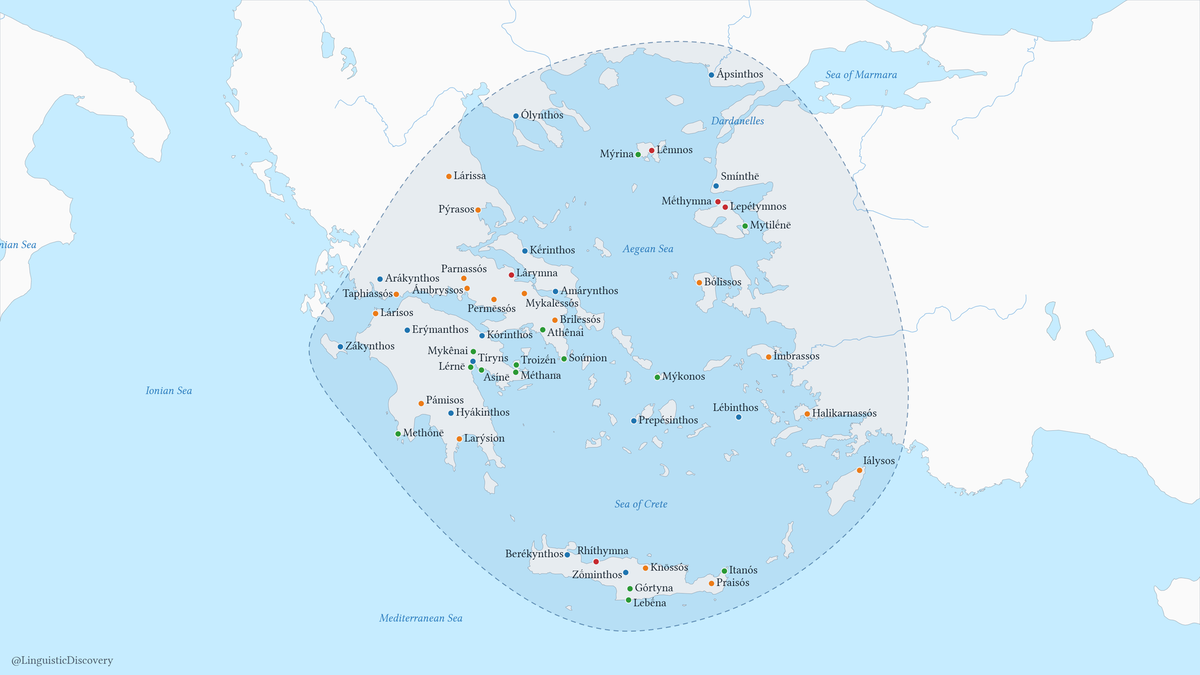
Hieber publishes article on mystery Greek vocabulary — Danny Hieber, a Ph.D. linguist who works with indigenous language communities, published a Linguistic Discovery newsletter article exploring approximately 1,000 Greek words that lack traceable Indo-European origins and proposing they derive from pre-Indo-European languages spoken by Early European Farmers who preceded Greek speakers in the Mediterranean.
What people are saying 2 voices from 1 site · best of 13 · verbatim
- What does current mainstream linguistics actually say about pre-Greek substrate influence versus Beekes's single-language hypothesis?
- Should Albanian and other Paleo-Balkan languages be analyzed alongside Greek for substrate comparisons?
- What would constitute reliable evidence for substrate borrowing versus coincidental etymological gaps?
- Sep 18
-
Plato wrote about a lot of these kinds of words in the dialogue Cratylus. The dialogue is about more than just etymology, of course, but it’s worth looking at if the subject is interesting to you.
-
Even for a non-linguist like myself, the article didn't feel right. I expected to find more information about the Thracians, who inhabited those lands for quite some time and left some extraordinary (albeit non-written) heritage.