AI inference costs plunge 725-fold in 18 months, Epoch AI report shows
Frontier models are getting smarter while becoming dramatically cheaper to run, challenging assumptions about open-source AI threats.
What to know
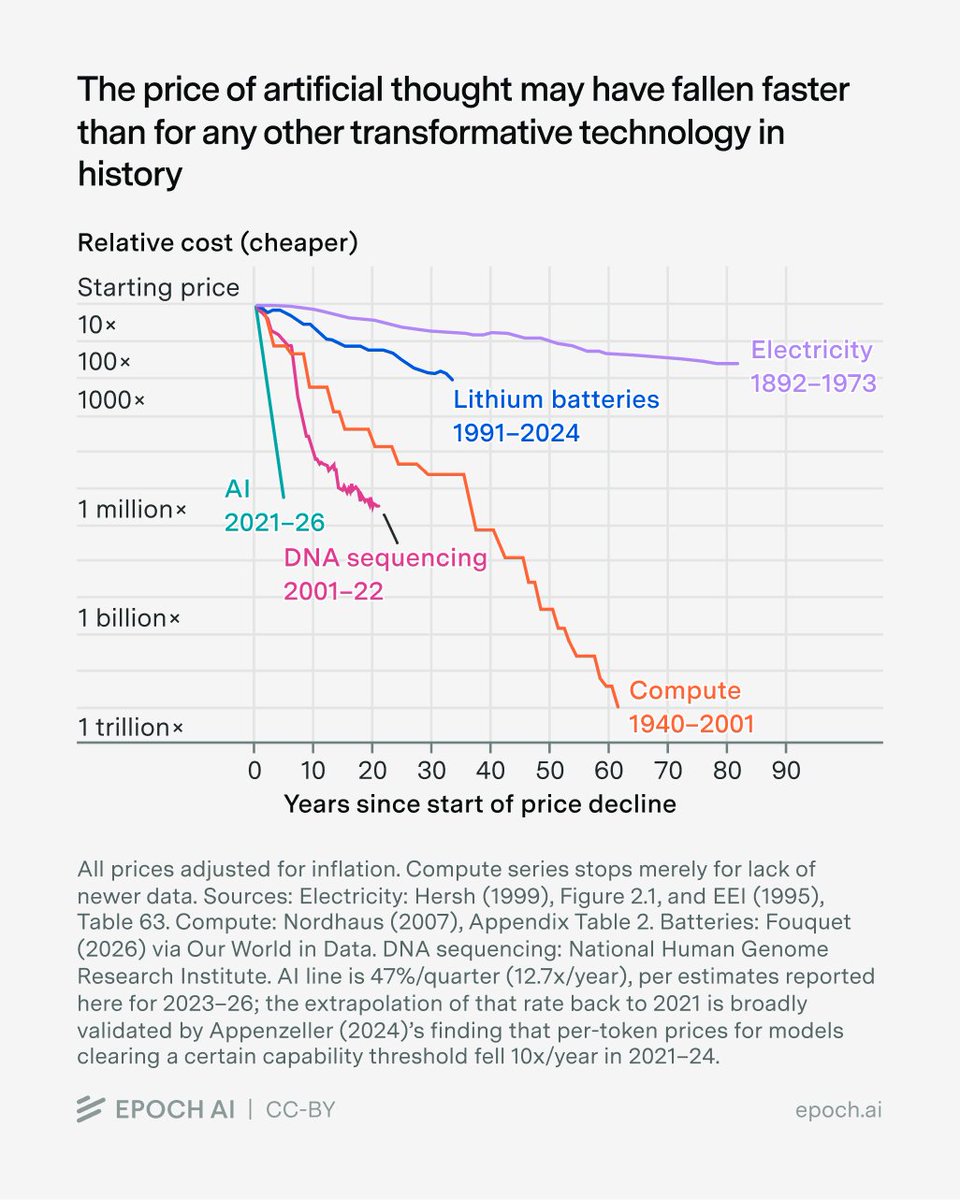
- AI inference costs fell 47% per quarter over three years—13-fold annually—faster than any transformative technology in history, according to Epoch AI analysis.
- Specific example: achieving 75% accuracy on a benchmark test cost $0.30 with OpenAI o3 in January 2025 but only $0.0004 with GPT-5.6 Luna in mid-2026—a 725-fold decline.
- Tabarrok argues this undermines the open-model threat because frontier models become cheaper to run at any performance level, but commenters contend competition from any source will drive prices down regardless.
The dispute Whether cost declines for AI inference actually reduce competitive threats to frontier-model companies or simply reflect inevitable commoditization driven by competition regardless of model origin. · positions read across 14 posts and comments
Competitive pressure will drive prices down regardless of source, so cost declines don't reduce the threat to big AI company profits.
-
“The 'threat' (to the profits of big AI companies) is that competition will drive prices down in a race to the bottom. It doesn't really 'help'…if that competition comes from open-ish models or from competing big AI companies or anywhere…”
jmull · Hacker News ↗
The Epoch AI report's funding sources and Tabarrok's uncritical acceptance undermine credibility.
-
“The actual report is by Epoch AI, which is financed by totally independent funds like (Eric) Schmidt Sciences. Professor Tabarrok uncritically praises the report, which might lead to the conclusion that either human intelligence or moral…”
129348681 · Hacker News ↗
The cost-per-token metric is misleading if total tokens per task are increasing, and 'buying intelligence' is not an accurate framing.
-
“I love marginal revolution. But I'm not fond of the unit stated. I dont believe we're buying intelligence.”
_superposition_ · Hacker News ↗
 Alex Tabarrok Economist, Marginal Revolution bloggerEpoch AI Research organizationOpenAI AI company
How it unfolded 5 developments, newest first · click a bar or a number to jump articlespostscomments
-
5
Commenter challenges claim that cost decline mitigates open-model threat
A Hacker News commenter disputes the article's argument that rapid cost reductions diminish the threat of open models to big AI companies, arguing instead that competition—from any source—will drive prices down regardless and reduce profit margins.
“The 'threat' (to the profits of big AI companies) is that competition will drive prices down in a race to the bottom. It doesn't really 'help' (drive the profits for big AI companies) if that competition comes from open-ish models or from competing big AI companies or anywhere else.”
— jmull -
> This is one reason the open-model threat is not as large as it appears: frontier models don’t merely outperform older models; they are rapidly becoming cheaper to run at any given level of performance.This really misses the point. The “threat” (to the profits of big AI companies) is that competition will drive prices down in a race to the…
2 more of the top 3 · 5 posts in this stretch
-
Yes, the price of inference is falling rapidly.What about the cost? Inference looks like a viable business model for those operators that have access to SOTA model and serving infrastructure, but the investment required to have it is enormous, and appears to be never-ending, because if an operator stops investing aggressively, its model and…
-
Cost per token goes down yes. But are you using more tokens per task/ prompt/ project?
-
-
4
Commenters debate whether cost decline addresses competitive threat and terminology
Multiple Hacker News commenters push back on the report's framing. One argues that falling inference costs don't reduce competitive pressure from open models or rival AI companies; another questions whether the framing of 'buying intelligence' is accurate; a third asks whether increased token usage per task offsets per-token savings.
“I'm sure marketing will run with it though.”
— _superposition_, Hacker News commenter · source -
first by HN Frontpage, 2d ago · also Marginal Revolution
-
Which reduces the price for hacking, which reduces the price of societal and technological rent-seeking aka parasitism, resulting in a unprecedented buildup of hatred on non-society contributing, extractive intelligence/parasitism.We are going to get lynchmobs hanging parasites and burning down data-centers before long.
2 more of the top 3 · 4 posts in this stretch
-
Absolute BS, my experience is people are using this "intelligence" to do more dumb shit. I'm not seeing intelligence, I'm seeing unqualified people wielding power tools but they don't know any basic carpentry skills.
-
It may be true for text outputs, but it's absolutely untrue for other modalities: image, speech, voice, and embedding. Heck, embedding models haven't even been updated in years.
-
-
3
Commenter questions independence of Epoch AI funding and Tabarrok's analysis
A Hacker News commenter challenges the credibility of the Epoch AI report, noting it is financed by sources including Eric Schmidt Sciences, and suggests Tabarrok's uncritical praise of the report reflects a decline in intellectual standards.
“The actual report is by Epoch AI, which is financed by totally independent funds like (Eric) Schmidt Sciences. Professor Tabarrok uncritically praises the report, which might lead to the conclusion that either human intelligence or moral standards are "falling rapidly".”
— 129348681 -
These ML/LLM/AI are systems where no one will ever be accountable for and guarantee its stability, safety, and its value.ML/LLM/AI may be useful, but it must always be considered unauthorized, mistrust, experimental, unverified, always probable to fail on each iteration. Its data must always be accountably supervized by an alive human, who…
2 more of the top 3 · 4 posts in this stretch
-
When intelligence is seen as a means to an end, rather than the lifeblood of your own perception, it makes sense the "price" goes down. What's being bought is, after all, artificial intelligence.The price of intelligence is the same. What's being lowered is the standard of living.
-
The actual report is by Epoch AI, which is financed by totally independent funds like (Eric) Schmidt Sciences.Professor Tabarrok uncritically praises the report, which might lead to the conclusion that either human intelligence or moral standards are "falling rapidly".
-
-
2
Tabarrok details cost decline with specific model comparison
The post highlights a concrete example: OpenAI o3 cost $0.30 per question to achieve 75% accuracy on GPQA Diamond in January 2025, while GPT-5.6 Luna achieved roughly the same score for $0.0004 in mid-2026—a 725-fold decline in under 18 months. Tabarrok argues frontier models are both smarter and cheaper to run at any performance level.
“OpenAI o3 cost about $0.30/question to attain 75% on GPQA Diamond in January 2025, while GPT-5.6 Luna attained roughly the same score for $0.0004 in mid-2026—a roughly 725-fold decline in under 18 months.”
— Alex Tabarrok -
Price of human intelligence is also falling rapidly. I suspect looking pretty is going to go up in value more rapidly.
-
-
1
Epoch AI releases analysis of AI cost declines
Economist Alex Tabarrok cites an Epoch AI report finding that the cost of a given level of AI performance has fallen an average of 47% per quarter over three years—a 13-fold drop annually, faster than any other transformative technology in history.
“Over the past three years, the cost of a given level of AI performance has fallen an average of some 47% per quarter. That is a 13-fold drop every year – a faster rate than any other transformative technology in history.”
— Alex Tabarrok
What people are saying 4 voices from 1 site · best of 14 · verbatim
- Sep 23
-
Why does electricity stop at 1973? It's been going back up again for the last few years.
-
I mean, this is more or less true of Marginal Revolution for over a decade now...
-
I love marginal revolution. But I'm not fond of the unit stated. I dont believe we're buying intelligence. I'm sure marketing will run with it though.
-
Well, since llms need matterial for self-education, someone still had to be inteligent enough. Or llms will freeze their “intelect” at some point.