UC Riverside study: Venus likely consumed its own moon
New computer models suggest Venus's slow rotation would have doomed any moon to spiral inward and crash into the planet.
What to know
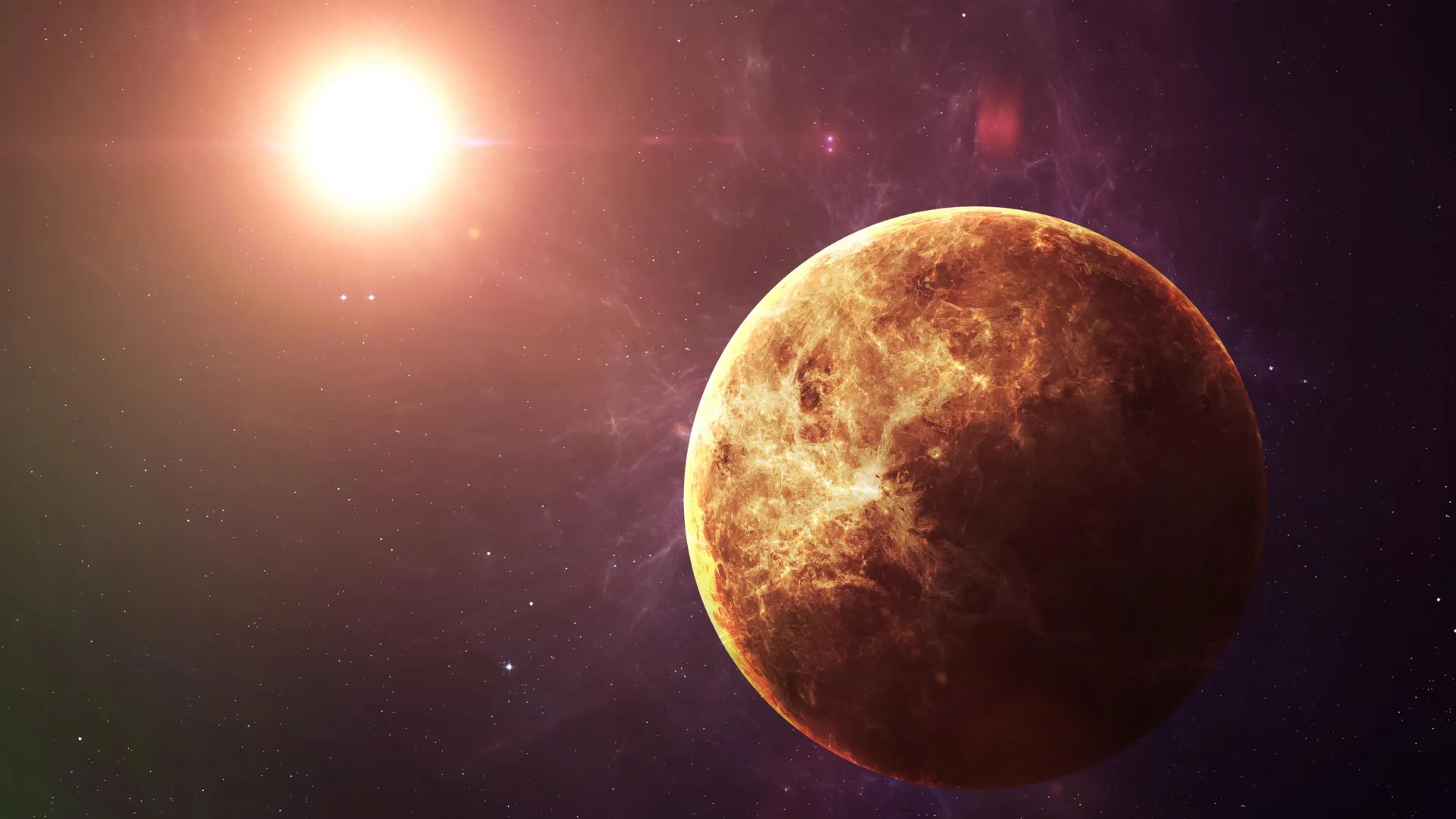
- UC Riverside research suggests Venus's 243-day rotation would have doomed any moon to spiral inward and collide with the planet, rather than drift away as Earth's moon does.
- Computer simulations across various hypothetical moon masses and scenarios consistently showed the same outcome: inward spiral and eventual collision within the first billion years.
- The finding shifts explanation from catastrophic impact or never forming a moon to a natural consequence of Venus's slow spin and ordinary tidal physics.
- Direct evidence of an ancient moon collision on Venus would be difficult to find because the planet underwent major resurfacing about a billion years ago.
Stephen Kane UC Riverside astrophysicist, study lead authorUC Riverside Research institution
How it unfolded 3 developments, newest first · click a bar or a number to jump articlesposts
-
2
Study shifts explanation from catastrophe to natural physics
The research departs from previous theories that Venus either never formed a moon or lost one in a massive external impact. Kane's work shows Venus's moon loss could be a natural outcome of ordinary tidal physics, with the planet's slow spin being the decisive factor rather than requiring an exotic event.
“My study shows Venus didn't require a catastrophe to arrive at what we can see today. It turns out the gravity of the planet itself combined with the rate at which it spins naturally caused the moon to collapse on top of it.”
— Stephen Kane, UC Riverside astrophysicist, study lead author · source -
first by srpske.rs, 12d ago · also Space Daily, Bangkok Post, Mashable
4 more headlines
- Venus may once have had a moon, but new simulations show that as the planet’s rotation slowed, tidal forces could have dragged the satellite inside the Roche limit and destroyed it—in some scenarios within just 30 million years. Space Daily · 9d ago
- Venus may have swallowed its moon Bangkok Post · 9d ago
- New Study Explains Why Venus Has No Moon Sci.News · 8d ago
- Scientists say if Venus ever had a moon like ours, it was doomed Mashable · 8d ago
-
first by The Times, 8d ago
-
-
background
Kane: any Venusian moon would crash within first billion years — According to Kane's modeling, if Venus ever had a moon, it would have been consumed within the first billion years of Venus's history—well before the planet's major resurfacing event roughly a billion years ago that erased most of the geological record.
-
3
Mechanism explainedRotation speed determines moon survival
The study identifies planetary rotation as the key factor. Earth rotates in 24 hours, transferring energy that pushes its moon outward at 4 cm per year. Venus rotates once every 243 Earth days, so a moon would receive no outward push and instead spiral inward due to tidal forces until crossing the Roche limit at roughly 17,000 km from Venus's center.
“We know that the moon is slowly moving away from the planet, at a rate of around four centimeters per year. That movement is closely tied to Earth's relatively rapid rotation.”
— Stephen Kane -
1
UC Riverside study published on Venus moon loss mechanism
Stephen Kane and colleagues at UC Riverside published research in The Astrophysical Journal proposing that Venus's slow rotation would cause any moon to spiral inward and crash into the planet. Computer simulations tested hypothetical moons ranging from half to ten times Earth's moon mass and found consistent results across most scenarios.
-
2 outlets Did Venus 'swallow' its own moon?
first by BBC, 7d ago · also The Brighter Side of News
1 more headline
- Venus may have swallowed its own moon, new models finds The Brighter Side of News · 7d ago
-
first by Science Daily, 7d ago
-
#^ Venus Moon Would Have Been Doomed From The Start, Says New Paper Venus likely never had a moon and even if it did, it would have soon been torn asunder by the planet’s own gravity, says prominent planetary astrophysicist.
-
Also covered reported alongside — the timeline has no entry for these yet
-
first by Smithsonian, 6d ago · also NY Post, New York Post
1 more headline
- Astrophysics study suggests Venus may have swallowed its moon NY Post · 5d ago
and 1 smaller piece